

634
W. Zhang et al.
Introduction
Controlling the selectivity in heterogeneous system is critical to reduce undesired
byproducts and improve energy efficiency and material utilization [1]. In mineral
processing, selective collectors are indispensable reagents to arbitrate the interfacial
reaction of different mineral surfaces for selective separation [2]. Commonly, selective collector is composed of polar and non-polar groups; the polar portion affords
the selective affinity to mineral surfaces, while the non-polar portion is termed as
hydrophobic group [3]. Most selective collectors are chelating reagents. The key
to the selectivity is the selective chemical affinity between collector molecules and
specific metal ions on mineral surfaces [4], which benefits from the lone pair of
electrons in heteroatoms of collector molecules. In fact, in this process, the chelating
heteroatoms in collector molecules serve as “selective active sites” to bind target
sites on mineral surfaces, offering the same functionality similar to enzymes [5, 6].
In general, chelation donor atoms (heteroatoms) endow collector molecule with
stronger selective chemical affinity towards specific metal ions [7]. For example,
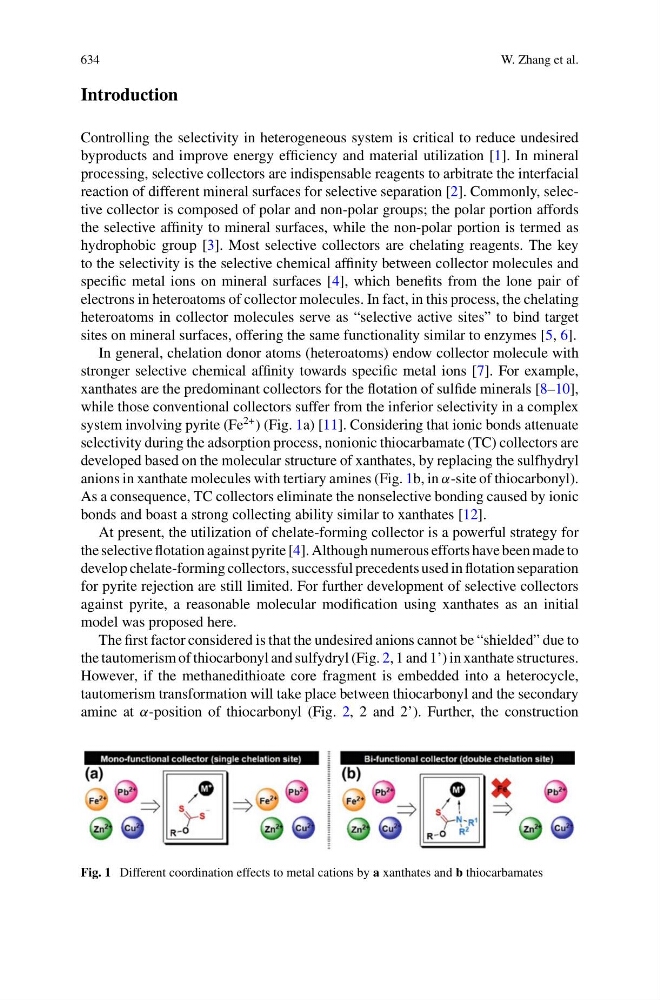
xanthates are the predominant collectors for the flotation of sulfide minerals [8–10],
while those conventional collectors suffer from the inferior selectivity in a complex
system involving pyrite (Fe
2+ ) (Fig. 1a) [11]. Considering that ionic bonds attenuate
selectivity during the adsorption process, nonionic thiocarbamate (TC) collectors are
developed based on the molecular structure of xanthates, by replacing the sulfhydryl
anions in xanthate molecules with tertiary amines (Fig. 1b, in α-site of thiocarbonyl).
As a consequence, TC collectors eliminate the nonselective bonding caused by ionic
bonds and boast a strong collecting ability similar to xanthates [12].
At present, the utilization of chelate-forming collector is a powerful strategy for
the selective flotation against pyrite [4]. Although numerous efforts have been made to
develop chelate-forming collectors, successful precedents used in flotation separation
for pyrite rejection are still limited. For further development of selective collectors
against pyrite, a reasonable molecular modification using xanthates as an initial
model was proposed here.
The first factor considered is that the undesired anions cannot be “shielded” due to
the tautomerism of thiocarbonyl and sulfydryl (Fig. 2, 1 and 1’) in xanthate structures.
However, if the methanedithioate core fragment is embedded into a heterocycle,
tautomerism transformation will take place between thiocarbonyl and the secondary
amine at α-position of thiocarbonyl (Fig. 2, 2 and 2’). Further, the construction
Fig. 1 Different coordination effects to metal cations by a xanthates and b thiocarbamates
W. Zhang et al.
Introduction
Controlling the selectivity in heterogeneous system is critical to reduce undesired
byproducts and improve energy efficiency and material utilization [1]. In mineral
processing, selective collectors are indispensable reagents to arbitrate the interfacial
reaction of different mineral surfaces for selective separation [2]. Commonly, selective collector is composed of polar and non-polar groups; the polar portion affords
the selective affinity to mineral surfaces, while the non-polar portion is termed as
hydrophobic group [3]. Most selective collectors are chelating reagents. The key
to the selectivity is the selective chemical affinity between collector molecules and
specific metal ions on mineral surfaces [4], which benefits from the lone pair of
electrons in heteroatoms of collector molecules. In fact, in this process, the chelating
heteroatoms in collector molecules serve as “selective active sites” to bind target
sites on mineral surfaces, offering the same functionality similar to enzymes [5, 6].
In general, chelation donor atoms (heteroatoms) endow collector molecule with
stronger selective chemical affinity towards specific metal ions [7]. For example,
xanthates are the predominant collectors for the flotation of sulfide minerals [8–10],
while those conventional collectors suffer from the inferior selectivity in a complex
system involving pyrite (Fe
2+ ) (Fig. 1a) [11]. Considering that ionic bonds attenuate
selectivity during the adsorption process, nonionic thiocarbamate (TC) collectors are
developed based on the molecular structure of xanthates, by replacing the sulfhydryl
anions in xanthate molecules with tertiary amines (Fig. 1b, in α-site of thiocarbonyl).
As a consequence, TC collectors eliminate the nonselective bonding caused by ionic
bonds and boast a strong collecting ability similar to xanthates [12].
At present, the utilization of chelate-forming collector is a powerful strategy for
the selective flotation against pyrite [4]. Although numerous efforts have been made to
develop chelate-forming collectors, successful precedents used in flotation separation
for pyrite rejection are still limited. For further development of selective collectors
against pyrite, a reasonable molecular modification using xanthates as an initial
model was proposed here.
The first factor considered is that the undesired anions cannot be “shielded” due to
the tautomerism of thiocarbonyl and sulfydryl (Fig. 2, 1 and 1’) in xanthate structures.
However, if the methanedithioate core fragment is embedded into a heterocycle,
tautomerism transformation will take place between thiocarbonyl and the secondary
amine at α-position of thiocarbonyl (Fig. 2, 2 and 2’). Further, the construction
Fig. 1 Different coordination effects to metal cations by a xanthates and b thiocarbamates