

Influence of Minor Elements in Waste Lead Battery Recycling
573
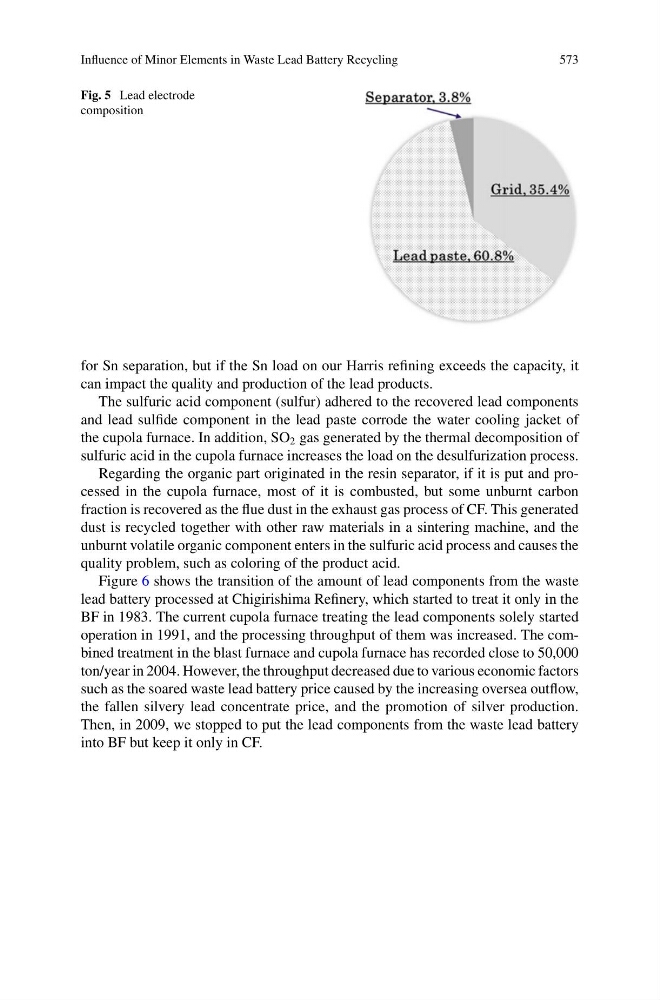
Fig. 5 Lead electrode
composition
for Sn separation, but if the Sn load on our Harris refining exceeds the capacity, it
can impact the quality and production of the lead products.
The sulfuric acid component (sulfur) adhered to the recovered lead components
and lead sulfide component in the lead paste corrode the water cooling jacket of
the cupola furnace. In addition, SO 2 gas generated by the thermal decomposition of
sulfuric acid in the cupola furnace increases the load on the desulfurization process.
Regarding the organic part originated in the resin separator, if it is put and processed in the cupola furnace, most of it is combusted, but some unburnt carbon
fraction is recovered as the flue dust in the exhaust gas process of CF. This generated
dust is recycled together with other raw materials in a sintering machine, and the
unburnt volatile organic component enters in the sulfuric acid process and causes the
quality problem, such as coloring of the product acid.
Figure 6 shows the transition of the amount of lead components from the waste
lead battery processed at Chigirishima Refinery, which started to treat it only in the
BF in 1983. The current cupola furnace treating the lead components solely started
operation in 1991, and the processing throughput of them was increased. The combined treatment in the blast furnace and cupola furnace has recorded close to 50,000
ton/year in 2004. However, the throughput decreased due to various economic factors
such as the soared waste lead battery price caused by the increasing oversea outflow,
the fallen silvery lead concentrate price, and the promotion of silver production.
Then, in 2009, we stopped to put the lead components from the waste lead battery
into BF but keep it only in CF.
573
Fig. 5 Lead electrode
composition
for Sn separation, but if the Sn load on our Harris refining exceeds the capacity, it
can impact the quality and production of the lead products.
The sulfuric acid component (sulfur) adhered to the recovered lead components
and lead sulfide component in the lead paste corrode the water cooling jacket of
the cupola furnace. In addition, SO 2 gas generated by the thermal decomposition of
sulfuric acid in the cupola furnace increases the load on the desulfurization process.
Regarding the organic part originated in the resin separator, if it is put and processed in the cupola furnace, most of it is combusted, but some unburnt carbon
fraction is recovered as the flue dust in the exhaust gas process of CF. This generated
dust is recycled together with other raw materials in a sintering machine, and the
unburnt volatile organic component enters in the sulfuric acid process and causes the
quality problem, such as coloring of the product acid.
Figure 6 shows the transition of the amount of lead components from the waste
lead battery processed at Chigirishima Refinery, which started to treat it only in the
BF in 1983. The current cupola furnace treating the lead components solely started
operation in 1991, and the processing throughput of them was increased. The combined treatment in the blast furnace and cupola furnace has recorded close to 50,000
ton/year in 2004. However, the throughput decreased due to various economic factors
such as the soared waste lead battery price caused by the increasing oversea outflow,
the fallen silvery lead concentrate price, and the promotion of silver production.
Then, in 2009, we stopped to put the lead components from the waste lead battery
into BF but keep it only in CF.