

Refractory Solutions by Laboratory Tests and Fieldworks …
567
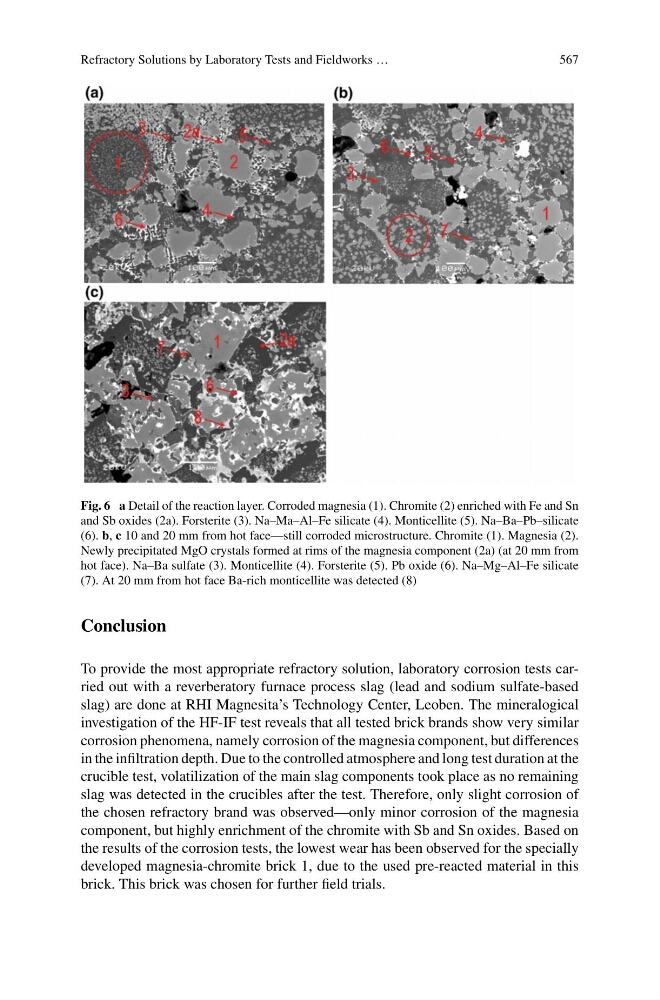
Fig. 6 a Detail of the reaction layer. Corroded magnesia (1). Chromite (2) enriched with Fe and Sn
and Sb oxides (2a). Forsterite (3). Na–Ma–Al–Fe silicate (4). Monticellite (5). Na–Ba–Pb–silicate
(6). b, c 10 and 20 mm from hot face—still corroded microstructure. Chromite (1). Magnesia (2).
Newly precipitated MgO crystals formed at rims of the magnesia component (2a) (at 20 mm from
hot face). Na–Ba sulfate (3). Monticellite (4). Forsterite (5). Pb oxide (6). Na–Mg–Al–Fe silicate
(7). At 20 mm from hot face Ba-rich monticellite was detected (8)
Conclusion
To provide the most appropriate refractory solution, laboratory corrosion tests carried out with a reverberatory furnace process slag (lead and sodium sulfate-based
slag) are done at RHI Magnesita’s Technology Center, Leoben. The mineralogical
investigation of the HF-IF test reveals that all tested brick brands show very similar
corrosion phenomena, namely corrosion of the magnesia component, but differences
in the infiltration depth. Due to the controlled atmosphere and long test duration at the
crucible test, volatilization of the main slag components took place as no remaining
slag was detected in the crucibles after the test. Therefore, only slight corrosion of
the chosen refractory brand was observed—only minor corrosion of the magnesia
component, but highly enrichment of the chromite with Sb and Sn oxides. Based on
the results of the corrosion tests, the lowest wear has been observed for the specially
developed magnesia-chromite brick 1, due to the used pre-reacted material in this
brick. This brick was chosen for further field trials.
567
Fig. 6 a Detail of the reaction layer. Corroded magnesia (1). Chromite (2) enriched with Fe and Sn
and Sb oxides (2a). Forsterite (3). Na–Ma–Al–Fe silicate (4). Monticellite (5). Na–Ba–Pb–silicate
(6). b, c 10 and 20 mm from hot face—still corroded microstructure. Chromite (1). Magnesia (2).
Newly precipitated MgO crystals formed at rims of the magnesia component (2a) (at 20 mm from
hot face). Na–Ba sulfate (3). Monticellite (4). Forsterite (5). Pb oxide (6). Na–Mg–Al–Fe silicate
(7). At 20 mm from hot face Ba-rich monticellite was detected (8)
Conclusion
To provide the most appropriate refractory solution, laboratory corrosion tests carried out with a reverberatory furnace process slag (lead and sodium sulfate-based
slag) are done at RHI Magnesita’s Technology Center, Leoben. The mineralogical
investigation of the HF-IF test reveals that all tested brick brands show very similar
corrosion phenomena, namely corrosion of the magnesia component, but differences
in the infiltration depth. Due to the controlled atmosphere and long test duration at the
crucible test, volatilization of the main slag components took place as no remaining
slag was detected in the crucibles after the test. Therefore, only slight corrosion of
the chosen refractory brand was observed—only minor corrosion of the magnesia
component, but highly enrichment of the chromite with Sb and Sn oxides. Based on
the results of the corrosion tests, the lowest wear has been observed for the specially
developed magnesia-chromite brick 1, due to the used pre-reacted material in this
brick. This brick was chosen for further field trials.