

546
W. Cui et al.
pressure is lower than 10
−8 atm. Further reduction can increase direct recovery of
Pb in the alloy, but the recovery of Bi will be reduced due to the vaporization of
Bi. For example, at Po 2 10
−10 atm, approximately 86% lead will be reported to the
alloy. However, the recovery of Bi to the alloy is only 94%. Lower oxygen partial
pressure also results in formation and vaporization of PbS causing the loss of lead.
If the temperature is higher for rapid reaction and better separation of the alloy from
the slag, the recovery of Bi will be even lower. Therefore, optimum temperature, Po 2,
and slag composition will need to be identified to balance the direct recovery rates of
Bi and Pb in the first reduction stage. The most important aims for the first reduction
stage is to (1) remove sulphur from the condensed system; (2) keep valuable elements
in the condensed system; (3) maximizing reduction of Bi and Pb reduction. The main
reactions include
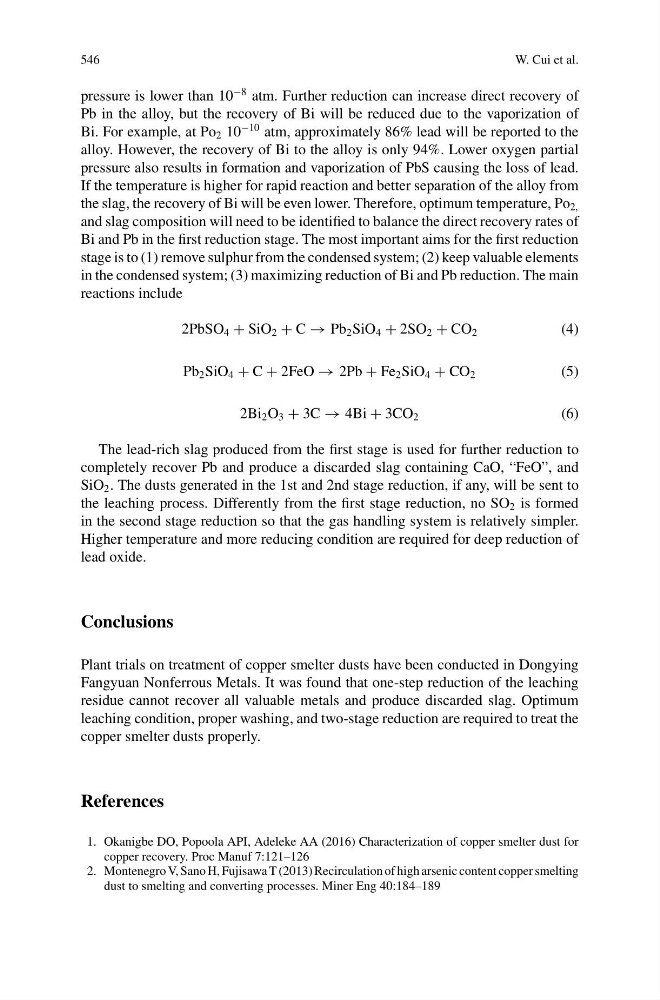
2PbSO 4 + SiO 2 + C → Pb 2 SiO 4 + 2SO 2 + CO 2
(4)
Pb 2 SiO 4 + C + 2FeO → 2Pb + Fe 2 SiO 4 + CO 2
(5)
2Bi 2 O 3 + 3C → 4Bi + 3CO 2
(6)
The lead-rich slag produced from the first stage is used for further reduction to
completely recover Pb and produce a discarded slag containing CaO, “FeO”, and
SiO 2 . The dusts generated in the 1st and 2nd stage reduction, if any, will be sent to
the leaching process. Differently from the first stage reduction, no SO 2 is formed
in the second stage reduction so that the gas handling system is relatively simpler.
Higher temperature and more reducing condition are required for deep reduction of
lead oxide.
Conclusions
Plant trials on treatment of copper smelter dusts have been conducted in Dongying
Fangyuan Nonferrous Metals. It was found that one-step reduction of the leaching
residue cannot recover all valuable metals and produce discarded slag. Optimum
leaching condition, proper washing, and two-stage reduction are required to treat the
copper smelter dusts properly.
References
1. Okanigbe DO, Popoola API, Adeleke AA (2016) Characterization of copper smelter dust for
copper recovery. Proc Manuf 7:121–126
2. Montenegro V, Sano H, Fujisawa T (2013) Recirculation of high arsenic content copper smelting
dust to smelting and converting processes. Miner Eng 40:184–189
W. Cui et al.
pressure is lower than 10
−8 atm. Further reduction can increase direct recovery of
Pb in the alloy, but the recovery of Bi will be reduced due to the vaporization of
Bi. For example, at Po 2 10
−10 atm, approximately 86% lead will be reported to the
alloy. However, the recovery of Bi to the alloy is only 94%. Lower oxygen partial
pressure also results in formation and vaporization of PbS causing the loss of lead.
If the temperature is higher for rapid reaction and better separation of the alloy from
the slag, the recovery of Bi will be even lower. Therefore, optimum temperature, Po 2,
and slag composition will need to be identified to balance the direct recovery rates of
Bi and Pb in the first reduction stage. The most important aims for the first reduction
stage is to (1) remove sulphur from the condensed system; (2) keep valuable elements
in the condensed system; (3) maximizing reduction of Bi and Pb reduction. The main
reactions include
2PbSO 4 + SiO 2 + C → Pb 2 SiO 4 + 2SO 2 + CO 2
(4)
Pb 2 SiO 4 + C + 2FeO → 2Pb + Fe 2 SiO 4 + CO 2
(5)
2Bi 2 O 3 + 3C → 4Bi + 3CO 2
(6)
The lead-rich slag produced from the first stage is used for further reduction to
completely recover Pb and produce a discarded slag containing CaO, “FeO”, and
SiO 2 . The dusts generated in the 1st and 2nd stage reduction, if any, will be sent to
the leaching process. Differently from the first stage reduction, no SO 2 is formed
in the second stage reduction so that the gas handling system is relatively simpler.
Higher temperature and more reducing condition are required for deep reduction of
lead oxide.
Conclusions
Plant trials on treatment of copper smelter dusts have been conducted in Dongying
Fangyuan Nonferrous Metals. It was found that one-step reduction of the leaching
residue cannot recover all valuable metals and produce discarded slag. Optimum
leaching condition, proper washing, and two-stage reduction are required to treat the
copper smelter dusts properly.
References
1. Okanigbe DO, Popoola API, Adeleke AA (2016) Characterization of copper smelter dust for
copper recovery. Proc Manuf 7:121–126
2. Montenegro V, Sano H, Fujisawa T (2013) Recirculation of high arsenic content copper smelting
dust to smelting and converting processes. Miner Eng 40:184–189