

Pyrometallurgical Recovery of Valuable Metals …
545
reactions are involved to produce Pb metal from PbSO 4 . The first reaction is to
desulfurize PbSO 4 with soda ash to form a marketable sodium sulfate product (1).
The lead carbonate continues to the reverb (2) and blast furnaces (3) for two-step
reduction [16]:
2PbSO 4 + 2Na 2 CO 3 + 2H 2 O → Pb 3 (CO 3 ) 2 (OH) 2 + 2Na 2 SO 4 + H 2 SO 4 (1)
2Pb 3 (CO 3 ) 2 (OH) 2 + C + 2SiO 2 → 2Pb + 2Pb 2 SiO 4 + 2H 2 O + 5CO 2 (2)
Pb 2 SiO 4 + C + 2FeO → 2Pb + Fe 2 SiO 4 + CO 2
(3)
However, copper smelter dusts are different from the lead battery paste. In addition
to PbSO 4 , CuSO 4 , ZnSO 4, and arsenic are also present in the dusts that can be easily
removed by water or acid. CuSO 4 will form sulfide matte, zinc and arsenic will
form dust during the reduction process if they are treated directly with PbSO 4 by
following the reactions above. On the other hand, it can be seen from Table 2 that onestep reduction may result in higher PbO in the slag (FY183) which requires further
treatment to obtain discarded slag with low PbO. Large amount of PbS-containing
dust generated during the process also reduces the productivity. Two-step reactions
are necessary to fully recover Pb and Bi and produce environmentally friendly slag.
This can be explained in detail by the thermodynamic considerations below.
FactSage 7.3 is used to predict the reactions for the treatment of leaching residue
of the dust [17]. The databases selected were “FactPS”, “FToxide”, and “FTmisc.
Certain amounts of flux such as CaO, FeO, and SiO 2 are added into the leaching
residue to make a low-liquidus slag.
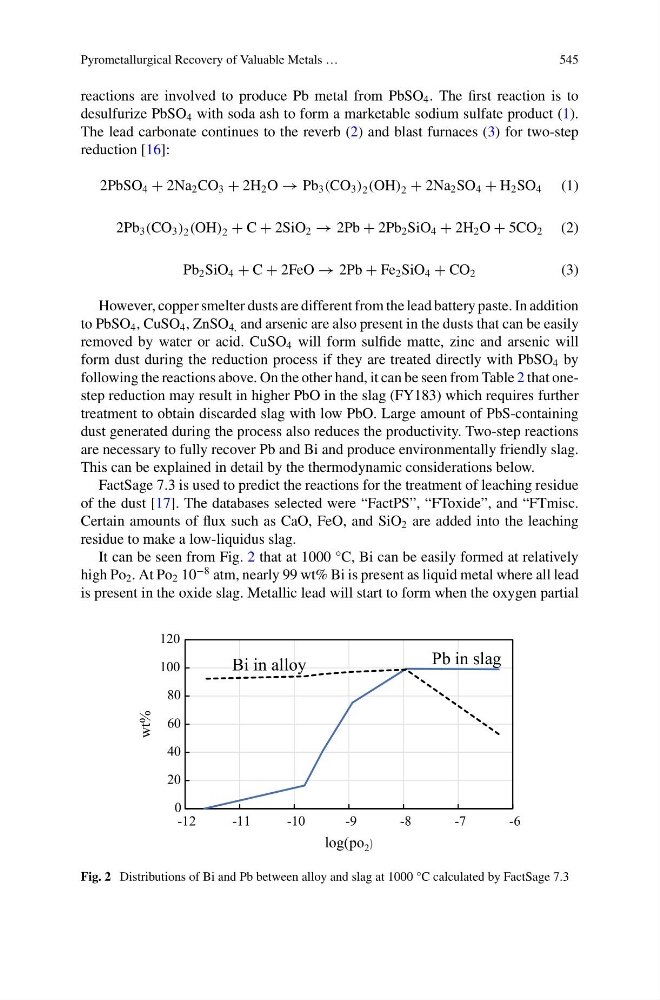
It can be seen from Fig. 2 that at 1000 °C, Bi can be easily formed at relatively
high Po 2 . At Po 2 10
−8 atm, nearly 99 wt% Bi is present as liquid metal where all lead
is present in the oxide slag. Metallic lead will start to form when the oxygen partial
0
20
40
60
80
100
120
-12
-11
-10
-9
-8
-7
-6
wt%
log(po 2 )
Bi in alloy
Pb in slag
Fig. 2 Distributions of Bi and Pb between alloy and slag at 1000 °C calculated by FactSage 7.3
545
reactions are involved to produce Pb metal from PbSO 4 . The first reaction is to
desulfurize PbSO 4 with soda ash to form a marketable sodium sulfate product (1).
The lead carbonate continues to the reverb (2) and blast furnaces (3) for two-step
reduction [16]:
2PbSO 4 + 2Na 2 CO 3 + 2H 2 O → Pb 3 (CO 3 ) 2 (OH) 2 + 2Na 2 SO 4 + H 2 SO 4 (1)
2Pb 3 (CO 3 ) 2 (OH) 2 + C + 2SiO 2 → 2Pb + 2Pb 2 SiO 4 + 2H 2 O + 5CO 2 (2)
Pb 2 SiO 4 + C + 2FeO → 2Pb + Fe 2 SiO 4 + CO 2
(3)
However, copper smelter dusts are different from the lead battery paste. In addition
to PbSO 4 , CuSO 4 , ZnSO 4, and arsenic are also present in the dusts that can be easily
removed by water or acid. CuSO 4 will form sulfide matte, zinc and arsenic will
form dust during the reduction process if they are treated directly with PbSO 4 by
following the reactions above. On the other hand, it can be seen from Table 2 that onestep reduction may result in higher PbO in the slag (FY183) which requires further
treatment to obtain discarded slag with low PbO. Large amount of PbS-containing
dust generated during the process also reduces the productivity. Two-step reactions
are necessary to fully recover Pb and Bi and produce environmentally friendly slag.
This can be explained in detail by the thermodynamic considerations below.
FactSage 7.3 is used to predict the reactions for the treatment of leaching residue
of the dust [17]. The databases selected were “FactPS”, “FToxide”, and “FTmisc.
Certain amounts of flux such as CaO, FeO, and SiO 2 are added into the leaching
residue to make a low-liquidus slag.
It can be seen from Fig. 2 that at 1000 °C, Bi can be easily formed at relatively
high Po 2 . At Po 2 10
−8 atm, nearly 99 wt% Bi is present as liquid metal where all lead
is present in the oxide slag. Metallic lead will start to form when the oxygen partial
0
20
40
60
80
100
120
-12
-11
-10
-9
-8
-7
-6
wt%
log(po 2 )
Bi in alloy
Pb in slag
Fig. 2 Distributions of Bi and Pb between alloy and slag at 1000 °C calculated by FactSage 7.3