

Hydrometallurgical Recovery …
527
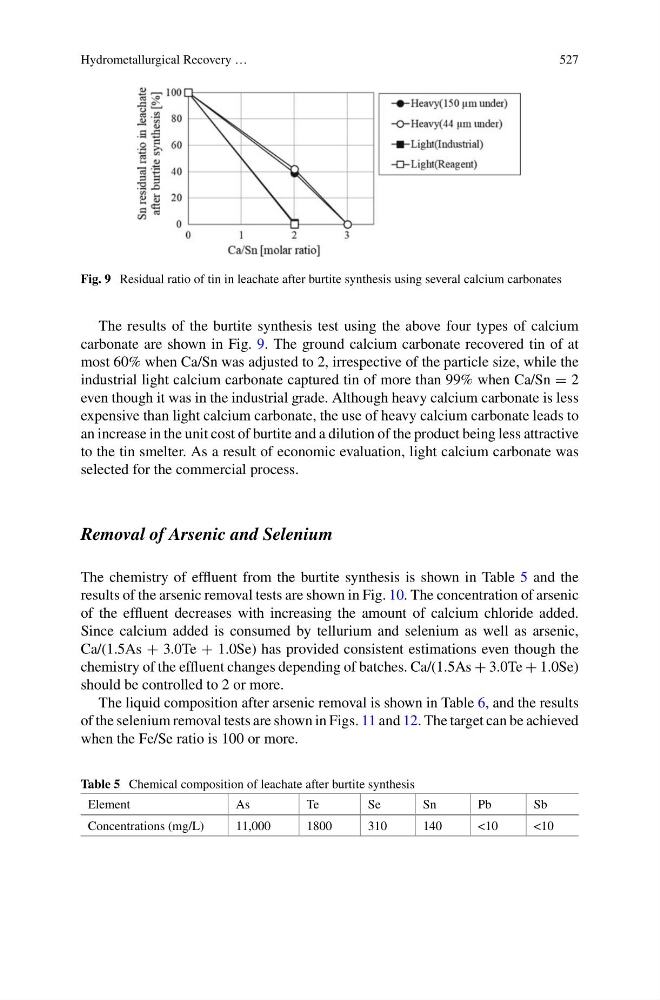
Fig. 9 Residual ratio of tin in leachate after burtite synthesis using several calcium carbonates
The results of the burtite synthesis test using the above four types of calcium
carbonate are shown in Fig. 9. The ground calcium carbonate recovered tin of at
most 60% when Ca/Sn was adjusted to 2, irrespective of the particle size, while the
industrial light calcium carbonate captured tin of more than 99% when Ca/Sn = 2
even though it was in the industrial grade. Although heavy calcium carbonate is less
expensive than light calcium carbonate, the use of heavy calcium carbonate leads to
an increase in the unit cost of burtite and a dilution of the product being less attractive
to the tin smelter. As a result of economic evaluation, light calcium carbonate was
selected for the commercial process.
Removal of Arsenic and Selenium
The chemistry of effluent from the burtite synthesis is shown in Table 5 and the
results of the arsenic removal tests are shown in Fig. 10. The concentration of arsenic
of the effluent decreases with increasing the amount of calcium chloride added.
Since calcium added is consumed by tellurium and selenium as well as arsenic,
Ca/(1.5As + 3.0Te + 1.0Se) has provided consistent estimations even though the
chemistry of the effluent changes depending of batches. Ca/(1.5As + 3.0Te + 1.0Se)
should be controlled to 2 or more.
The liquid composition after arsenic removal is shown in Table 6, and the results
of the selenium removal tests are shown in Figs. 11 and 12. The target can be achieved
when the Fe/Se ratio is 100 or more.
Table 5 Chemical composition of leachate after burtite synthesis
Element
As
Te
Se
Sn
Pb
Sb
Concentrations (mg/L)
11,000
1800
310
140
<10
<10
527
Fig. 9 Residual ratio of tin in leachate after burtite synthesis using several calcium carbonates
The results of the burtite synthesis test using the above four types of calcium
carbonate are shown in Fig. 9. The ground calcium carbonate recovered tin of at
most 60% when Ca/Sn was adjusted to 2, irrespective of the particle size, while the
industrial light calcium carbonate captured tin of more than 99% when Ca/Sn = 2
even though it was in the industrial grade. Although heavy calcium carbonate is less
expensive than light calcium carbonate, the use of heavy calcium carbonate leads to
an increase in the unit cost of burtite and a dilution of the product being less attractive
to the tin smelter. As a result of economic evaluation, light calcium carbonate was
selected for the commercial process.
Removal of Arsenic and Selenium
The chemistry of effluent from the burtite synthesis is shown in Table 5 and the
results of the arsenic removal tests are shown in Fig. 10. The concentration of arsenic
of the effluent decreases with increasing the amount of calcium chloride added.
Since calcium added is consumed by tellurium and selenium as well as arsenic,
Ca/(1.5As + 3.0Te + 1.0Se) has provided consistent estimations even though the
chemistry of the effluent changes depending of batches. Ca/(1.5As + 3.0Te + 1.0Se)
should be controlled to 2 or more.
The liquid composition after arsenic removal is shown in Table 6, and the results
of the selenium removal tests are shown in Figs. 11 and 12. The target can be achieved
when the Fe/Se ratio is 100 or more.
Table 5 Chemical composition of leachate after burtite synthesis
Element
As
Te
Se
Sn
Pb
Sb
Concentrations (mg/L)
11,000
1800
310
140
<10
<10