

526
R. Sato et al.
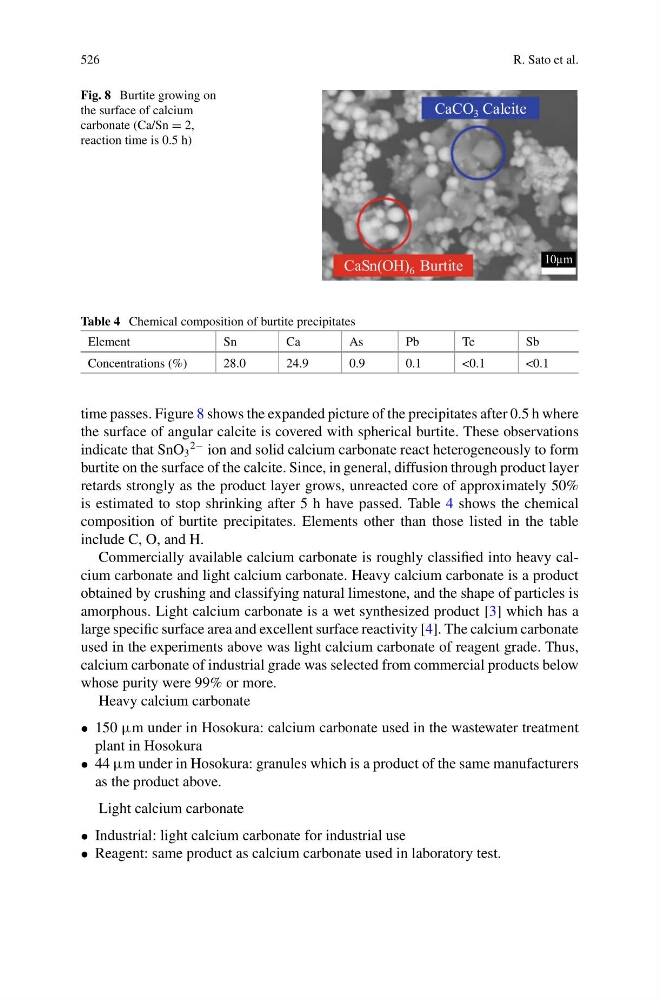
Fig. 8 Burtite growing on
the surface of calcium
carbonate (Ca/Sn = 2,
reaction time is 0.5 h)
CaCO 3 Calcite
CaSn(OH) 6 Burtite
10μm
Table 4 Chemical composition of burtite precipitates
Element
Sn
Ca
As
Pb
Te
Sb
Concentrations (%)
28.0
24.9
0.9
0.1
<0.1
<0.1
time passes. Figure 8 shows the expanded picture of the precipitates after 0.5 h where
the surface of angular calcite is covered with spherical burtite. These observations
indicate that SnO 3
2− ion and solid calcium carbonate react heterogeneously to form
burtite on the surface of the calcite. Since, in general, diffusion through product layer
retards strongly as the product layer grows, unreacted core of approximately 50%
is estimated to stop shrinking after 5 h have passed. Table 4 shows the chemical
composition of burtite precipitates. Elements other than those listed in the table
include C, O, and H.
Commercially available calcium carbonate is roughly classified into heavy calcium carbonate and light calcium carbonate. Heavy calcium carbonate is a product
obtained by crushing and classifying natural limestone, and the shape of particles is
amorphous. Light calcium carbonate is a wet synthesized product [3] which has a
large specific surface area and excellent surface reactivity [4]. The calcium carbonate
used in the experiments above was light calcium carbonate of reagent grade. Thus,
calcium carbonate of industrial grade was selected from commercial products below
whose purity were 99% or more.
Heavy calcium carbonate
• 150 µm under in Hosokura: calcium carbonate used in the wastewater treatment
plant in Hosokura
• 44 µm under in Hosokura: granules which is a product of the same manufacturers
as the product above.
Light calcium carbonate
• Industrial: light calcium carbonate for industrial use
• Reagent: same product as calcium carbonate used in laboratory test.
R. Sato et al.
Fig. 8 Burtite growing on
the surface of calcium
carbonate (Ca/Sn = 2,
reaction time is 0.5 h)
CaCO 3 Calcite
CaSn(OH) 6 Burtite
10μm
Table 4 Chemical composition of burtite precipitates
Element
Sn
Ca
As
Pb
Te
Sb
Concentrations (%)
28.0
24.9
0.9
0.1
<0.1
<0.1
time passes. Figure 8 shows the expanded picture of the precipitates after 0.5 h where
the surface of angular calcite is covered with spherical burtite. These observations
indicate that SnO 3
2− ion and solid calcium carbonate react heterogeneously to form
burtite on the surface of the calcite. Since, in general, diffusion through product layer
retards strongly as the product layer grows, unreacted core of approximately 50%
is estimated to stop shrinking after 5 h have passed. Table 4 shows the chemical
composition of burtite precipitates. Elements other than those listed in the table
include C, O, and H.
Commercially available calcium carbonate is roughly classified into heavy calcium carbonate and light calcium carbonate. Heavy calcium carbonate is a product
obtained by crushing and classifying natural limestone, and the shape of particles is
amorphous. Light calcium carbonate is a wet synthesized product [3] which has a
large specific surface area and excellent surface reactivity [4]. The calcium carbonate
used in the experiments above was light calcium carbonate of reagent grade. Thus,
calcium carbonate of industrial grade was selected from commercial products below
whose purity were 99% or more.
Heavy calcium carbonate
• 150 µm under in Hosokura: calcium carbonate used in the wastewater treatment
plant in Hosokura
• 44 µm under in Hosokura: granules which is a product of the same manufacturers
as the product above.
Light calcium carbonate
• Industrial: light calcium carbonate for industrial use
• Reagent: same product as calcium carbonate used in laboratory test.