

522
R. Sato et al.
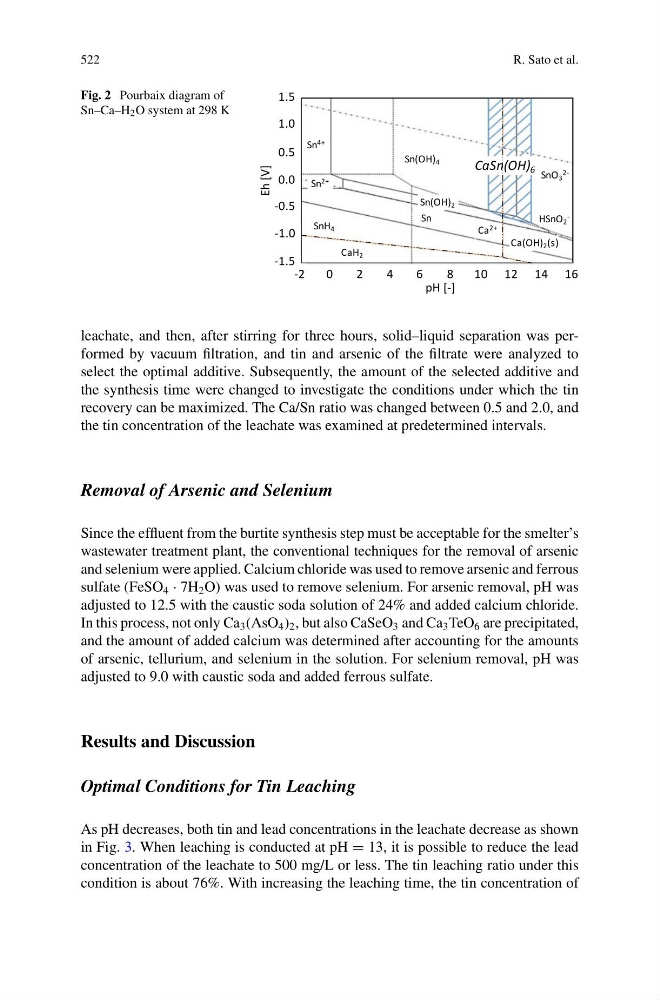
Fig. 2 Pourbaix diagram of
Sn–Ca–H 2 O system at 298 K
pH [-]
Eh [V]
-2
0
2
4
6
8
10 12 14 16
-1.5
1.5
1.0
0.5
0.0
-0.5
-1.0
Sn 4+
Sn(OH) 4
Sn
SnH 4
Sn 2+
Sn(OH) 2
SnO 3
2HSnO 2
-
CaSn(OH) 6
CaH 2
Ca 2+
Ca(OH) 2 (s)
leachate, and then, after stirring for three hours, solid–liquid separation was performed by vacuum filtration, and tin and arsenic of the filtrate were analyzed to
select the optimal additive. Subsequently, the amount of the selected additive and
the synthesis time were changed to investigate the conditions under which the tin
recovery can be maximized. The Ca/Sn ratio was changed between 0.5 and 2.0, and
the tin concentration of the leachate was examined at predetermined intervals.
Removal of Arsenic and Selenium
Since the effluent from the burtite synthesis step must be acceptable for the smelter’s
wastewater treatment plant, the conventional techniques for the removal of arsenic
and selenium were applied. Calcium chloride was used to remove arsenic and ferrous
sulfate (FeSO 4 · 7H 2 O) was used to remove selenium. For arsenic removal, pH was
adjusted to 12.5 with the caustic soda solution of 24% and added calcium chloride.
In this process, not only Ca 3 (AsO 4 ) 2 , but also CaSeO 3 and Ca 3 TeO 6 are precipitated,
and the amount of added calcium was determined after accounting for the amounts
of arsenic, tellurium, and selenium in the solution. For selenium removal, pH was
adjusted to 9.0 with caustic soda and added ferrous sulfate.
Results and Discussion
Optimal Conditions for Tin Leaching
As pH decreases, both tin and lead concentrations in the leachate decrease as shown
in Fig. 3. When leaching is conducted at pH = 13, it is possible to reduce the lead
concentration of the leachate to 500 mg/L or less. The tin leaching ratio under this
condition is about 76%. With increasing the leaching time, the tin concentration of
R. Sato et al.
Fig. 2 Pourbaix diagram of
Sn–Ca–H 2 O system at 298 K
pH [-]
Eh [V]
-2
0
2
4
6
8
10 12 14 16
-1.5
1.5
1.0
0.5
0.0
-0.5
-1.0
Sn 4+
Sn(OH) 4
Sn
SnH 4
Sn 2+
Sn(OH) 2
SnO 3
2HSnO 2
-
CaSn(OH) 6
CaH 2
Ca 2+
Ca(OH) 2 (s)
leachate, and then, after stirring for three hours, solid–liquid separation was performed by vacuum filtration, and tin and arsenic of the filtrate were analyzed to
select the optimal additive. Subsequently, the amount of the selected additive and
the synthesis time were changed to investigate the conditions under which the tin
recovery can be maximized. The Ca/Sn ratio was changed between 0.5 and 2.0, and
the tin concentration of the leachate was examined at predetermined intervals.
Removal of Arsenic and Selenium
Since the effluent from the burtite synthesis step must be acceptable for the smelter’s
wastewater treatment plant, the conventional techniques for the removal of arsenic
and selenium were applied. Calcium chloride was used to remove arsenic and ferrous
sulfate (FeSO 4 · 7H 2 O) was used to remove selenium. For arsenic removal, pH was
adjusted to 12.5 with the caustic soda solution of 24% and added calcium chloride.
In this process, not only Ca 3 (AsO 4 ) 2 , but also CaSeO 3 and Ca 3 TeO 6 are precipitated,
and the amount of added calcium was determined after accounting for the amounts
of arsenic, tellurium, and selenium in the solution. For selenium removal, pH was
adjusted to 9.0 with caustic soda and added ferrous sulfate.
Results and Discussion
Optimal Conditions for Tin Leaching
As pH decreases, both tin and lead concentrations in the leachate decrease as shown
in Fig. 3. When leaching is conducted at pH = 13, it is possible to reduce the lead
concentration of the leachate to 500 mg/L or less. The tin leaching ratio under this
condition is about 76%. With increasing the leaching time, the tin concentration of