

520
R. Sato et al.
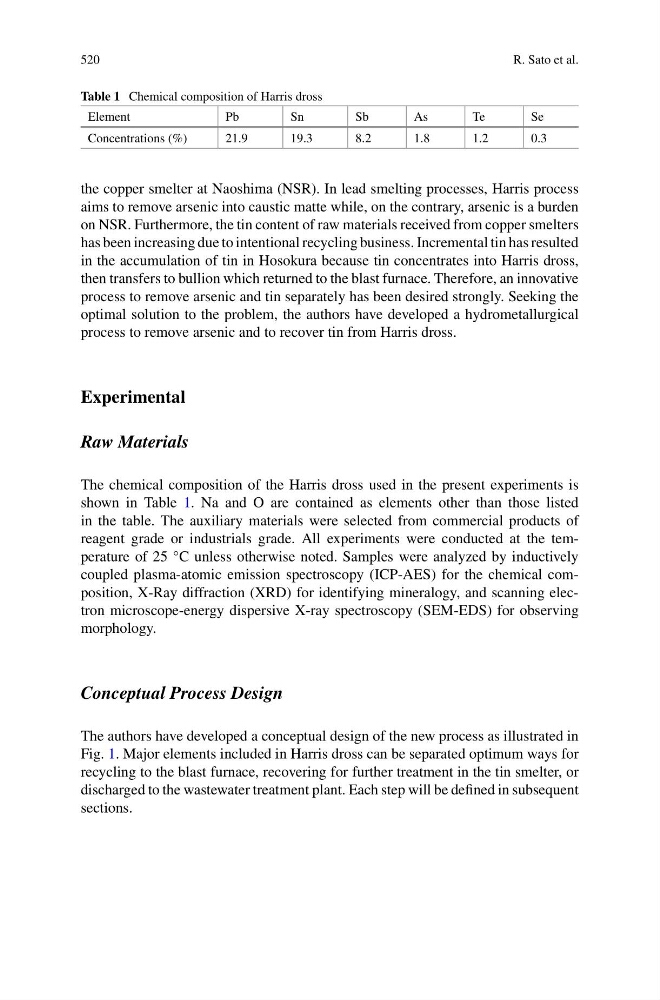
Table 1 Chemical composition of Harris dross
Element
Pb
Sn
Sb
As
Te
Se
Concentrations (%)
21.9
19.3
8.2
1.8
1.2
0.3
the copper smelter at Naoshima (NSR). In lead smelting processes, Harris process
aims to remove arsenic into caustic matte while, on the contrary, arsenic is a burden
on NSR. Furthermore, the tin content of raw materials received from copper smelters
has been increasing due to intentional recycling business. Incremental tin has resulted
in the accumulation of tin in Hosokura because tin concentrates into Harris dross,
then transfers to bullion which returned to the blast furnace. Therefore, an innovative
process to remove arsenic and tin separately has been desired strongly. Seeking the
optimal solution to the problem, the authors have developed a hydrometallurgical
process to remove arsenic and to recover tin from Harris dross.
Experimental
Raw Materials
The chemical composition of the Harris dross used in the present experiments is
shown in Table 1. Na and O are contained as elements other than those listed
in the table. The auxiliary materials were selected from commercial products of
reagent grade or industrials grade. All experiments were conducted at the temperature of 25 °C unless otherwise noted. Samples were analyzed by inductively
coupled plasma-atomic emission spectroscopy (ICP-AES) for the chemical composition, X-Ray diffraction (XRD) for identifying mineralogy, and scanning electron microscope-energy dispersive X-ray spectroscopy (SEM-EDS) for observing
morphology.
Conceptual Process Design
The authors have developed a conceptual design of the new process as illustrated in
Fig. 1. Major elements included in Harris dross can be separated optimum ways for
recycling to the blast furnace, recovering for further treatment in the tin smelter, or
discharged to the wastewater treatment plant. Each step will be defined in subsequent
sections.
R. Sato et al.
Table 1 Chemical composition of Harris dross
Element
Pb
Sn
Sb
As
Te
Se
Concentrations (%)
21.9
19.3
8.2
1.8
1.2
0.3
the copper smelter at Naoshima (NSR). In lead smelting processes, Harris process
aims to remove arsenic into caustic matte while, on the contrary, arsenic is a burden
on NSR. Furthermore, the tin content of raw materials received from copper smelters
has been increasing due to intentional recycling business. Incremental tin has resulted
in the accumulation of tin in Hosokura because tin concentrates into Harris dross,
then transfers to bullion which returned to the blast furnace. Therefore, an innovative
process to remove arsenic and tin separately has been desired strongly. Seeking the
optimal solution to the problem, the authors have developed a hydrometallurgical
process to remove arsenic and to recover tin from Harris dross.
Experimental
Raw Materials
The chemical composition of the Harris dross used in the present experiments is
shown in Table 1. Na and O are contained as elements other than those listed
in the table. The auxiliary materials were selected from commercial products of
reagent grade or industrials grade. All experiments were conducted at the temperature of 25 °C unless otherwise noted. Samples were analyzed by inductively
coupled plasma-atomic emission spectroscopy (ICP-AES) for the chemical composition, X-Ray diffraction (XRD) for identifying mineralogy, and scanning electron microscope-energy dispersive X-ray spectroscopy (SEM-EDS) for observing
morphology.
Conceptual Process Design
The authors have developed a conceptual design of the new process as illustrated in
Fig. 1. Major elements included in Harris dross can be separated optimum ways for
recycling to the blast furnace, recovering for further treatment in the tin smelter, or
discharged to the wastewater treatment plant. Each step will be defined in subsequent
sections.