

498
S. Grund and E. van Genderen
through their respective programs such as the IZA Sustainability Charter [27] or
the ICMM Performance Expectations [28]. Since 2019, IZA represents its member companies in the International Responsible Business Conduct (IRBC) for the
Metal Sector in the Netherlands [29] and in the Responsible Steel Standard [30].
Furthermore, companies belonging to the zinc value chain support sustainability and
responsibility initiatives, such as the UN Global Compact [31], the Global Reporting
Initiative (GRI) [32], or the Extractive Industries Transparency Initiative (EITI) [33].
Zinc Contributes to the UN SDGs
Embedded in IZA’s material stewardship activities, the global zinc industry in 2019
has worked on the SDG sector roadmap for the global zinc industry supported by
ERM [34, 35]. The concept of SDG sector roadmaps has been developed by the World
Business Council for Sustainable Development (WBCSD) in cooperation with ERM
[34]. It consists of three main steps:
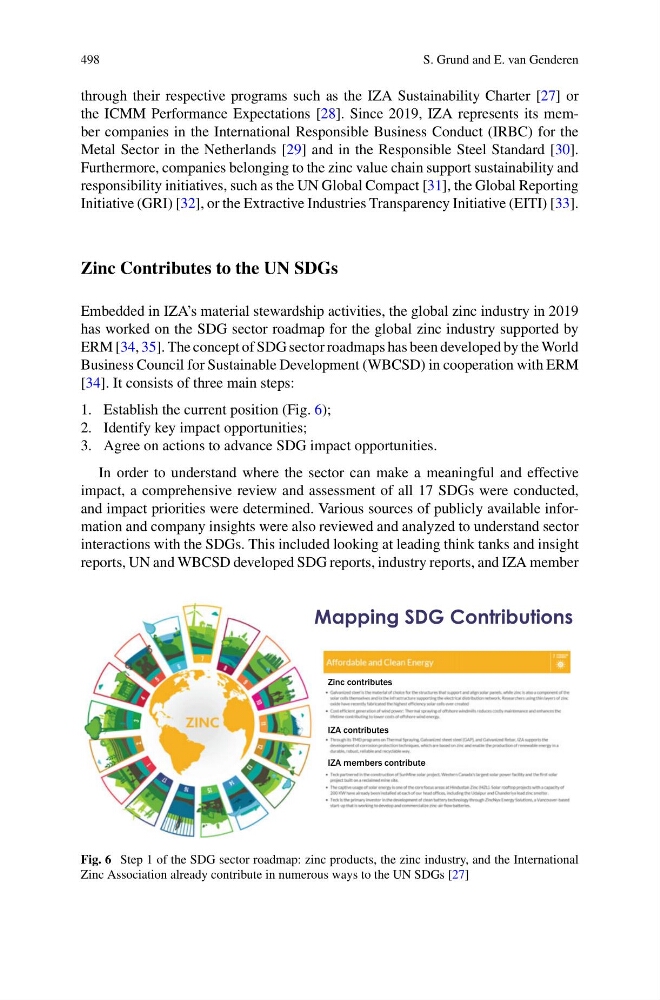
1. Establish the current position (Fig. 6);
2. Identify key impact opportunities;
3. Agree on actions to advance SDG impact opportunities.
In order to understand where the sector can make a meaningful and effective
impact, a comprehensive review and assessment of all 17 SDGs were conducted,
and impact priorities were determined. Various sources of publicly available information and company insights were also reviewed and analyzed to understand sector
interactions with the SDGs. This included looking at leading think tanks and insight
reports, UN and WBCSD developed SDG reports, industry reports, and IZA member
Mapping SDG Contributions
Zinc contributes
IZA contributes
IZA members contribute
Fig. 6 Step 1 of the SDG sector roadmap: zinc products, the zinc industry, and the International
Zinc Association already contribute in numerous ways to the UN SDGs [27]
S. Grund and E. van Genderen
through their respective programs such as the IZA Sustainability Charter [27] or
the ICMM Performance Expectations [28]. Since 2019, IZA represents its member companies in the International Responsible Business Conduct (IRBC) for the
Metal Sector in the Netherlands [29] and in the Responsible Steel Standard [30].
Furthermore, companies belonging to the zinc value chain support sustainability and
responsibility initiatives, such as the UN Global Compact [31], the Global Reporting
Initiative (GRI) [32], or the Extractive Industries Transparency Initiative (EITI) [33].
Zinc Contributes to the UN SDGs
Embedded in IZA’s material stewardship activities, the global zinc industry in 2019
has worked on the SDG sector roadmap for the global zinc industry supported by
ERM [34, 35]. The concept of SDG sector roadmaps has been developed by the World
Business Council for Sustainable Development (WBCSD) in cooperation with ERM
[34]. It consists of three main steps:
1. Establish the current position (Fig. 6);
2. Identify key impact opportunities;
3. Agree on actions to advance SDG impact opportunities.
In order to understand where the sector can make a meaningful and effective
impact, a comprehensive review and assessment of all 17 SDGs were conducted,
and impact priorities were determined. Various sources of publicly available information and company insights were also reviewed and analyzed to understand sector
interactions with the SDGs. This included looking at leading think tanks and insight
reports, UN and WBCSD developed SDG reports, industry reports, and IZA member
Mapping SDG Contributions
Zinc contributes
IZA contributes
IZA members contribute
Fig. 6 Step 1 of the SDG sector roadmap: zinc products, the zinc industry, and the International
Zinc Association already contribute in numerous ways to the UN SDGs [27]