

Material Stewardship for Zinc
495
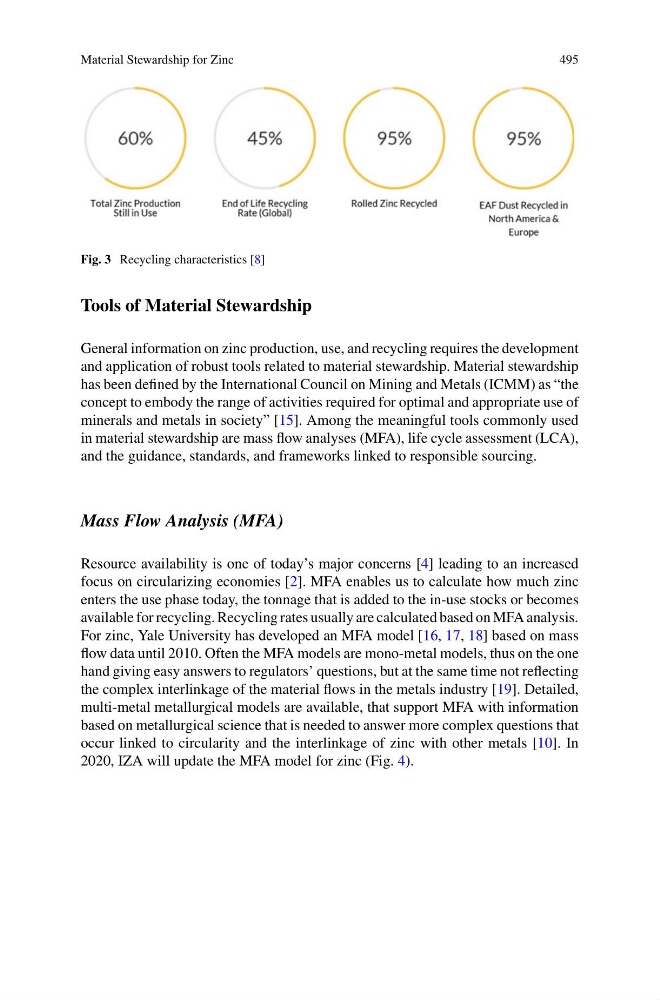
Fig. 3 Recycling characteristics [8]
Tools of Material Stewardship
General information on zinc production, use, and recycling requires the development
and application of robust tools related to material stewardship. Material stewardship
has been defined by the International Council on Mining and Metals (ICMM) as “the
concept to embody the range of activities required for optimal and appropriate use of
minerals and metals in society” [15]. Among the meaningful tools commonly used
in material stewardship are mass flow analyses (MFA), life cycle assessment (LCA),
and the guidance, standards, and frameworks linked to responsible sourcing.
Mass Flow Analysis (MFA)
Resource availability is one of today’s major concerns [4] leading to an increased
focus on circularizing economies [2]. MFA enables us to calculate how much zinc
enters the use phase today, the tonnage that is added to the in-use stocks or becomes
available for recycling. Recycling rates usually are calculated based on MFA analysis.
For zinc, Yale University has developed an MFA model [16, 17, 18] based on mass
flow data until 2010. Often the MFA models are mono-metal models, thus on the one
hand giving easy answers to regulators’ questions, but at the same time not reflecting
the complex interlinkage of the material flows in the metals industry [19]. Detailed,
multi-metal metallurgical models are available, that support MFA with information
based on metallurgical science that is needed to answer more complex questions that
occur linked to circularity and the interlinkage of zinc with other metals [10]. In
2020, IZA will update the MFA model for zinc (Fig. 4).
495
Fig. 3 Recycling characteristics [8]
Tools of Material Stewardship
General information on zinc production, use, and recycling requires the development
and application of robust tools related to material stewardship. Material stewardship
has been defined by the International Council on Mining and Metals (ICMM) as “the
concept to embody the range of activities required for optimal and appropriate use of
minerals and metals in society” [15]. Among the meaningful tools commonly used
in material stewardship are mass flow analyses (MFA), life cycle assessment (LCA),
and the guidance, standards, and frameworks linked to responsible sourcing.
Mass Flow Analysis (MFA)
Resource availability is one of today’s major concerns [4] leading to an increased
focus on circularizing economies [2]. MFA enables us to calculate how much zinc
enters the use phase today, the tonnage that is added to the in-use stocks or becomes
available for recycling. Recycling rates usually are calculated based on MFA analysis.
For zinc, Yale University has developed an MFA model [16, 17, 18] based on mass
flow data until 2010. Often the MFA models are mono-metal models, thus on the one
hand giving easy answers to regulators’ questions, but at the same time not reflecting
the complex interlinkage of the material flows in the metals industry [19]. Detailed,
multi-metal metallurgical models are available, that support MFA with information
based on metallurgical science that is needed to answer more complex questions that
occur linked to circularity and the interlinkage of zinc with other metals [10]. In
2020, IZA will update the MFA model for zinc (Fig. 4).