

Material Stewardship for Zinc
493
For the zinc industry, the International Zinc Association (IZA) is the focal point
for joint material stewardship actions. Through its global programs, IZA ensures that
necessary information is objectively collected and communicated to users, regulators,
and other stakeholders. IZA also provides the zinc industry a forum to develop
strategies and co-ordinate activities that productively and efficiently contribute to
the UN SDGs.
Zinc Production, Use, and Recycling
Zinc is a material of versatile properties and thus of a broad variety of uses. Due
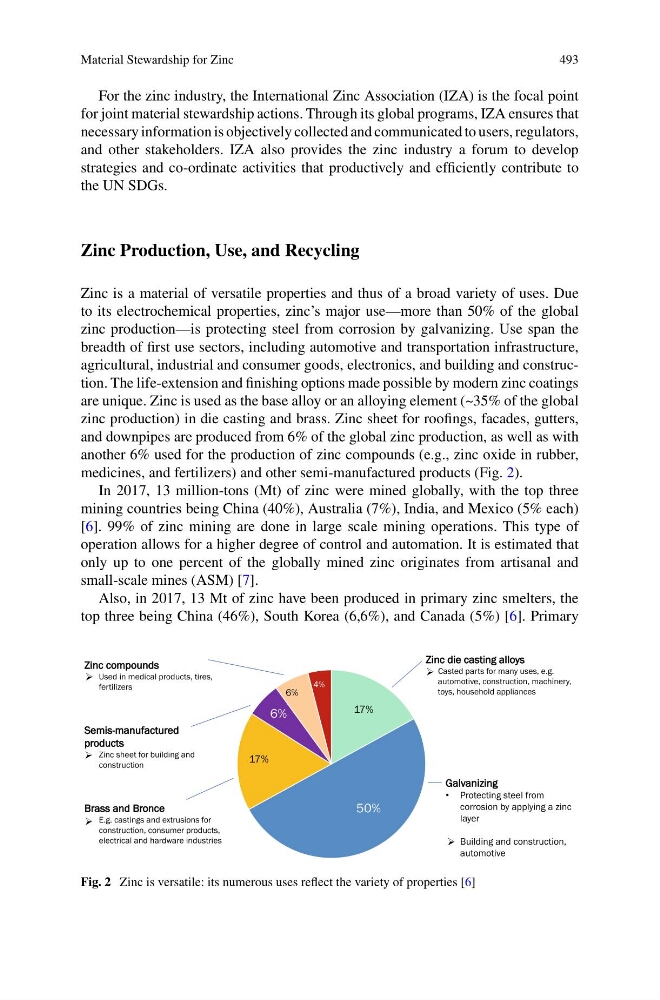
to its electrochemical properties, zinc’s major use—more than 50% of the global
zinc production—is protecting steel from corrosion by galvanizing. Use span the
breadth of first use sectors, including automotive and transportation infrastructure,
agricultural, industrial and consumer goods, electronics, and building and construction. The life-extension and finishing options made possible by modern zinc coatings
are unique. Zinc is used as the base alloy or an alloying element (~35% of the global
zinc production) in die casting and brass. Zinc sheet for roofings, facades, gutters,
and downpipes are produced from 6% of the global zinc production, as well as with
another 6% used for the production of zinc compounds (e.g., zinc oxide in rubber,
medicines, and fertilizers) and other semi-manufactured products (Fig. 2).
In 2017, 13 million-tons (Mt) of zinc were mined globally, with the top three
mining countries being China (40%), Australia (7%), India, and Mexico (5% each)
[6]. 99% of zinc mining are done in large scale mining operations. This type of
operation allows for a higher degree of control and automation. It is estimated that
only up to one percent of the globally mined zinc originates from artisanal and
small-scale mines (ASM) [7].
Also, in 2017, 13 Mt of zinc have been produced in primary zinc smelters, the
top three being China (46%), South Korea (6,6%), and Canada (5%) [6]. Primary
17%
50%
17%
6%
6%
4%
Ga Galvan anizing
• Protecting steel from
corrosion by applying a zinc
layer
Building and construction,
automotive
Zinc d die cast sting alloys ys
Casted parts for many uses, e.g.
automotive, construction, machinery,
toys, household appliances
Brass ass and and Bron once
E.g. castings and extrusions for
construction, consumer products,
electrical and hardware industries
Sem emis is-manu manufactured tured
product oducts
Zinc sheet for building and
construction
Zinc co compound unds
Used in medical products, tires,
fertilizers
Fig. 2 Zinc is versatile: its numerous uses reflect the variety of properties [6]
493
For the zinc industry, the International Zinc Association (IZA) is the focal point
for joint material stewardship actions. Through its global programs, IZA ensures that
necessary information is objectively collected and communicated to users, regulators,
and other stakeholders. IZA also provides the zinc industry a forum to develop
strategies and co-ordinate activities that productively and efficiently contribute to
the UN SDGs.
Zinc Production, Use, and Recycling
Zinc is a material of versatile properties and thus of a broad variety of uses. Due
to its electrochemical properties, zinc’s major use—more than 50% of the global
zinc production—is protecting steel from corrosion by galvanizing. Use span the
breadth of first use sectors, including automotive and transportation infrastructure,
agricultural, industrial and consumer goods, electronics, and building and construction. The life-extension and finishing options made possible by modern zinc coatings
are unique. Zinc is used as the base alloy or an alloying element (~35% of the global
zinc production) in die casting and brass. Zinc sheet for roofings, facades, gutters,
and downpipes are produced from 6% of the global zinc production, as well as with
another 6% used for the production of zinc compounds (e.g., zinc oxide in rubber,
medicines, and fertilizers) and other semi-manufactured products (Fig. 2).
In 2017, 13 million-tons (Mt) of zinc were mined globally, with the top three
mining countries being China (40%), Australia (7%), India, and Mexico (5% each)
[6]. 99% of zinc mining are done in large scale mining operations. This type of
operation allows for a higher degree of control and automation. It is estimated that
only up to one percent of the globally mined zinc originates from artisanal and
small-scale mines (ASM) [7].
Also, in 2017, 13 Mt of zinc have been produced in primary zinc smelters, the
top three being China (46%), South Korea (6,6%), and Canada (5%) [6]. Primary
17%
50%
17%
6%
6%
4%
Ga Galvan anizing
• Protecting steel from
corrosion by applying a zinc
layer
Building and construction,
automotive
Zinc d die cast sting alloys ys
Casted parts for many uses, e.g.
automotive, construction, machinery,
toys, household appliances
Brass ass and and Bron once
E.g. castings and extrusions for
construction, consumer products,
electrical and hardware industries
Sem emis is-manu manufactured tured
product oducts
Zinc sheet for building and
construction
Zinc co compound unds
Used in medical products, tires,
fertilizers
Fig. 2 Zinc is versatile: its numerous uses reflect the variety of properties [6]