

Effect of Alumina Ceramics Surface Condition …
483
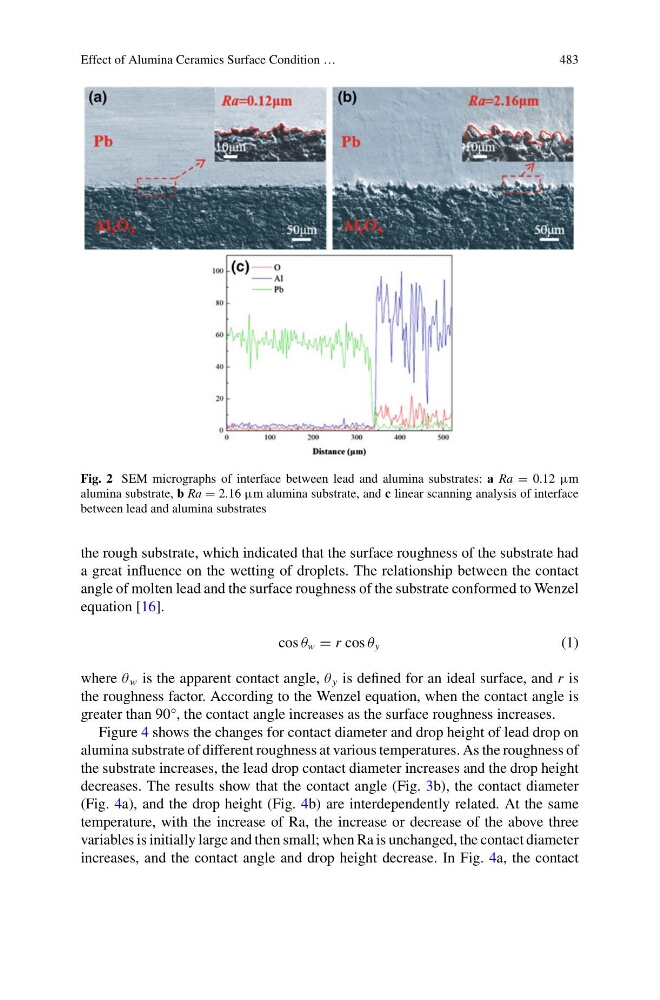
Fig. 2 SEM micrographs of interface between lead and alumina substrates: a Ra = 0.12 µm
alumina substrate, b Ra = 2.16 µm alumina substrate, and c linear scanning analysis of interface
between lead and alumina substrates
the rough substrate, which indicated that the surface roughness of the substrate had
a great influence on the wetting of droplets. The relationship between the contact
angle of molten lead and the surface roughness of the substrate conformed to Wenzel
equation [16].
cos θ w = r cos θ y
(1)
where θ w is the apparent contact angle, θ y is defined for an ideal surface, and r is
the roughness factor. According to the Wenzel equation, when the contact angle is
greater than 90°, the contact angle increases as the surface roughness increases.
Figure 4 shows the changes for contact diameter and drop height of lead drop on
alumina substrate of different roughness at various temperatures. As the roughness of
the substrate increases, the lead drop contact diameter increases and the drop height
decreases. The results show that the contact angle (Fig. 3b), the contact diameter
(Fig. 4a), and the drop height (Fig. 4b) are interdependently related. At the same
temperature, with the increase of Ra, the increase or decrease of the above three
variables is initially large and then small; when Ra is unchanged, the contact diameter
increases, and the contact angle and drop height decrease. In Fig. 4a, the contact
483
Fig. 2 SEM micrographs of interface between lead and alumina substrates: a Ra = 0.12 µm
alumina substrate, b Ra = 2.16 µm alumina substrate, and c linear scanning analysis of interface
between lead and alumina substrates
the rough substrate, which indicated that the surface roughness of the substrate had
a great influence on the wetting of droplets. The relationship between the contact
angle of molten lead and the surface roughness of the substrate conformed to Wenzel
equation [16].
cos θ w = r cos θ y
(1)
where θ w is the apparent contact angle, θ y is defined for an ideal surface, and r is
the roughness factor. According to the Wenzel equation, when the contact angle is
greater than 90°, the contact angle increases as the surface roughness increases.
Figure 4 shows the changes for contact diameter and drop height of lead drop on
alumina substrate of different roughness at various temperatures. As the roughness of
the substrate increases, the lead drop contact diameter increases and the drop height
decreases. The results show that the contact angle (Fig. 3b), the contact diameter
(Fig. 4a), and the drop height (Fig. 4b) are interdependently related. At the same
temperature, with the increase of Ra, the increase or decrease of the above three
variables is initially large and then small; when Ra is unchanged, the contact diameter
increases, and the contact angle and drop height decrease. In Fig. 4a, the contact