

Leaching of Turkish Oxidized Pb–Zn Flotation Tailings …
463
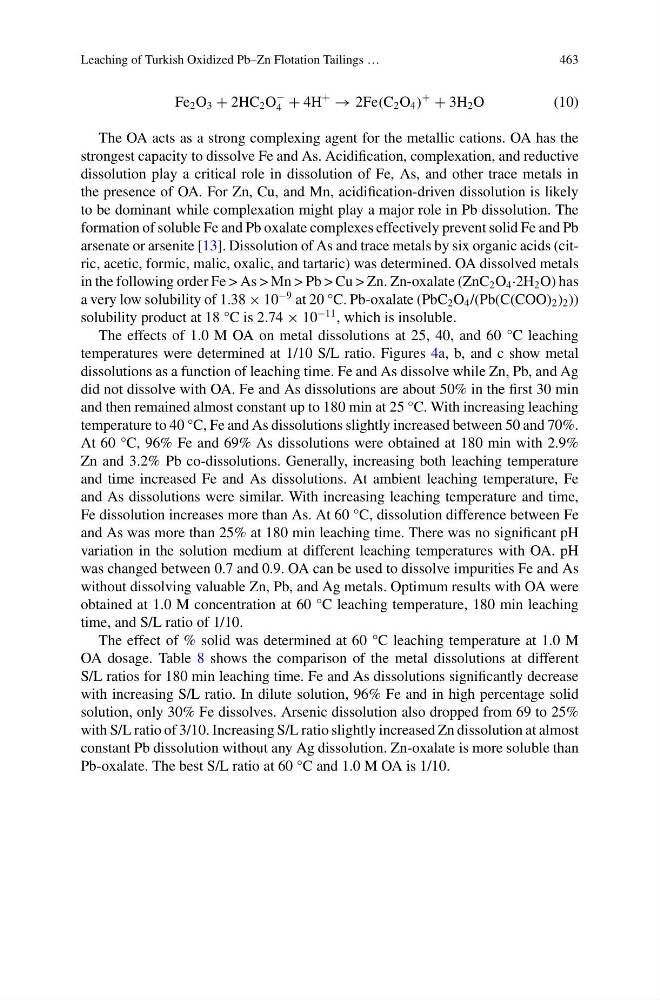
Fe 2 O 3 + 2HC 2 O
−
4 + 4H
+
→ 2Fe(C 2 O 4 )
+
+ 3H 2 O
( 1 0 )
The OA acts as a strong complexing agent for the metallic cations. OA has the
strongest capacity to dissolve Fe and As. Acidification, complexation, and reductive
dissolution play a critical role in dissolution of Fe, As, and other trace metals in
the presence of OA. For Zn, Cu, and Mn, acidification-driven dissolution is likely
to be dominant while complexation might play a major role in Pb dissolution. The
formation of soluble Fe and Pb oxalate complexes effectively prevent solid Fe and Pb
arsenate or arsenite [13]. Dissolution of As and trace metals by six organic acids (citric, acetic, formic, malic, oxalic, and tartaric) was determined. OA dissolved metals
in the following order Fe > As > Mn > Pb > Cu > Zn. Zn-oxalate (ZnC 2 O 4 ·2H 2 O) has
a very low solubility of 1.38 × 10
−9 at 20 °C. Pb-oxalate (PbC 2 O 4 /(Pb(C(COO) 2 ) 2 ))
solubility product at 18 °C is 2.74 × 10
−11 , which is insoluble.
The effects of 1.0 M OA on metal dissolutions at 25, 40, and 60 °C leaching
temperatures were determined at 1/10 S/L ratio. Figures 4a, b, and c show metal
dissolutions as a function of leaching time. Fe and As dissolve while Zn, Pb, and Ag
did not dissolve with OA. Fe and As dissolutions are about 50% in the first 30 min
and then remained almost constant up to 180 min at 25 °C. With increasing leaching
temperature to 40 °C, Fe and As dissolutions slightly increased between 50 and 70%.
At 60 °C, 96% Fe and 69% As dissolutions were obtained at 180 min with 2.9%
Zn and 3.2% Pb co-dissolutions. Generally, increasing both leaching temperature
and time increased Fe and As dissolutions. At ambient leaching temperature, Fe
and As dissolutions were similar. With increasing leaching temperature and time,
Fe dissolution increases more than As. At 60 °C, dissolution difference between Fe
and As was more than 25% at 180 min leaching time. There was no significant pH
variation in the solution medium at different leaching temperatures with OA. pH
was changed between 0.7 and 0.9. OA can be used to dissolve impurities Fe and As
without dissolving valuable Zn, Pb, and Ag metals. Optimum results with OA were
obtained at 1.0 M concentration at 60 °C leaching temperature, 180 min leaching
time, and S/L ratio of 1/10.
The effect of % solid was determined at 60 °C leaching temperature at 1.0 M
OA dosage. Table 8 shows the comparison of the metal dissolutions at different
S/L ratios for 180 min leaching time. Fe and As dissolutions significantly decrease
with increasing S/L ratio. In dilute solution, 96% Fe and in high percentage solid
solution, only 30% Fe dissolves. Arsenic dissolution also dropped from 69 to 25%
with S/L ratio of 3/10. Increasing S/L ratio slightly increased Zn dissolution at almost
constant Pb dissolution without any Ag dissolution. Zn-oxalate is more soluble than
Pb-oxalate. The best S/L ratio at 60 °C and 1.0 M OA is 1/10.
463
Fe 2 O 3 + 2HC 2 O
−
4 + 4H
+
→ 2Fe(C 2 O 4 )
+
+ 3H 2 O
( 1 0 )
The OA acts as a strong complexing agent for the metallic cations. OA has the
strongest capacity to dissolve Fe and As. Acidification, complexation, and reductive
dissolution play a critical role in dissolution of Fe, As, and other trace metals in
the presence of OA. For Zn, Cu, and Mn, acidification-driven dissolution is likely
to be dominant while complexation might play a major role in Pb dissolution. The
formation of soluble Fe and Pb oxalate complexes effectively prevent solid Fe and Pb
arsenate or arsenite [13]. Dissolution of As and trace metals by six organic acids (citric, acetic, formic, malic, oxalic, and tartaric) was determined. OA dissolved metals
in the following order Fe > As > Mn > Pb > Cu > Zn. Zn-oxalate (ZnC 2 O 4 ·2H 2 O) has
a very low solubility of 1.38 × 10
−9 at 20 °C. Pb-oxalate (PbC 2 O 4 /(Pb(C(COO) 2 ) 2 ))
solubility product at 18 °C is 2.74 × 10
−11 , which is insoluble.
The effects of 1.0 M OA on metal dissolutions at 25, 40, and 60 °C leaching
temperatures were determined at 1/10 S/L ratio. Figures 4a, b, and c show metal
dissolutions as a function of leaching time. Fe and As dissolve while Zn, Pb, and Ag
did not dissolve with OA. Fe and As dissolutions are about 50% in the first 30 min
and then remained almost constant up to 180 min at 25 °C. With increasing leaching
temperature to 40 °C, Fe and As dissolutions slightly increased between 50 and 70%.
At 60 °C, 96% Fe and 69% As dissolutions were obtained at 180 min with 2.9%
Zn and 3.2% Pb co-dissolutions. Generally, increasing both leaching temperature
and time increased Fe and As dissolutions. At ambient leaching temperature, Fe
and As dissolutions were similar. With increasing leaching temperature and time,
Fe dissolution increases more than As. At 60 °C, dissolution difference between Fe
and As was more than 25% at 180 min leaching time. There was no significant pH
variation in the solution medium at different leaching temperatures with OA. pH
was changed between 0.7 and 0.9. OA can be used to dissolve impurities Fe and As
without dissolving valuable Zn, Pb, and Ag metals. Optimum results with OA were
obtained at 1.0 M concentration at 60 °C leaching temperature, 180 min leaching
time, and S/L ratio of 1/10.
The effect of % solid was determined at 60 °C leaching temperature at 1.0 M
OA dosage. Table 8 shows the comparison of the metal dissolutions at different
S/L ratios for 180 min leaching time. Fe and As dissolutions significantly decrease
with increasing S/L ratio. In dilute solution, 96% Fe and in high percentage solid
solution, only 30% Fe dissolves. Arsenic dissolution also dropped from 69 to 25%
with S/L ratio of 3/10. Increasing S/L ratio slightly increased Zn dissolution at almost
constant Pb dissolution without any Ag dissolution. Zn-oxalate is more soluble than
Pb-oxalate. The best S/L ratio at 60 °C and 1.0 M OA is 1/10.