

462
M. Kaya et al.
0
66
71
80
83.20
0
16.30
18
20
22.10
0
20
40
60
80
100
0
30
60
120
180
Metal dissolution (%)
Time (min.)
Zn
Fe
Pb
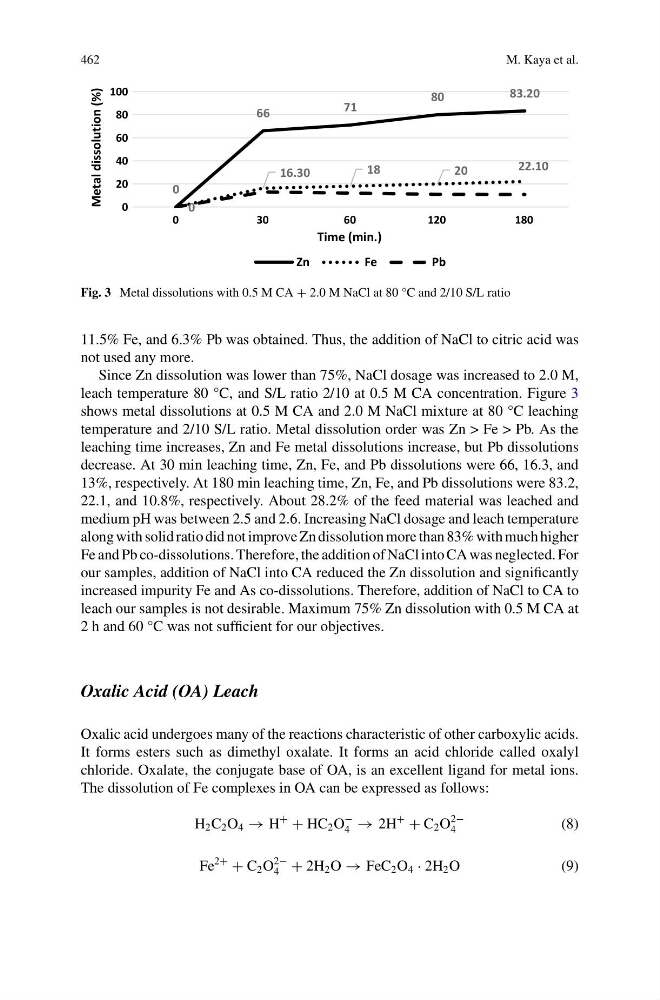
Fig. 3 Metal dissolutions with 0.5 M CA + 2.0 M NaCl at 80 °C and 2/10 S/L ratio
11.5% Fe, and 6.3% Pb was obtained. Thus, the addition of NaCl to citric acid was
not used any more.
Since Zn dissolution was lower than 75%, NaCl dosage was increased to 2.0 M,
leach temperature 80 °C, and S/L ratio 2/10 at 0.5 M CA concentration. Figure 3
shows metal dissolutions at 0.5 M CA and 2.0 M NaCl mixture at 80 °C leaching
temperature and 2/10 S/L ratio. Metal dissolution order was Zn > Fe > Pb. As the
leaching time increases, Zn and Fe metal dissolutions increase, but Pb dissolutions
decrease. At 30 min leaching time, Zn, Fe, and Pb dissolutions were 66, 16.3, and
13%, respectively. At 180 min leaching time, Zn, Fe, and Pb dissolutions were 83.2,
22.1, and 10.8%, respectively. About 28.2% of the feed material was leached and
medium pH was between 2.5 and 2.6. Increasing NaCl dosage and leach temperature
along with solid ratio did not improve Zn dissolution more than 83% with much higher
Fe and Pb co-dissolutions. Therefore, the addition of NaCl into CA was neglected. For
our samples, addition of NaCl into CA reduced the Zn dissolution and significantly
increased impurity Fe and As co-dissolutions. Therefore, addition of NaCl to CA to
leach our samples is not desirable. Maximum 75% Zn dissolution with 0.5 M CA at
2 h and 60 °C was not sufficient for our objectives.
Oxalic Acid (OA) Leach
Oxalic acid undergoes many of the reactions characteristic of other carboxylic acids.
It forms esters such as dimethyl oxalate. It forms an acid chloride called oxalyl
chloride. Oxalate, the conjugate base of OA, is an excellent ligand for metal ions.
The dissolution of Fe complexes in OA can be expressed as follows:
H 2 C 2 O 4 → H
+
+ HC 2 O
−
4 → 2H
+
+ C 2 O
2−
4
(8)
Fe
2+
+ C 2 O
2−
4 + 2H 2 O → FeC 2 O 4 · 2H 2 O
( 9 )
M. Kaya et al.
0
66
71
80
83.20
0
16.30
18
20
22.10
0
20
40
60
80
100
0
30
60
120
180
Metal dissolution (%)
Time (min.)
Zn
Fe
Pb
Fig. 3 Metal dissolutions with 0.5 M CA + 2.0 M NaCl at 80 °C and 2/10 S/L ratio
11.5% Fe, and 6.3% Pb was obtained. Thus, the addition of NaCl to citric acid was
not used any more.
Since Zn dissolution was lower than 75%, NaCl dosage was increased to 2.0 M,
leach temperature 80 °C, and S/L ratio 2/10 at 0.5 M CA concentration. Figure 3
shows metal dissolutions at 0.5 M CA and 2.0 M NaCl mixture at 80 °C leaching
temperature and 2/10 S/L ratio. Metal dissolution order was Zn > Fe > Pb. As the
leaching time increases, Zn and Fe metal dissolutions increase, but Pb dissolutions
decrease. At 30 min leaching time, Zn, Fe, and Pb dissolutions were 66, 16.3, and
13%, respectively. At 180 min leaching time, Zn, Fe, and Pb dissolutions were 83.2,
22.1, and 10.8%, respectively. About 28.2% of the feed material was leached and
medium pH was between 2.5 and 2.6. Increasing NaCl dosage and leach temperature
along with solid ratio did not improve Zn dissolution more than 83% with much higher
Fe and Pb co-dissolutions. Therefore, the addition of NaCl into CA was neglected. For
our samples, addition of NaCl into CA reduced the Zn dissolution and significantly
increased impurity Fe and As co-dissolutions. Therefore, addition of NaCl to CA to
leach our samples is not desirable. Maximum 75% Zn dissolution with 0.5 M CA at
2 h and 60 °C was not sufficient for our objectives.
Oxalic Acid (OA) Leach
Oxalic acid undergoes many of the reactions characteristic of other carboxylic acids.
It forms esters such as dimethyl oxalate. It forms an acid chloride called oxalyl
chloride. Oxalate, the conjugate base of OA, is an excellent ligand for metal ions.
The dissolution of Fe complexes in OA can be expressed as follows:
H 2 C 2 O 4 → H
+
+ HC 2 O
−
4 → 2H
+
+ C 2 O
2−
4
(8)
Fe
2+
+ C 2 O
2−
4 + 2H 2 O → FeC 2 O 4 · 2H 2 O
( 9 )