

Simulation of an Alternative Direct Leaching Process …
409
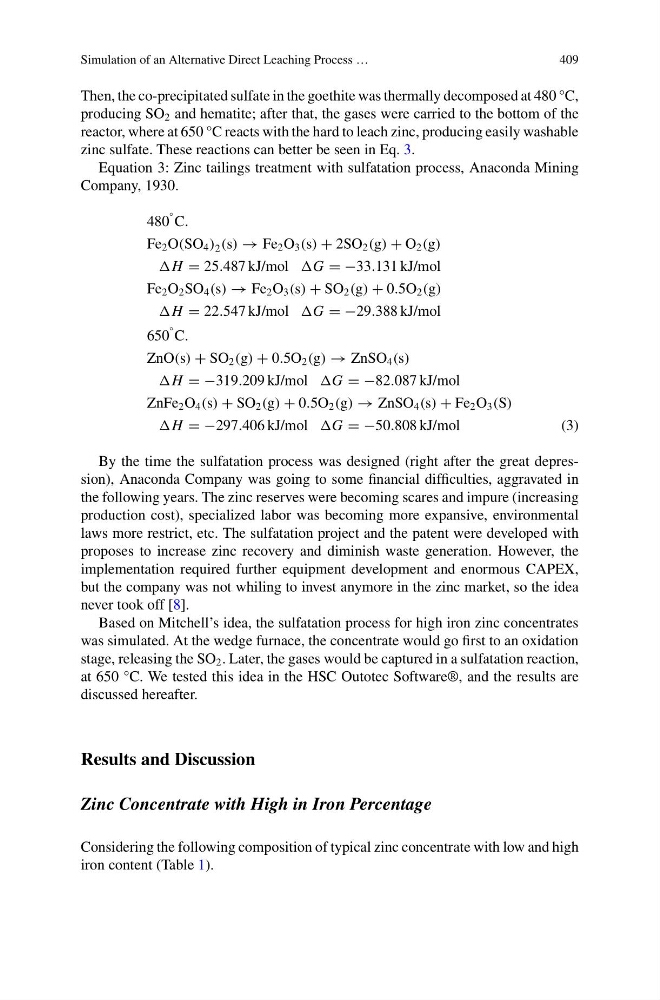
Then, the co-precipitated sulfate in the goethite was thermally decomposed at 480 °C,
producing SO 2 and hematite; after that, the gases were carried to the bottom of the
reactor, where at 650 °C reacts with the hard to leach zinc, producing easily washable
zinc sulfate. These reactions can better be seen in Eq. 3.
Equation 3: Zinc tailings treatment with sulfatation process, Anaconda Mining
Company, 1930.
480
◦ C.
Fe 2 O(SO 4 ) 2 (s) → Fe 2 O 3 (s) + 2SO 2 (g) + O 2 (g)
H = 25.487 kJ/mol G = −33.131 kJ/mol
Fe 2 O 2 SO 4 (s) → Fe 2 O 3 (s) + SO 2 (g) + 0.5O 2 (g)
H = 22.547 kJ/mol G = −29.388 kJ/mol
650
◦ C.
ZnO(s) + SO 2 (g) + 0.5O 2 (g) → ZnSO 4 (s)
H = −319.209 kJ/mol G = −82.087 kJ/mol
ZnFe 2 O 4 (s) + SO 2 (g) + 0.5O 2 (g) → ZnSO 4 (s) + Fe 2 O 3 (S)
H = −297.406 kJ/mol G = −50.808 kJ/mol
(3)
By the time the sulfatation process was designed (right after the great depression), Anaconda Company was going to some financial difficulties, aggravated in
the following years. The zinc reserves were becoming scares and impure (increasing
production cost), specialized labor was becoming more expansive, environmental
laws more restrict, etc. The sulfatation project and the patent were developed with
proposes to increase zinc recovery and diminish waste generation. However, the
implementation required further equipment development and enormous CAPEX,
but the company was not whiling to invest anymore in the zinc market, so the idea
never took off [8].
Based on Mitchell’s idea, the sulfatation process for high iron zinc concentrates
was simulated. At the wedge furnace, the concentrate would go first to an oxidation
stage, releasing the SO 2 . Later, the gases would be captured in a sulfatation reaction,
at 650 °C. We tested this idea in the HSC Outotec Software®, and the results are
discussed hereafter.
Results and Discussion
Zinc Concentrate with High in Iron Percentage
Considering the following composition of typical zinc concentrate with low and high
iron content (Table 1).
409
Then, the co-precipitated sulfate in the goethite was thermally decomposed at 480 °C,
producing SO 2 and hematite; after that, the gases were carried to the bottom of the
reactor, where at 650 °C reacts with the hard to leach zinc, producing easily washable
zinc sulfate. These reactions can better be seen in Eq. 3.
Equation 3: Zinc tailings treatment with sulfatation process, Anaconda Mining
Company, 1930.
480
◦ C.
Fe 2 O(SO 4 ) 2 (s) → Fe 2 O 3 (s) + 2SO 2 (g) + O 2 (g)
H = 25.487 kJ/mol G = −33.131 kJ/mol
Fe 2 O 2 SO 4 (s) → Fe 2 O 3 (s) + SO 2 (g) + 0.5O 2 (g)
H = 22.547 kJ/mol G = −29.388 kJ/mol
650
◦ C.
ZnO(s) + SO 2 (g) + 0.5O 2 (g) → ZnSO 4 (s)
H = −319.209 kJ/mol G = −82.087 kJ/mol
ZnFe 2 O 4 (s) + SO 2 (g) + 0.5O 2 (g) → ZnSO 4 (s) + Fe 2 O 3 (S)
H = −297.406 kJ/mol G = −50.808 kJ/mol
(3)
By the time the sulfatation process was designed (right after the great depression), Anaconda Company was going to some financial difficulties, aggravated in
the following years. The zinc reserves were becoming scares and impure (increasing
production cost), specialized labor was becoming more expansive, environmental
laws more restrict, etc. The sulfatation project and the patent were developed with
proposes to increase zinc recovery and diminish waste generation. However, the
implementation required further equipment development and enormous CAPEX,
but the company was not whiling to invest anymore in the zinc market, so the idea
never took off [8].
Based on Mitchell’s idea, the sulfatation process for high iron zinc concentrates
was simulated. At the wedge furnace, the concentrate would go first to an oxidation
stage, releasing the SO 2 . Later, the gases would be captured in a sulfatation reaction,
at 650 °C. We tested this idea in the HSC Outotec Software®, and the results are
discussed hereafter.
Results and Discussion
Zinc Concentrate with High in Iron Percentage
Considering the following composition of typical zinc concentrate with low and high
iron content (Table 1).