

408
C. C. S. de Oliveira and D. D. Pereira
Direct Leaching Processes
Alternatively to the RLE process, the direct leaching (DL) mechanisms can recover
zinc from its concentrates without the need of a roaster. Under the DL category,
we can find the bioleaching process (in which bacteria converts ZnS to ZnSO 4 ) and
the inorganic routes: In an autoclave or high water column tank (Albion leaching
process), ZnS is mixed with Fe
3+ to oxidize the sulfide, precipitating as elementary
sulfur, and leaving the zinc soluble. The produced Fe
2+ must now go to an oxidizing
stage (usually with pure O 2 ), in order to return to the begging of the process or for
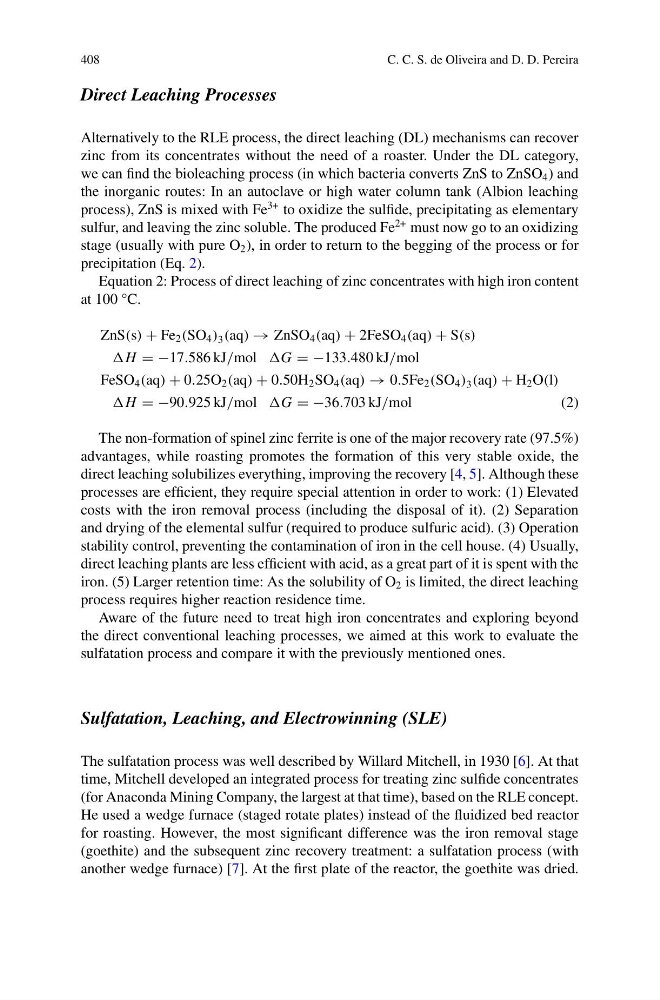
precipitation (Eq. 2).
Equation 2: Process of direct leaching of zinc concentrates with high iron content
at 100 °C.
ZnS(s) + Fe 2 (SO 4 ) 3 (aq) → ZnSO 4 (aq) + 2FeSO 4 (aq) + S(s)
H = −17.586 kJ/mol G = −133.480 kJ/mol
FeSO 4 (aq) + 0.25O 2 (aq) + 0.50H 2 SO 4 (aq) → 0.5Fe 2 (SO 4 ) 3 (aq) + H 2 O(l)
H = −90.925 kJ/mol G = −36.703 kJ/mol
(2)
The non-formation of spinel zinc ferrite is one of the major recovery rate (97.5%)
advantages, while roasting promotes the formation of this very stable oxide, the
direct leaching solubilizes everything, improving the recovery [4, 5]. Although these
processes are efficient, they require special attention in order to work: (1) Elevated
costs with the iron removal process (including the disposal of it). (2) Separation
and drying of the elemental sulfur (required to produce sulfuric acid). (3) Operation
stability control, preventing the contamination of iron in the cell house. (4) Usually,
direct leaching plants are less efficient with acid, as a great part of it is spent with the
iron. (5) Larger retention time: As the solubility of O 2 is limited, the direct leaching
process requires higher reaction residence time.
Aware of the future need to treat high iron concentrates and exploring beyond
the direct conventional leaching processes, we aimed at this work to evaluate the
sulfatation process and compare it with the previously mentioned ones.
Sulfatation, Leaching, and Electrowinning (SLE)
The sulfatation process was well described by Willard Mitchell, in 1930 [6]. At that
time, Mitchell developed an integrated process for treating zinc sulfide concentrates
(for Anaconda Mining Company, the largest at that time), based on the RLE concept.
He used a wedge furnace (staged rotate plates) instead of the fluidized bed reactor
for roasting. However, the most significant difference was the iron removal stage
(goethite) and the subsequent zinc recovery treatment: a sulfatation process (with
another wedge furnace) [7]. At the first plate of the reactor, the goethite was dried.
C. C. S. de Oliveira and D. D. Pereira
Direct Leaching Processes
Alternatively to the RLE process, the direct leaching (DL) mechanisms can recover
zinc from its concentrates without the need of a roaster. Under the DL category,
we can find the bioleaching process (in which bacteria converts ZnS to ZnSO 4 ) and
the inorganic routes: In an autoclave or high water column tank (Albion leaching
process), ZnS is mixed with Fe
3+ to oxidize the sulfide, precipitating as elementary
sulfur, and leaving the zinc soluble. The produced Fe
2+ must now go to an oxidizing
stage (usually with pure O 2 ), in order to return to the begging of the process or for
precipitation (Eq. 2).
Equation 2: Process of direct leaching of zinc concentrates with high iron content
at 100 °C.
ZnS(s) + Fe 2 (SO 4 ) 3 (aq) → ZnSO 4 (aq) + 2FeSO 4 (aq) + S(s)
H = −17.586 kJ/mol G = −133.480 kJ/mol
FeSO 4 (aq) + 0.25O 2 (aq) + 0.50H 2 SO 4 (aq) → 0.5Fe 2 (SO 4 ) 3 (aq) + H 2 O(l)
H = −90.925 kJ/mol G = −36.703 kJ/mol
(2)
The non-formation of spinel zinc ferrite is one of the major recovery rate (97.5%)
advantages, while roasting promotes the formation of this very stable oxide, the
direct leaching solubilizes everything, improving the recovery [4, 5]. Although these
processes are efficient, they require special attention in order to work: (1) Elevated
costs with the iron removal process (including the disposal of it). (2) Separation
and drying of the elemental sulfur (required to produce sulfuric acid). (3) Operation
stability control, preventing the contamination of iron in the cell house. (4) Usually,
direct leaching plants are less efficient with acid, as a great part of it is spent with the
iron. (5) Larger retention time: As the solubility of O 2 is limited, the direct leaching
process requires higher reaction residence time.
Aware of the future need to treat high iron concentrates and exploring beyond
the direct conventional leaching processes, we aimed at this work to evaluate the
sulfatation process and compare it with the previously mentioned ones.
Sulfatation, Leaching, and Electrowinning (SLE)
The sulfatation process was well described by Willard Mitchell, in 1930 [6]. At that
time, Mitchell developed an integrated process for treating zinc sulfide concentrates
(for Anaconda Mining Company, the largest at that time), based on the RLE concept.
He used a wedge furnace (staged rotate plates) instead of the fluidized bed reactor
for roasting. However, the most significant difference was the iron removal stage
(goethite) and the subsequent zinc recovery treatment: a sulfatation process (with
another wedge furnace) [7]. At the first plate of the reactor, the goethite was dried.