

398
J. Salminen et al.
and Pb in the intermediated slag. Coke has only been added during the reduction
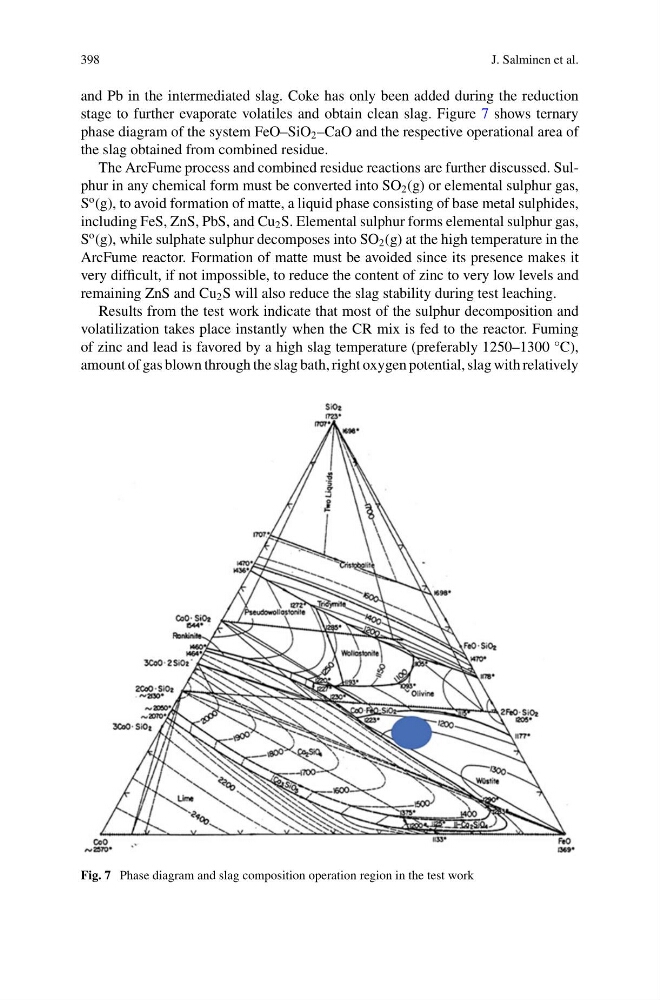
stage to further evaporate volatiles and obtain clean slag. Figure 7 shows ternary
phase diagram of the system FeO–SiO 2 –CaO and the respective operational area of
the slag obtained from combined residue.
The ArcFume process and combined residue reactions are further discussed. Sulphur in any chemical form must be converted into SO 2 (g) or elemental sulphur gas,
S
o (g), to avoid formation of matte, a liquid phase consisting of base metal sulphides,
including FeS, ZnS, PbS, and Cu 2 S. Elemental sulphur forms elemental sulphur gas,
S
o (g), while sulphate sulphur decomposes into SO 2 (g) at the high temperature in the
ArcFume reactor. Formation of matte must be avoided since its presence makes it
very difficult, if not impossible, to reduce the content of zinc to very low levels and
remaining ZnS and Cu 2 S will also reduce the slag stability during test leaching.
Results from the test work indicate that most of the sulphur decomposition and
volatilization takes place instantly when the CR mix is fed to the reactor. Fuming
of zinc and lead is favored by a high slag temperature (preferably 1250–1300 °C),
amount of gas blown through the slag bath, right oxygen potential, slag with relatively
Fig. 7 Phase diagram and slag composition operation region in the test work
J. Salminen et al.
and Pb in the intermediated slag. Coke has only been added during the reduction
stage to further evaporate volatiles and obtain clean slag. Figure 7 shows ternary
phase diagram of the system FeO–SiO 2 –CaO and the respective operational area of
the slag obtained from combined residue.
The ArcFume process and combined residue reactions are further discussed. Sulphur in any chemical form must be converted into SO 2 (g) or elemental sulphur gas,
S
o (g), to avoid formation of matte, a liquid phase consisting of base metal sulphides,
including FeS, ZnS, PbS, and Cu 2 S. Elemental sulphur forms elemental sulphur gas,
S
o (g), while sulphate sulphur decomposes into SO 2 (g) at the high temperature in the
ArcFume reactor. Formation of matte must be avoided since its presence makes it
very difficult, if not impossible, to reduce the content of zinc to very low levels and
remaining ZnS and Cu 2 S will also reduce the slag stability during test leaching.
Results from the test work indicate that most of the sulphur decomposition and
volatilization takes place instantly when the CR mix is fed to the reactor. Fuming
of zinc and lead is favored by a high slag temperature (preferably 1250–1300 °C),
amount of gas blown through the slag bath, right oxygen potential, slag with relatively
Fig. 7 Phase diagram and slag composition operation region in the test work