

Smelting Jarosite and Sulphur Residue in a Plasma Furnace
397
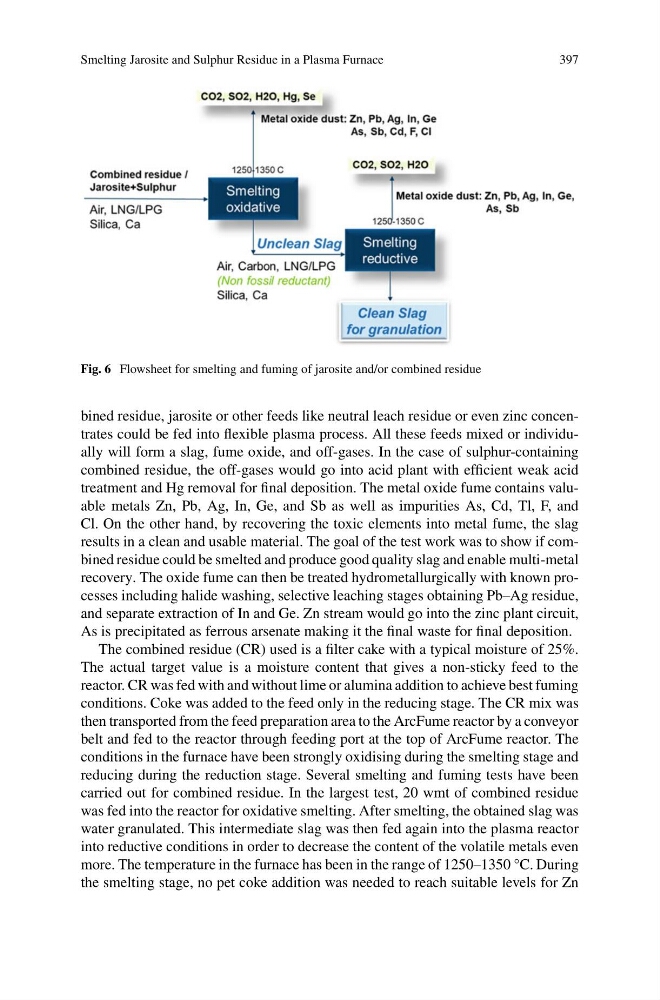
Fig. 6 Flowsheet for smelting and fuming of jarosite and/or combined residue
bined residue, jarosite or other feeds like neutral leach residue or even zinc concentrates could be fed into flexible plasma process. All these feeds mixed or individually will form a slag, fume oxide, and off-gases. In the case of sulphur-containing
combined residue, the off-gases would go into acid plant with efficient weak acid
treatment and Hg removal for final deposition. The metal oxide fume contains valuable metals Zn, Pb, Ag, In, Ge, and Sb as well as impurities As, Cd, Tl, F, and
Cl. On the other hand, by recovering the toxic elements into metal fume, the slag
results in a clean and usable material. The goal of the test work was to show if combined residue could be smelted and produce good quality slag and enable multi-metal
recovery. The oxide fume can then be treated hydrometallurgically with known processes including halide washing, selective leaching stages obtaining Pb–Ag residue,
and separate extraction of In and Ge. Zn stream would go into the zinc plant circuit,
As is precipitated as ferrous arsenate making it the final waste for final deposition.
The combined residue (CR) used is a filter cake with a typical moisture of 25%.
The actual target value is a moisture content that gives a non-sticky feed to the
reactor. CR was fed with and without lime or alumina addition to achieve best fuming
conditions. Coke was added to the feed only in the reducing stage. The CR mix was
then transported from the feed preparation area to the ArcFume reactor by a conveyor
belt and fed to the reactor through feeding port at the top of ArcFume reactor. The
conditions in the furnace have been strongly oxidising during the smelting stage and
reducing during the reduction stage. Several smelting and fuming tests have been
carried out for combined residue. In the largest test, 20 wmt of combined residue
was fed into the reactor for oxidative smelting. After smelting, the obtained slag was
water granulated. This intermediate slag was then fed again into the plasma reactor
into reductive conditions in order to decrease the content of the volatile metals even
more. The temperature in the furnace has been in the range of 1250–1350 °C. During
the smelting stage, no pet coke addition was needed to reach suitable levels for Zn
397
Fig. 6 Flowsheet for smelting and fuming of jarosite and/or combined residue
bined residue, jarosite or other feeds like neutral leach residue or even zinc concentrates could be fed into flexible plasma process. All these feeds mixed or individually will form a slag, fume oxide, and off-gases. In the case of sulphur-containing
combined residue, the off-gases would go into acid plant with efficient weak acid
treatment and Hg removal for final deposition. The metal oxide fume contains valuable metals Zn, Pb, Ag, In, Ge, and Sb as well as impurities As, Cd, Tl, F, and
Cl. On the other hand, by recovering the toxic elements into metal fume, the slag
results in a clean and usable material. The goal of the test work was to show if combined residue could be smelted and produce good quality slag and enable multi-metal
recovery. The oxide fume can then be treated hydrometallurgically with known processes including halide washing, selective leaching stages obtaining Pb–Ag residue,
and separate extraction of In and Ge. Zn stream would go into the zinc plant circuit,
As is precipitated as ferrous arsenate making it the final waste for final deposition.
The combined residue (CR) used is a filter cake with a typical moisture of 25%.
The actual target value is a moisture content that gives a non-sticky feed to the
reactor. CR was fed with and without lime or alumina addition to achieve best fuming
conditions. Coke was added to the feed only in the reducing stage. The CR mix was
then transported from the feed preparation area to the ArcFume reactor by a conveyor
belt and fed to the reactor through feeding port at the top of ArcFume reactor. The
conditions in the furnace have been strongly oxidising during the smelting stage and
reducing during the reduction stage. Several smelting and fuming tests have been
carried out for combined residue. In the largest test, 20 wmt of combined residue
was fed into the reactor for oxidative smelting. After smelting, the obtained slag was
water granulated. This intermediate slag was then fed again into the plasma reactor
into reductive conditions in order to decrease the content of the volatile metals even
more. The temperature in the furnace has been in the range of 1250–1350 °C. During
the smelting stage, no pet coke addition was needed to reach suitable levels for Zn