

356
A. Abadías Llamas et al.
evaluating how the fraction of concentrate introduced to the DZS flowsheet affects
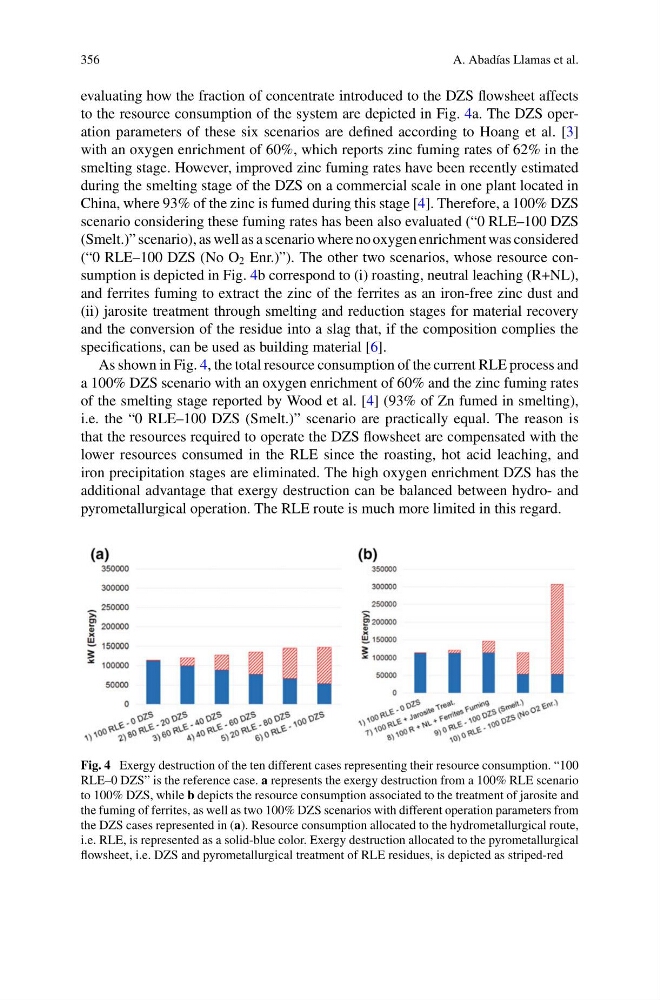
to the resource consumption of the system are depicted in Fig. 4a. The DZS operation parameters of these six scenarios are defined according to Hoang et al. [3]
with an oxygen enrichment of 60%, which reports zinc fuming rates of 62% in the
smelting stage. However, improved zinc fuming rates have been recently estimated
during the smelting stage of the DZS on a commercial scale in one plant located in
China, where 93% of the zinc is fumed during this stage [4]. Therefore, a 100% DZS
scenario considering these fuming rates has been also evaluated (“0 RLE–100 DZS
(Smelt.)” scenario), as well as a scenario where no oxygen enrichment was considered
(“0 RLE–100 DZS (No O 2 Enr.)”). The other two scenarios, whose resource consumption is depicted in Fig. 4b correspond to (i) roasting, neutral leaching (R+NL),
and ferrites fuming to extract the zinc of the ferrites as an iron-free zinc dust and
(ii) jarosite treatment through smelting and reduction stages for material recovery
and the conversion of the residue into a slag that, if the composition complies the
specifications, can be used as building material [6].
As shown in Fig. 4, the total resource consumption of the current RLE process and
a 100% DZS scenario with an oxygen enrichment of 60% and the zinc fuming rates
of the smelting stage reported by Wood et al. [4] (93% of Zn fumed in smelting),
i.e. the “0 RLE–100 DZS (Smelt.)” scenario are practically equal. The reason is
that the resources required to operate the DZS flowsheet are compensated with the
lower resources consumed in the RLE since the roasting, hot acid leaching, and
iron precipitation stages are eliminated. The high oxygen enrichment DZS has the
additional advantage that exergy destruction can be balanced between hydro- and
pyrometallurgical operation. The RLE route is much more limited in this regard.
Fig. 4 Exergy destruction of the ten different cases representing their resource consumption. “100
RLE–0 DZS” is the reference case. a represents the exergy destruction from a 100% RLE scenario
to 100% DZS, while b depicts the resource consumption associated to the treatment of jarosite and
the fuming of ferrites, as well as two 100% DZS scenarios with different operation parameters from
the DZS cases represented in (a). Resource consumption allocated to the hydrometallurgical route,
i.e. RLE, is represented as a solid-blue color. Exergy destruction allocated to the pyrometallurgical
flowsheet, i.e. DZS and pyrometallurgical treatment of RLE residues, is depicted as striped-red
A. Abadías Llamas et al.
evaluating how the fraction of concentrate introduced to the DZS flowsheet affects
to the resource consumption of the system are depicted in Fig. 4a. The DZS operation parameters of these six scenarios are defined according to Hoang et al. [3]
with an oxygen enrichment of 60%, which reports zinc fuming rates of 62% in the
smelting stage. However, improved zinc fuming rates have been recently estimated
during the smelting stage of the DZS on a commercial scale in one plant located in
China, where 93% of the zinc is fumed during this stage [4]. Therefore, a 100% DZS
scenario considering these fuming rates has been also evaluated (“0 RLE–100 DZS
(Smelt.)” scenario), as well as a scenario where no oxygen enrichment was considered
(“0 RLE–100 DZS (No O 2 Enr.)”). The other two scenarios, whose resource consumption is depicted in Fig. 4b correspond to (i) roasting, neutral leaching (R+NL),
and ferrites fuming to extract the zinc of the ferrites as an iron-free zinc dust and
(ii) jarosite treatment through smelting and reduction stages for material recovery
and the conversion of the residue into a slag that, if the composition complies the
specifications, can be used as building material [6].
As shown in Fig. 4, the total resource consumption of the current RLE process and
a 100% DZS scenario with an oxygen enrichment of 60% and the zinc fuming rates
of the smelting stage reported by Wood et al. [4] (93% of Zn fumed in smelting),
i.e. the “0 RLE–100 DZS (Smelt.)” scenario are practically equal. The reason is
that the resources required to operate the DZS flowsheet are compensated with the
lower resources consumed in the RLE since the roasting, hot acid leaching, and
iron precipitation stages are eliminated. The high oxygen enrichment DZS has the
additional advantage that exergy destruction can be balanced between hydro- and
pyrometallurgical operation. The RLE route is much more limited in this regard.
Fig. 4 Exergy destruction of the ten different cases representing their resource consumption. “100
RLE–0 DZS” is the reference case. a represents the exergy destruction from a 100% RLE scenario
to 100% DZS, while b depicts the resource consumption associated to the treatment of jarosite and
the fuming of ferrites, as well as two 100% DZS scenarios with different operation parameters from
the DZS cases represented in (a). Resource consumption allocated to the hydrometallurgical route,
i.e. RLE, is represented as a solid-blue color. Exergy destruction allocated to the pyrometallurgical
flowsheet, i.e. DZS and pyrometallurgical treatment of RLE residues, is depicted as striped-red