

354
A. Abadías Llamas et al.
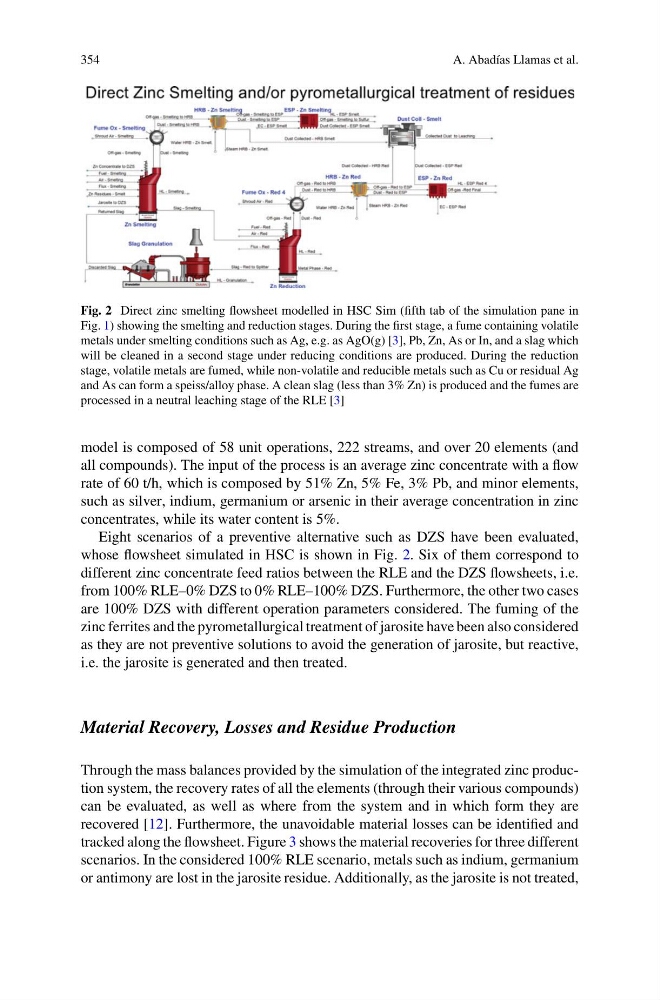
Fig. 2 Direct zinc smelting flowsheet modelled in HSC Sim (fifth tab of the simulation pane in
Fig. 1) showing the smelting and reduction stages. During the first stage, a fume containing volatile
metals under smelting conditions such as Ag, e.g. as AgO(g) [3], Pb, Zn, As or In, and a slag which
will be cleaned in a second stage under reducing conditions are produced. During the reduction
stage, volatile metals are fumed, while non-volatile and reducible metals such as Cu or residual Ag
and As can form a speiss/alloy phase. A clean slag (less than 3% Zn) is produced and the fumes are
processed in a neutral leaching stage of the RLE [3]
model is composed of 58 unit operations, 222 streams, and over 20 elements (and
all compounds). The input of the process is an average zinc concentrate with a flow
rate of 60 t/h, which is composed by 51% Zn, 5% Fe, 3% Pb, and minor elements,
such as silver, indium, germanium or arsenic in their average concentration in zinc
concentrates, while its water content is 5%.
Eight scenarios of a preventive alternative such as DZS have been evaluated,
whose flowsheet simulated in HSC is shown in Fig. 2. Six of them correspond to
different zinc concentrate feed ratios between the RLE and the DZS flowsheets, i.e.
from 100% RLE–0% DZS to 0% RLE–100% DZS. Furthermore, the other two cases
are 100% DZS with different operation parameters considered. The fuming of the
zinc ferrites and the pyrometallurgical treatment of jarosite have been also considered
as they are not preventive solutions to avoid the generation of jarosite, but reactive,
i.e. the jarosite is generated and then treated.
Material Recovery, Losses and Residue Production
Through the mass balances provided by the simulation of the integrated zinc production system, the recovery rates of all the elements (through their various compounds)
can be evaluated, as well as where from the system and in which form they are
recovered [12]. Furthermore, the unavoidable material losses can be identified and
tracked along the flowsheet. Figure 3 shows the material recoveries for three different
scenarios. In the considered 100% RLE scenario, metals such as indium, germanium
or antimony are lost in the jarosite residue. Additionally, as the jarosite is not treated,
A. Abadías Llamas et al.
Fig. 2 Direct zinc smelting flowsheet modelled in HSC Sim (fifth tab of the simulation pane in
Fig. 1) showing the smelting and reduction stages. During the first stage, a fume containing volatile
metals under smelting conditions such as Ag, e.g. as AgO(g) [3], Pb, Zn, As or In, and a slag which
will be cleaned in a second stage under reducing conditions are produced. During the reduction
stage, volatile metals are fumed, while non-volatile and reducible metals such as Cu or residual Ag
and As can form a speiss/alloy phase. A clean slag (less than 3% Zn) is produced and the fumes are
processed in a neutral leaching stage of the RLE [3]
model is composed of 58 unit operations, 222 streams, and over 20 elements (and
all compounds). The input of the process is an average zinc concentrate with a flow
rate of 60 t/h, which is composed by 51% Zn, 5% Fe, 3% Pb, and minor elements,
such as silver, indium, germanium or arsenic in their average concentration in zinc
concentrates, while its water content is 5%.
Eight scenarios of a preventive alternative such as DZS have been evaluated,
whose flowsheet simulated in HSC is shown in Fig. 2. Six of them correspond to
different zinc concentrate feed ratios between the RLE and the DZS flowsheets, i.e.
from 100% RLE–0% DZS to 0% RLE–100% DZS. Furthermore, the other two cases
are 100% DZS with different operation parameters considered. The fuming of the
zinc ferrites and the pyrometallurgical treatment of jarosite have been also considered
as they are not preventive solutions to avoid the generation of jarosite, but reactive,
i.e. the jarosite is generated and then treated.
Material Recovery, Losses and Residue Production
Through the mass balances provided by the simulation of the integrated zinc production system, the recovery rates of all the elements (through their various compounds)
can be evaluated, as well as where from the system and in which form they are
recovered [12]. Furthermore, the unavoidable material losses can be identified and
tracked along the flowsheet. Figure 3 shows the material recoveries for three different
scenarios. In the considered 100% RLE scenario, metals such as indium, germanium
or antimony are lost in the jarosite residue. Additionally, as the jarosite is not treated,