

KCM—Innovator in the Pb Metal Production Through Ausmelt …
323
Table 3 Slag content during smelting stage in %
Pb
Zn
Fe
SiO 2
CaO
40–45
10–12
11–13
10–12
6–8
Table 4 Typical granulated slag chemistry in %
Pb
Zn
Fe
SiO 2
CaO
Sb
As
4–5
17–18
~22
19–21
8–10
0.4
0.2
Table 5 Typical lead bullion analysis in %
Pb
Cu
As
Sb
Bi
Smelting
99.0
0.5
0.02
0.2
0.3
Reduction
97.5
0.7
0.3
1.3
0.1
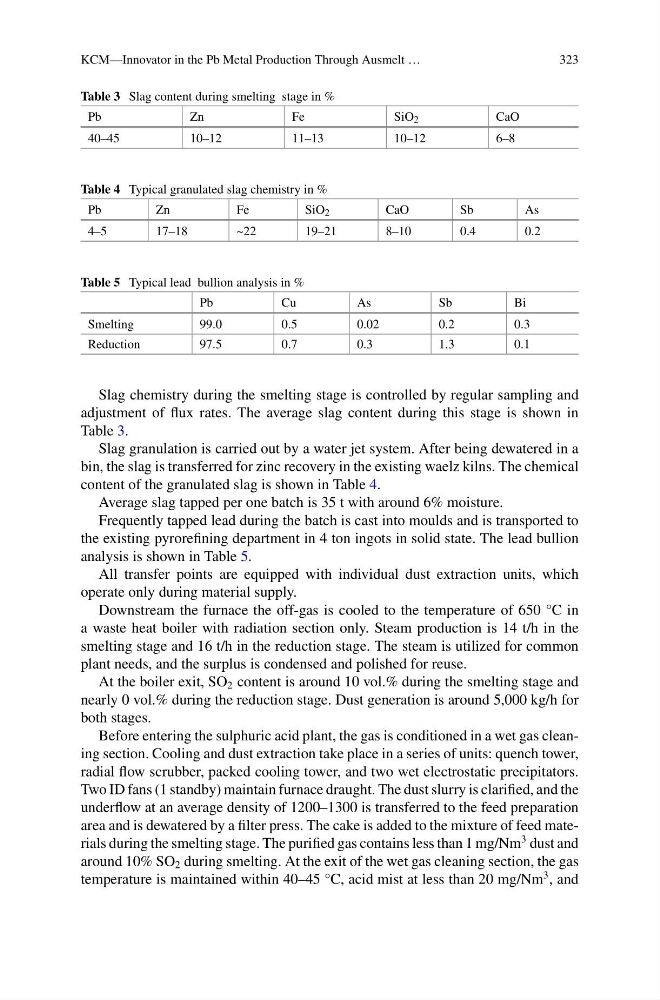
Slag chemistry during the smelting stage is controlled by regular sampling and
adjustment of flux rates. The average slag content during this stage is shown in
Table 3.
Slag granulation is carried out by a water jet system. After being dewatered in a
bin, the slag is transferred for zinc recovery in the existing waelz kilns. The chemical
content of the granulated slag is shown in Table 4.
Average slag tapped per one batch is 35 t with around 6% moisture.
Frequently tapped lead during the batch is cast into moulds and is transported to
the existing pyrorefining department in 4 ton ingots in solid state. The lead bullion
analysis is shown in Table 5.
All transfer points are equipped with individual dust extraction units, which
operate only during material supply.
Downstream the furnace the off-gas is cooled to the temperature of 650 °C in
a waste heat boiler with radiation section only. Steam production is 14 t/h in the
smelting stage and 16 t/h in the reduction stage. The steam is utilized for common
plant needs, and the surplus is condensed and polished for reuse.
At the boiler exit, SO 2 content is around 10 vol.% during the smelting stage and
nearly 0 vol.% during the reduction stage. Dust generation is around 5,000 kg/h for
both stages.
Before entering the sulphuric acid plant, the gas is conditioned in a wet gas cleaning section. Cooling and dust extraction take place in a series of units: quench tower,
radial flow scrubber, packed cooling tower, and two wet electrostatic precipitators.
Two ID fans (1 standby) maintain furnace draught. The dust slurry is clarified, and the
underflow at an average density of 1200–1300 is transferred to the feed preparation
area and is dewatered by a filter press. The cake is added to the mixture of feed materials during the smelting stage. The purified gas contains less than 1 mg/Nm
3 dust and
around 10% SO 2 during smelting. At the exit of the wet gas cleaning section, the gas
temperature is maintained within 40–45 °C, acid mist at less than 20 mg/Nm
3 , and
323
Table 3 Slag content during smelting stage in %
Pb
Zn
Fe
SiO 2
CaO
40–45
10–12
11–13
10–12
6–8
Table 4 Typical granulated slag chemistry in %
Pb
Zn
Fe
SiO 2
CaO
Sb
As
4–5
17–18
~22
19–21
8–10
0.4
0.2
Table 5 Typical lead bullion analysis in %
Pb
Cu
As
Sb
Bi
Smelting
99.0
0.5
0.02
0.2
0.3
Reduction
97.5
0.7
0.3
1.3
0.1
Slag chemistry during the smelting stage is controlled by regular sampling and
adjustment of flux rates. The average slag content during this stage is shown in
Table 3.
Slag granulation is carried out by a water jet system. After being dewatered in a
bin, the slag is transferred for zinc recovery in the existing waelz kilns. The chemical
content of the granulated slag is shown in Table 4.
Average slag tapped per one batch is 35 t with around 6% moisture.
Frequently tapped lead during the batch is cast into moulds and is transported to
the existing pyrorefining department in 4 ton ingots in solid state. The lead bullion
analysis is shown in Table 5.
All transfer points are equipped with individual dust extraction units, which
operate only during material supply.
Downstream the furnace the off-gas is cooled to the temperature of 650 °C in
a waste heat boiler with radiation section only. Steam production is 14 t/h in the
smelting stage and 16 t/h in the reduction stage. The steam is utilized for common
plant needs, and the surplus is condensed and polished for reuse.
At the boiler exit, SO 2 content is around 10 vol.% during the smelting stage and
nearly 0 vol.% during the reduction stage. Dust generation is around 5,000 kg/h for
both stages.
Before entering the sulphuric acid plant, the gas is conditioned in a wet gas cleaning section. Cooling and dust extraction take place in a series of units: quench tower,
radial flow scrubber, packed cooling tower, and two wet electrostatic precipitators.
Two ID fans (1 standby) maintain furnace draught. The dust slurry is clarified, and the
underflow at an average density of 1200–1300 is transferred to the feed preparation
area and is dewatered by a filter press. The cake is added to the mixture of feed materials during the smelting stage. The purified gas contains less than 1 mg/Nm
3 dust and
around 10% SO 2 during smelting. At the exit of the wet gas cleaning section, the gas
temperature is maintained within 40–45 °C, acid mist at less than 20 mg/Nm
3 , and