

314
J. Antrekowitsch and G. Hanke
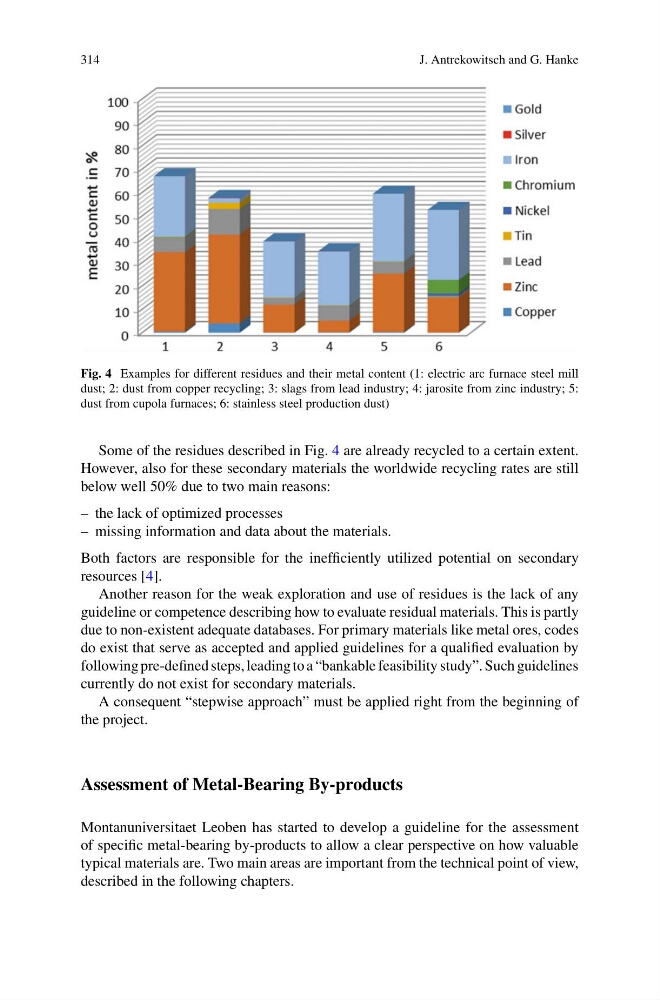
Fig. 4 Examples for different residues and their metal content (1: electric arc furnace steel mill
dust; 2: dust from copper recycling; 3: slags from lead industry; 4: jarosite from zinc industry; 5:
dust from cupola furnaces; 6: stainless steel production dust)
Some of the residues described in Fig. 4 are already recycled to a certain extent.
However, also for these secondary materials the worldwide recycling rates are still
below well 50% due to two main reasons:
– the lack of optimized processes
– missing information and data about the materials.
Both factors are responsible for the inefficiently utilized potential on secondary
resources [4].
Another reason for the weak exploration and use of residues is the lack of any
guideline or competence describing how to evaluate residual materials. This is partly
due to non-existent adequate databases. For primary materials like metal ores, codes
do exist that serve as accepted and applied guidelines for a qualified evaluation by
following pre-defined steps, leading to a “bankable feasibility study”. Such guidelines
currently do not exist for secondary materials.
A consequent “stepwise approach” must be applied right from the beginning of
the project.
Assessment of Metal-Bearing By-products
Montanuniversitaet Leoben has started to develop a guideline for the assessment
of specific metal-bearing by-products to allow a clear perspective on how valuable
typical materials are. Two main areas are important from the technical point of view,
described in the following chapters.
J. Antrekowitsch and G. Hanke
Fig. 4 Examples for different residues and their metal content (1: electric arc furnace steel mill
dust; 2: dust from copper recycling; 3: slags from lead industry; 4: jarosite from zinc industry; 5:
dust from cupola furnaces; 6: stainless steel production dust)
Some of the residues described in Fig. 4 are already recycled to a certain extent.
However, also for these secondary materials the worldwide recycling rates are still
below well 50% due to two main reasons:
– the lack of optimized processes
– missing information and data about the materials.
Both factors are responsible for the inefficiently utilized potential on secondary
resources [4].
Another reason for the weak exploration and use of residues is the lack of any
guideline or competence describing how to evaluate residual materials. This is partly
due to non-existent adequate databases. For primary materials like metal ores, codes
do exist that serve as accepted and applied guidelines for a qualified evaluation by
following pre-defined steps, leading to a “bankable feasibility study”. Such guidelines
currently do not exist for secondary materials.
A consequent “stepwise approach” must be applied right from the beginning of
the project.
Assessment of Metal-Bearing By-products
Montanuniversitaet Leoben has started to develop a guideline for the assessment
of specific metal-bearing by-products to allow a clear perspective on how valuable
typical materials are. Two main areas are important from the technical point of view,
described in the following chapters.