

Evaluation and Certification Strategies for Lead–Zinc …
313
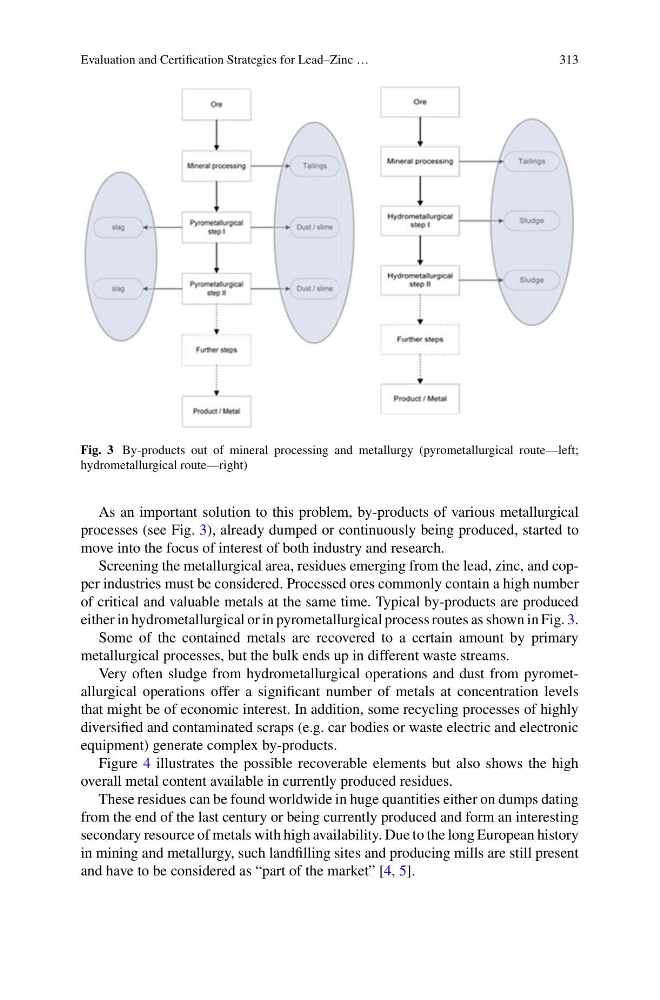
Fig. 3 By-products out of mineral processing and metallurgy (pyrometallurgical route—left;
hydrometallurgical route—right)
As an important solution to this problem, by-products of various metallurgical
processes (see Fig. 3), already dumped or continuously being produced, started to
move into the focus of interest of both industry and research.
Screening the metallurgical area, residues emerging from the lead, zinc, and copper industries must be considered. Processed ores commonly contain a high number
of critical and valuable metals at the same time. Typical by-products are produced
either in hydrometallurgical or in pyrometallurgical process routes as shown in Fig. 3.
Some of the contained metals are recovered to a certain amount by primary
metallurgical processes, but the bulk ends up in different waste streams.
Very often sludge from hydrometallurgical operations and dust from pyrometallurgical operations offer a significant number of metals at concentration levels
that might be of economic interest. In addition, some recycling processes of highly
diversified and contaminated scraps (e.g. car bodies or waste electric and electronic
equipment) generate complex by-products.
Figure 4 illustrates the possible recoverable elements but also shows the high
overall metal content available in currently produced residues.
These residues can be found worldwide in huge quantities either on dumps dating
from the end of the last century or being currently produced and form an interesting
secondary resource of metals with high availability. Due to the long European history
in mining and metallurgy, such landfilling sites and producing mills are still present
and have to be considered as “part of the market” [4, 5].
313
Fig. 3 By-products out of mineral processing and metallurgy (pyrometallurgical route—left;
hydrometallurgical route—right)
As an important solution to this problem, by-products of various metallurgical
processes (see Fig. 3), already dumped or continuously being produced, started to
move into the focus of interest of both industry and research.
Screening the metallurgical area, residues emerging from the lead, zinc, and copper industries must be considered. Processed ores commonly contain a high number
of critical and valuable metals at the same time. Typical by-products are produced
either in hydrometallurgical or in pyrometallurgical process routes as shown in Fig. 3.
Some of the contained metals are recovered to a certain amount by primary
metallurgical processes, but the bulk ends up in different waste streams.
Very often sludge from hydrometallurgical operations and dust from pyrometallurgical operations offer a significant number of metals at concentration levels
that might be of economic interest. In addition, some recycling processes of highly
diversified and contaminated scraps (e.g. car bodies or waste electric and electronic
equipment) generate complex by-products.
Figure 4 illustrates the possible recoverable elements but also shows the high
overall metal content available in currently produced residues.
These residues can be found worldwide in huge quantities either on dumps dating
from the end of the last century or being currently produced and form an interesting
secondary resource of metals with high availability. Due to the long European history
in mining and metallurgy, such landfilling sites and producing mills are still present
and have to be considered as “part of the market” [4, 5].