

Zinc Residue Fuming Process in Side-Submerged Combustion …
273
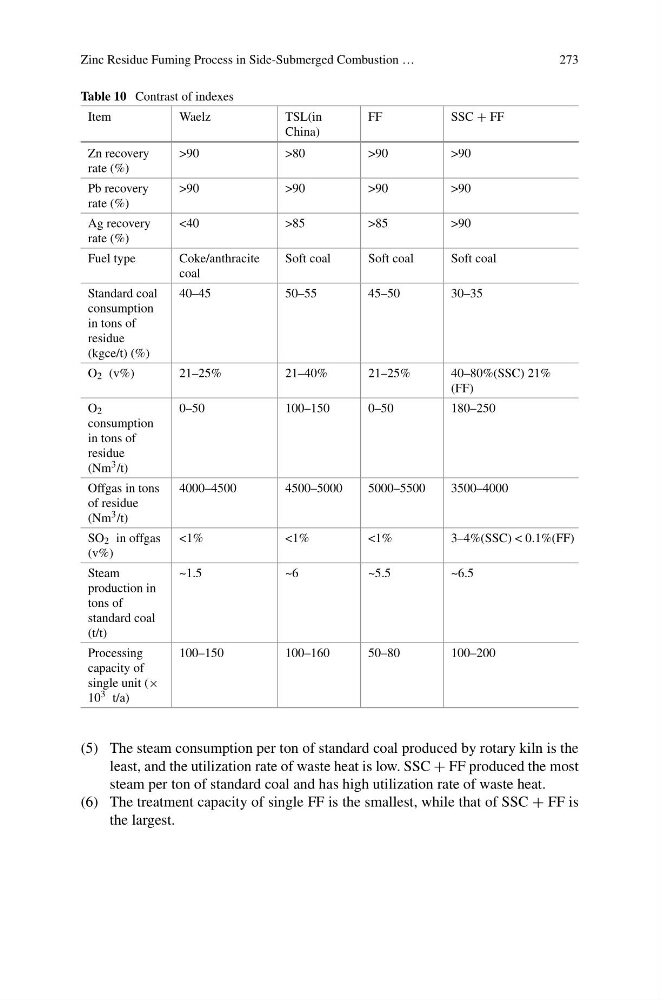
Table 10 Contrast of indexes
Item
Waelz
TSL(in
China)
FF
SSC + FF
Zn recovery
rate (%)
>90
>80
>90
>90
Pb recovery
rate (%)
>90
>90
>90
>90
Ag recovery
rate (%)
<40
>85
>85
>90
Fuel type
Coke/anthracite
coal
Soft coal
Soft coal
Soft coal
Standard coal
consumption
in tons of
residue
(kgce/t) (%)
40–45
50–55
45–50
30–35
O 2 (v%)
21–25%
21–40%
21–25%
40–80%(SSC) 21%
(FF)
O 2
consumption
in tons of
residue
(Nm 3 /t)
0–50
100–150
0–50
180–250
Offgas in tons
of residue
(Nm 3 /t)
4000–4500
4500–5000
5000–5500
3500–4000
SO 2 in offgas
(v%)
<1%
<1%
<1%
3–4%(SSC) < 0.1%(FF)
Steam
production in
tons of
standard coal
(t/t)
~1.5
~6
~5.5
~6.5
Processing
capacity of
single unit (×
10 3 t/a)
100–150
100–160
50–80
100–200
(5) The steam consumption per ton of standard coal produced by rotary kiln is the
least, and the utilization rate of waste heat is low. SSC + FF produced the most
steam per ton of standard coal and has high utilization rate of waste heat.
(6) The treatment capacity of single FF is the smallest, while that of SSC + FF is
the largest.
273
Table 10 Contrast of indexes
Item
Waelz
TSL(in
China)
FF
SSC + FF
Zn recovery
rate (%)
>90
>80
>90
>90
Pb recovery
rate (%)
>90
>90
>90
>90
Ag recovery
rate (%)
<40
>85
>85
>90
Fuel type
Coke/anthracite
coal
Soft coal
Soft coal
Soft coal
Standard coal
consumption
in tons of
residue
(kgce/t) (%)
40–45
50–55
45–50
30–35
O 2 (v%)
21–25%
21–40%
21–25%
40–80%(SSC) 21%
(FF)
O 2
consumption
in tons of
residue
(Nm 3 /t)
0–50
100–150
0–50
180–250
Offgas in tons
of residue
(Nm 3 /t)
4000–4500
4500–5000
5000–5500
3500–4000
SO 2 in offgas
(v%)
<1%
<1%
<1%
3–4%(SSC) < 0.1%(FF)
Steam
production in
tons of
standard coal
(t/t)
~1.5
~6
~5.5
~6.5
Processing
capacity of
single unit (×
10 3 t/a)
100–150
100–160
50–80
100–200
(5) The steam consumption per ton of standard coal produced by rotary kiln is the
least, and the utilization rate of waste heat is low. SSC + FF produced the most
steam per ton of standard coal and has high utilization rate of waste heat.
(6) The treatment capacity of single FF is the smallest, while that of SSC + FF is
the largest.