

272
L. Xu and S. Ma
Table 6 Slag
Element
Zn
Pb
Ag
Ge
wt%
1–2
0.05–0.2
0.001–0.002
0.001–0.002
Table 7 Dust
Element
Zn
Pb
Ag
Ge
wt%
55–65
3–8
0.004–0.006
0.01–0.02
Table 8 Volatilization rates
Element
Zn
Pb
Ag
Ge
%
90–95
90–95
45–55
75–85
Table 9 Recovery rate of various metals
Element
Zn
Pb
Ag
Ge
%
92–96
95–98
92–96
92–96
Summary
The current trial production results show that the system of SSC + FF system works
well.
The standard coal consumption per ton of zinc residues is ~310 kgce/t.
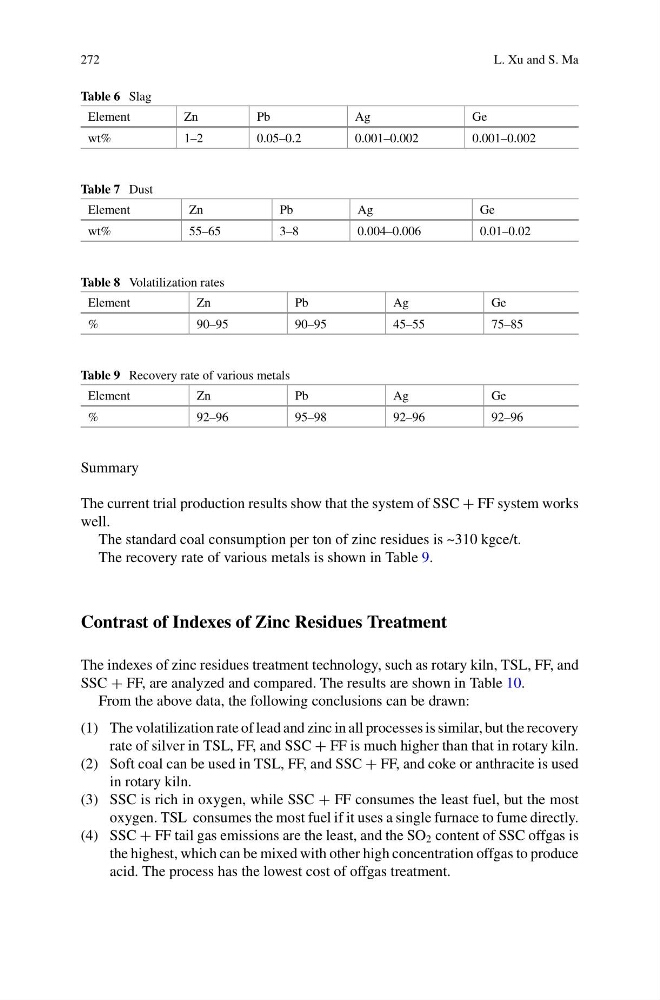
The recovery rate of various metals is shown in Table 9.
Contrast of Indexes of Zinc Residues Treatment
The indexes of zinc residues treatment technology, such as rotary kiln, TSL, FF, and
SSC + FF, are analyzed and compared. The results are shown in Table 10.
From the above data, the following conclusions can be drawn:
(1) The volatilization rate of lead and zinc in all processes is similar, but the recovery
rate of silver in TSL, FF, and SSC + FF is much higher than that in rotary kiln.
(2) Soft coal can be used in TSL, FF, and SSC + FF, and coke or anthracite is used
in rotary kiln.
(3) SSC is rich in oxygen, while SSC + FF consumes the least fuel, but the most
oxygen. TSL consumes the most fuel if it uses a single furnace to fume directly.
(4) SSC + FF tail gas emissions are the least, and the SO 2 content of SSC offgas is
the highest, which can be mixed with other high concentration offgas to produce
acid. The process has the lowest cost of offgas treatment.
L. Xu and S. Ma
Table 6 Slag
Element
Zn
Pb
Ag
Ge
wt%
1–2
0.05–0.2
0.001–0.002
0.001–0.002
Table 7 Dust
Element
Zn
Pb
Ag
Ge
wt%
55–65
3–8
0.004–0.006
0.01–0.02
Table 8 Volatilization rates
Element
Zn
Pb
Ag
Ge
%
90–95
90–95
45–55
75–85
Table 9 Recovery rate of various metals
Element
Zn
Pb
Ag
Ge
%
92–96
95–98
92–96
92–96
Summary
The current trial production results show that the system of SSC + FF system works
well.
The standard coal consumption per ton of zinc residues is ~310 kgce/t.
The recovery rate of various metals is shown in Table 9.
Contrast of Indexes of Zinc Residues Treatment
The indexes of zinc residues treatment technology, such as rotary kiln, TSL, FF, and
SSC + FF, are analyzed and compared. The results are shown in Table 10.
From the above data, the following conclusions can be drawn:
(1) The volatilization rate of lead and zinc in all processes is similar, but the recovery
rate of silver in TSL, FF, and SSC + FF is much higher than that in rotary kiln.
(2) Soft coal can be used in TSL, FF, and SSC + FF, and coke or anthracite is used
in rotary kiln.
(3) SSC is rich in oxygen, while SSC + FF consumes the least fuel, but the most
oxygen. TSL consumes the most fuel if it uses a single furnace to fume directly.
(4) SSC + FF tail gas emissions are the least, and the SO 2 content of SSC offgas is
the highest, which can be mixed with other high concentration offgas to produce
acid. The process has the lowest cost of offgas treatment.