

Recovery of Lead from Zinc Plant Residue by Alkaline Leaching …
257
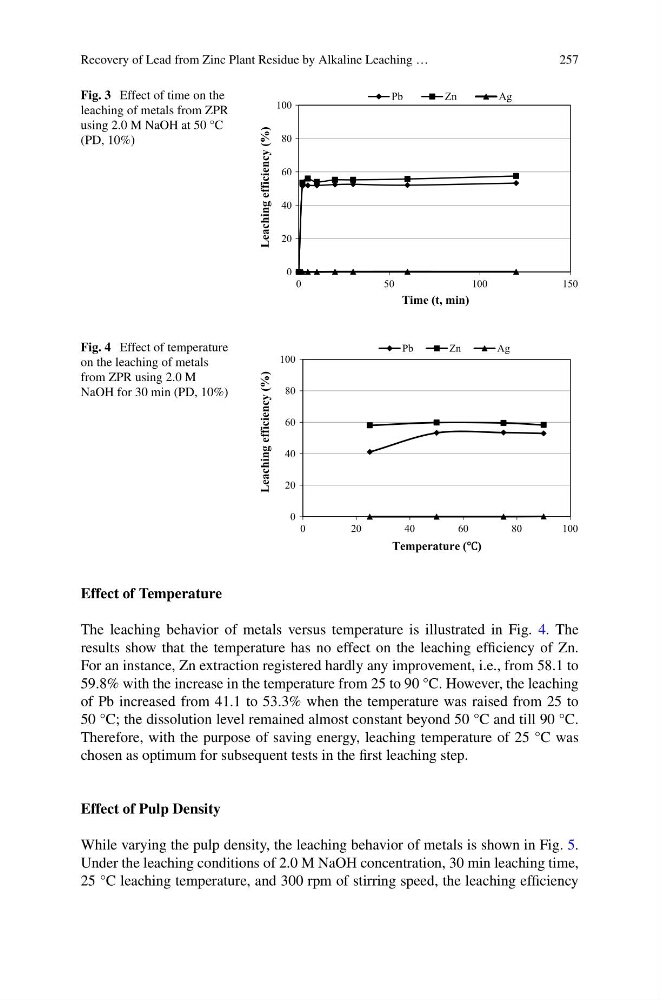
Fig. 3 Effect of time on the
leaching of metals from ZPR
using 2.0 M NaOH at 50 °C
(PD, 10%)
0
20
40
60
80
100
0
50
100
150
Leaching efficiency (%)
Time (t, min)
Pb
Zn
Ag
Fig. 4 Effect of temperature
on the leaching of metals
from ZPR using 2.0 M
NaOH for 30 min (PD, 10%)
0
20
40
60
80
100
0
2 0
4 0
6 0
8 0
1 0 0
Leaching efficiency (%)
Temperature ( )
Pb
Zn
Ag
Effect of Temperature
The leaching behavior of metals versus temperature is illustrated in Fig. 4. The
results show that the temperature has no effect on the leaching efficiency of Zn.
For an instance, Zn extraction registered hardly any improvement, i.e., from 58.1 to
59.8% with the increase in the temperature from 25 to 90 °C. However, the leaching
of Pb increased from 41.1 to 53.3% when the temperature was raised from 25 to
50 °C; the dissolution level remained almost constant beyond 50 °C and till 90 °C.
Therefore, with the purpose of saving energy, leaching temperature of 25 °C was
chosen as optimum for subsequent tests in the first leaching step.
Effect of Pulp Density
While varying the pulp density, the leaching behavior of metals is shown in Fig. 5.
Under the leaching conditions of 2.0 M NaOH concentration, 30 min leaching time,
25 °C leaching temperature, and 300 rpm of stirring speed, the leaching efficiency
257
Fig. 3 Effect of time on the
leaching of metals from ZPR
using 2.0 M NaOH at 50 °C
(PD, 10%)
0
20
40
60
80
100
0
50
100
150
Leaching efficiency (%)
Time (t, min)
Pb
Zn
Ag
Fig. 4 Effect of temperature
on the leaching of metals
from ZPR using 2.0 M
NaOH for 30 min (PD, 10%)
0
20
40
60
80
100
0
2 0
4 0
6 0
8 0
1 0 0
Leaching efficiency (%)
Temperature ( )
Pb
Zn
Ag
Effect of Temperature
The leaching behavior of metals versus temperature is illustrated in Fig. 4. The
results show that the temperature has no effect on the leaching efficiency of Zn.
For an instance, Zn extraction registered hardly any improvement, i.e., from 58.1 to
59.8% with the increase in the temperature from 25 to 90 °C. However, the leaching
of Pb increased from 41.1 to 53.3% when the temperature was raised from 25 to
50 °C; the dissolution level remained almost constant beyond 50 °C and till 90 °C.
Therefore, with the purpose of saving energy, leaching temperature of 25 °C was
chosen as optimum for subsequent tests in the first leaching step.
Effect of Pulp Density
While varying the pulp density, the leaching behavior of metals is shown in Fig. 5.
Under the leaching conditions of 2.0 M NaOH concentration, 30 min leaching time,
25 °C leaching temperature, and 300 rpm of stirring speed, the leaching efficiency