

256
J. Kim et al.
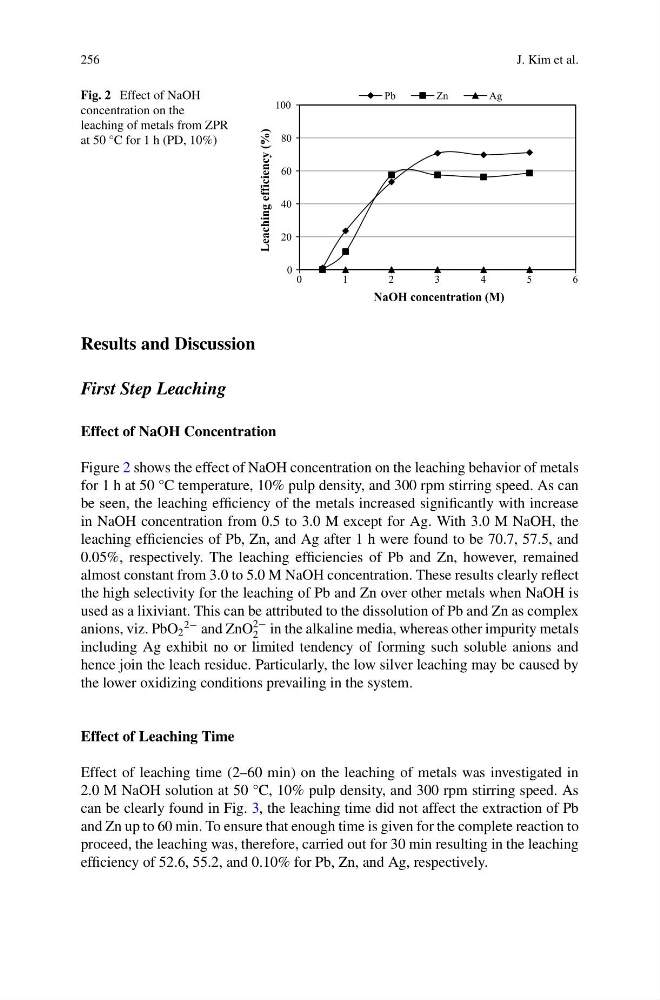
Fig. 2 Effect of NaOH
concentration on the
leaching of metals from ZPR
at 50 °C for 1 h (PD, 10%)
0
20
40
60
80
100
0
1
2
3
4
5
6
Leaching efficiency (%)
NaOH concentration (M)
Pb
Zn
Ag
Results and Discussion
First Step Leaching
Effect of NaOH Concentration
Figure 2 shows the effect of NaOH concentration on the leaching behavior of metals
for 1 h at 50 °C temperature, 10% pulp density, and 300 rpm stirring speed. As can
be seen, the leaching efficiency of the metals increased significantly with increase
in NaOH concentration from 0.5 to 3.0 M except for Ag. With 3.0 M NaOH, the
leaching efficiencies of Pb, Zn, and Ag after 1 h were found to be 70.7, 57.5, and
0.05%, respectively. The leaching efficiencies of Pb and Zn, however, remained
almost constant from 3.0 to 5.0 M NaOH concentration. These results clearly reflect
the high selectivity for the leaching of Pb and Zn over other metals when NaOH is
used as a lixiviant. This can be attributed to the dissolution of Pb and Zn as complex
anions, viz. PbO 2
2− and ZnO
2−
2 in the alkaline media, whereas other impurity metals
including Ag exhibit no or limited tendency of forming such soluble anions and
hence join the leach residue. Particularly, the low silver leaching may be caused by
the lower oxidizing conditions prevailing in the system.
Effect of Leaching Time
Effect of leaching time (2–60 min) on the leaching of metals was investigated in
2.0 M NaOH solution at 50 °C, 10% pulp density, and 300 rpm stirring speed. As
can be clearly found in Fig. 3, the leaching time did not affect the extraction of Pb
and Zn up to 60 min. To ensure that enough time is given for the complete reaction to
proceed, the leaching was, therefore, carried out for 30 min resulting in the leaching
efficiency of 52.6, 55.2, and 0.10% for Pb, Zn, and Ag, respectively.
J. Kim et al.
Fig. 2 Effect of NaOH
concentration on the
leaching of metals from ZPR
at 50 °C for 1 h (PD, 10%)
0
20
40
60
80
100
0
1
2
3
4
5
6
Leaching efficiency (%)
NaOH concentration (M)
Pb
Zn
Ag
Results and Discussion
First Step Leaching
Effect of NaOH Concentration
Figure 2 shows the effect of NaOH concentration on the leaching behavior of metals
for 1 h at 50 °C temperature, 10% pulp density, and 300 rpm stirring speed. As can
be seen, the leaching efficiency of the metals increased significantly with increase
in NaOH concentration from 0.5 to 3.0 M except for Ag. With 3.0 M NaOH, the
leaching efficiencies of Pb, Zn, and Ag after 1 h were found to be 70.7, 57.5, and
0.05%, respectively. The leaching efficiencies of Pb and Zn, however, remained
almost constant from 3.0 to 5.0 M NaOH concentration. These results clearly reflect
the high selectivity for the leaching of Pb and Zn over other metals when NaOH is
used as a lixiviant. This can be attributed to the dissolution of Pb and Zn as complex
anions, viz. PbO 2
2− and ZnO
2−
2 in the alkaline media, whereas other impurity metals
including Ag exhibit no or limited tendency of forming such soluble anions and
hence join the leach residue. Particularly, the low silver leaching may be caused by
the lower oxidizing conditions prevailing in the system.
Effect of Leaching Time
Effect of leaching time (2–60 min) on the leaching of metals was investigated in
2.0 M NaOH solution at 50 °C, 10% pulp density, and 300 rpm stirring speed. As
can be clearly found in Fig. 3, the leaching time did not affect the extraction of Pb
and Zn up to 60 min. To ensure that enough time is given for the complete reaction to
proceed, the leaching was, therefore, carried out for 30 min resulting in the leaching
efficiency of 52.6, 55.2, and 0.10% for Pb, Zn, and Ag, respectively.