

250
M. J. Dias et al.
Table 1 Chemical characterization of the silicate cake
Element
Content (%)
Zn
40.67
S i O 2
17.69
Mg
1.30
Ca
3.64
Fe
4.10
of about 97.63% could get up to 98.47%. The amount of silicate cake tested to neutralize the necessary amount of acid followed a ratio of 1.41 kg dry mass/kg H 2 SO 4 .
The mean chemical characterization of the silicate cake is described in Table 1.
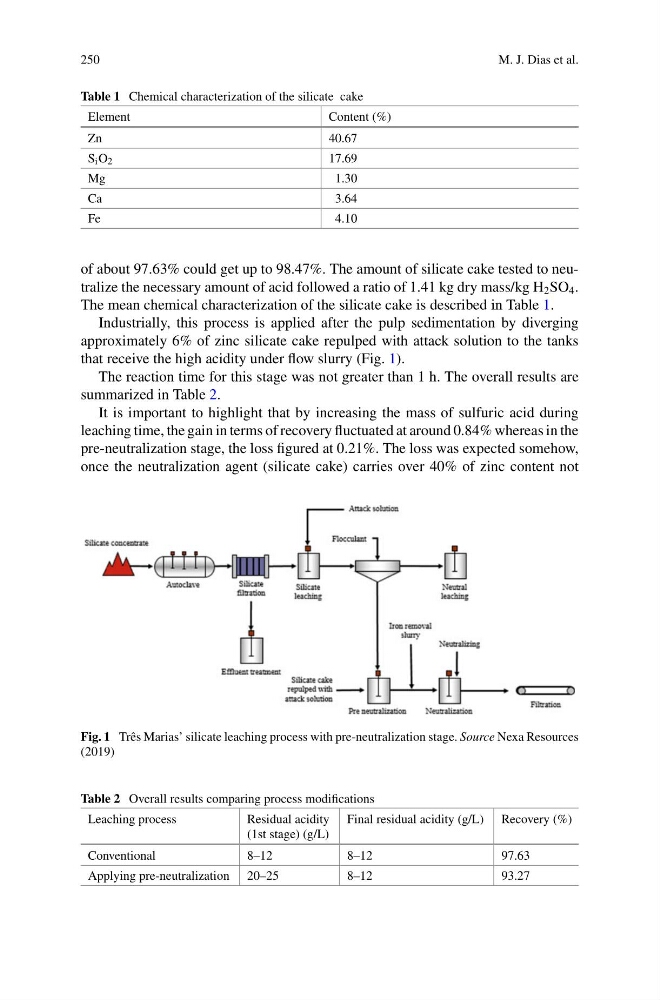
Industrially, this process is applied after the pulp sedimentation by diverging
approximately 6% of zinc silicate cake repulped with attack solution to the tanks
that receive the high acidity under flow slurry (Fig. 1).
The reaction time for this stage was not greater than 1 h. The overall results are
summarized in Table 2.
It is important to highlight that by increasing the mass of sulfuric acid during
leaching time, the gain in terms of recovery fluctuated at around 0.84% whereas in the
pre-neutralization stage, the loss figured at 0.21%. The loss was expected somehow,
once the neutralization agent (silicate cake) carries over 40% of zinc content not
Fig. 1 Três Marias’ silicate leaching process with pre-neutralization stage. Source Nexa Resources
(2019)
Table 2 Overall results comparing process modifications
Leaching process
Residual acidity
(1st stage) (g/L)
Final residual acidity (g/L) Recovery (%)
Conventional
8–12
8–12
97.63
Applying pre-neutralization 20–25
8–12
93.27
M. J. Dias et al.
Table 1 Chemical characterization of the silicate cake
Element
Content (%)
Zn
40.67
S i O 2
17.69
Mg
1.30
Ca
3.64
Fe
4.10
of about 97.63% could get up to 98.47%. The amount of silicate cake tested to neutralize the necessary amount of acid followed a ratio of 1.41 kg dry mass/kg H 2 SO 4 .
The mean chemical characterization of the silicate cake is described in Table 1.
Industrially, this process is applied after the pulp sedimentation by diverging
approximately 6% of zinc silicate cake repulped with attack solution to the tanks
that receive the high acidity under flow slurry (Fig. 1).
The reaction time for this stage was not greater than 1 h. The overall results are
summarized in Table 2.
It is important to highlight that by increasing the mass of sulfuric acid during
leaching time, the gain in terms of recovery fluctuated at around 0.84% whereas in the
pre-neutralization stage, the loss figured at 0.21%. The loss was expected somehow,
once the neutralization agent (silicate cake) carries over 40% of zinc content not
Fig. 1 Três Marias’ silicate leaching process with pre-neutralization stage. Source Nexa Resources
(2019)
Table 2 Overall results comparing process modifications
Leaching process
Residual acidity
(1st stage) (g/L)
Final residual acidity (g/L) Recovery (%)
Conventional
8–12
8–12
97.63
Applying pre-neutralization 20–25
8–12
93.27