

Increase in Zinc Recovery from a Silicate Concentrate …
249
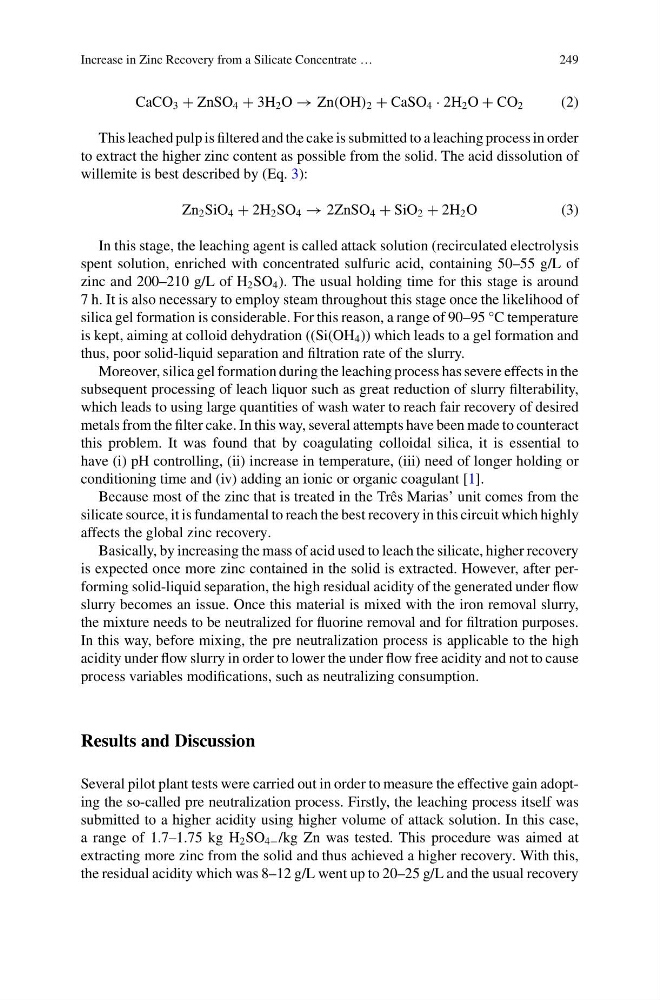
CaCO 3 + ZnSO 4 + 3H 2 O → Zn(OH) 2 + CaSO 4 · 2H 2 O + CO 2
(2)
This leached pulp is filtered and the cake is submitted to a leaching process in order
to extract the higher zinc content as possible from the solid. The acid dissolution of
willemite is best described by (Eq. 3):
Zn 2 SiO 4 + 2H 2 SO 4 → 2ZnSO 4 + SiO 2 + 2H 2 O
( 3 )
In this stage, the leaching agent is called attack solution (recirculated electrolysis
spent solution, enriched with concentrated sulfuric acid, containing 50–55 g/L of
zinc and 200–210 g/L of H 2 SO 4 ). The usual holding time for this stage is around
7 h. It is also necessary to employ steam throughout this stage once the likelihood of
silica gel formation is considerable. For this reason, a range of 90–95 °C temperature
is kept, aiming at colloid dehydration ((Si(OH 4 )) which leads to a gel formation and
thus, poor solid-liquid separation and filtration rate of the slurry.
Moreover, silica gel formation during the leaching process has severe effects in the
subsequent processing of leach liquor such as great reduction of slurry filterability,
which leads to using large quantities of wash water to reach fair recovery of desired
metals from the filter cake. In this way, several attempts have been made to counteract
this problem. It was found that by coagulating colloidal silica, it is essential to
have (i) pH controlling, (ii) increase in temperature, (iii) need of longer holding or
conditioning time and (iv) adding an ionic or organic coagulant [1].
Because most of the zinc that is treated in the Três Marias’ unit comes from the
silicate source, it is fundamental to reach the best recovery in this circuit which highly
affects the global zinc recovery.
Basically, by increasing the mass of acid used to leach the silicate, higher recovery
is expected once more zinc contained in the solid is extracted. However, after performing solid-liquid separation, the high residual acidity of the generated under flow
slurry becomes an issue. Once this material is mixed with the iron removal slurry,
the mixture needs to be neutralized for fluorine removal and for filtration purposes.
In this way, before mixing, the pre neutralization process is applicable to the high
acidity under flow slurry in order to lower the under flow free acidity and not to cause
process variables modifications, such as neutralizing consumption.
Results and Discussion
Several pilot plant tests were carried out in order to measure the effective gain adopting the so-called pre neutralization process. Firstly, the leaching process itself was
submitted to a higher acidity using higher volume of attack solution. In this case,
a range of 1.7–1.75 kg H 2 SO 4− /kg Zn was tested. This procedure was aimed at
extracting more zinc from the solid and thus achieved a higher recovery. With this,
the residual acidity which was 8–12 g/L went up to 20–25 g/L and the usual recovery
249
CaCO 3 + ZnSO 4 + 3H 2 O → Zn(OH) 2 + CaSO 4 · 2H 2 O + CO 2
(2)
This leached pulp is filtered and the cake is submitted to a leaching process in order
to extract the higher zinc content as possible from the solid. The acid dissolution of
willemite is best described by (Eq. 3):
Zn 2 SiO 4 + 2H 2 SO 4 → 2ZnSO 4 + SiO 2 + 2H 2 O
( 3 )
In this stage, the leaching agent is called attack solution (recirculated electrolysis
spent solution, enriched with concentrated sulfuric acid, containing 50–55 g/L of
zinc and 200–210 g/L of H 2 SO 4 ). The usual holding time for this stage is around
7 h. It is also necessary to employ steam throughout this stage once the likelihood of
silica gel formation is considerable. For this reason, a range of 90–95 °C temperature
is kept, aiming at colloid dehydration ((Si(OH 4 )) which leads to a gel formation and
thus, poor solid-liquid separation and filtration rate of the slurry.
Moreover, silica gel formation during the leaching process has severe effects in the
subsequent processing of leach liquor such as great reduction of slurry filterability,
which leads to using large quantities of wash water to reach fair recovery of desired
metals from the filter cake. In this way, several attempts have been made to counteract
this problem. It was found that by coagulating colloidal silica, it is essential to
have (i) pH controlling, (ii) increase in temperature, (iii) need of longer holding or
conditioning time and (iv) adding an ionic or organic coagulant [1].
Because most of the zinc that is treated in the Três Marias’ unit comes from the
silicate source, it is fundamental to reach the best recovery in this circuit which highly
affects the global zinc recovery.
Basically, by increasing the mass of acid used to leach the silicate, higher recovery
is expected once more zinc contained in the solid is extracted. However, after performing solid-liquid separation, the high residual acidity of the generated under flow
slurry becomes an issue. Once this material is mixed with the iron removal slurry,
the mixture needs to be neutralized for fluorine removal and for filtration purposes.
In this way, before mixing, the pre neutralization process is applicable to the high
acidity under flow slurry in order to lower the under flow free acidity and not to cause
process variables modifications, such as neutralizing consumption.
Results and Discussion
Several pilot plant tests were carried out in order to measure the effective gain adopting the so-called pre neutralization process. Firstly, the leaching process itself was
submitted to a higher acidity using higher volume of attack solution. In this case,
a range of 1.7–1.75 kg H 2 SO 4− /kg Zn was tested. This procedure was aimed at
extracting more zinc from the solid and thus achieved a higher recovery. With this,
the residual acidity which was 8–12 g/L went up to 20–25 g/L and the usual recovery