

A Dynamic Model of a Submerged Plasma Slag Fuming Process
239
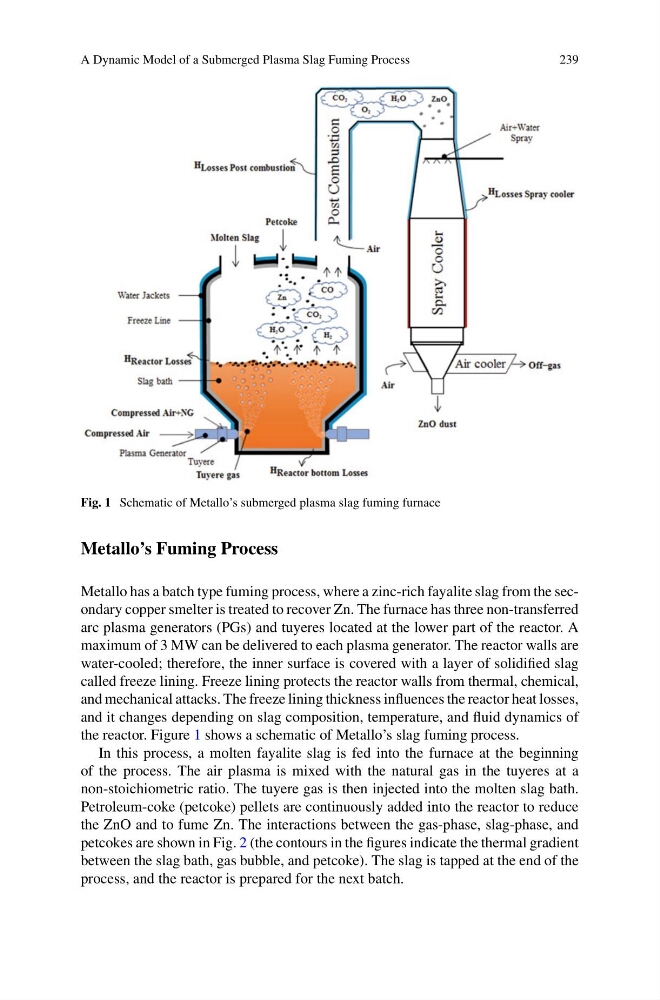
Fig. 1 Schematic of Metallo’s submerged plasma slag fuming furnace
Metallo’s Fuming Process
Metallo has a batch type fuming process, where a zinc-rich fayalite slag from the secondary copper smelter is treated to recover Zn. The furnace has three non-transferred
arc plasma generators (PGs) and tuyeres located at the lower part of the reactor. A
maximum of 3 MW can be delivered to each plasma generator. The reactor walls are
water-cooled; therefore, the inner surface is covered with a layer of solidified slag
called freeze lining. Freeze lining protects the reactor walls from thermal, chemical,
and mechanical attacks. The freeze lining thickness influences the reactor heat losses,
and it changes depending on slag composition, temperature, and fluid dynamics of
the reactor. Figure 1 shows a schematic of Metallo’s slag fuming process.
In this process, a molten fayalite slag is fed into the furnace at the beginning
of the process. The air plasma is mixed with the natural gas in the tuyeres at a
non-stoichiometric ratio. The tuyere gas is then injected into the molten slag bath.
Petroleum-coke (petcoke) pellets are continuously added into the reactor to reduce
the ZnO and to fume Zn. The interactions between the gas-phase, slag-phase, and
petcokes are shown in Fig. 2 (the contours in the figures indicate the thermal gradient
between the slag bath, gas bubble, and petcoke). The slag is tapped at the end of the
process, and the reactor is prepared for the next batch.
239
Fig. 1 Schematic of Metallo’s submerged plasma slag fuming furnace
Metallo’s Fuming Process
Metallo has a batch type fuming process, where a zinc-rich fayalite slag from the secondary copper smelter is treated to recover Zn. The furnace has three non-transferred
arc plasma generators (PGs) and tuyeres located at the lower part of the reactor. A
maximum of 3 MW can be delivered to each plasma generator. The reactor walls are
water-cooled; therefore, the inner surface is covered with a layer of solidified slag
called freeze lining. Freeze lining protects the reactor walls from thermal, chemical,
and mechanical attacks. The freeze lining thickness influences the reactor heat losses,
and it changes depending on slag composition, temperature, and fluid dynamics of
the reactor. Figure 1 shows a schematic of Metallo’s slag fuming process.
In this process, a molten fayalite slag is fed into the furnace at the beginning
of the process. The air plasma is mixed with the natural gas in the tuyeres at a
non-stoichiometric ratio. The tuyere gas is then injected into the molten slag bath.
Petroleum-coke (petcoke) pellets are continuously added into the reactor to reduce
the ZnO and to fume Zn. The interactions between the gas-phase, slag-phase, and
petcokes are shown in Fig. 2 (the contours in the figures indicate the thermal gradient
between the slag bath, gas bubble, and petcoke). The slag is tapped at the end of the
process, and the reactor is prepared for the next batch.