

198
P. Weber et al.
Calculation of thermal and chemical equilibrium is carried out for each zone
individually. Due to the heat and mass transfer between the zones and adaptive
boundary conditions such as heat transfer to cooling water, these calculations were
carried out iteratively.
Because the SBF process is a batch process, the model had to refine further by
dividing the batch into linked phases. The aforementioned iterative approach was
carried out for each process phase in succession, while the products were used as
initial material for each subsequent phase. After several iterations of the whole cycle,
the system reached steady state. From this steady state, output data were generated
which includes:
• Mass of products and intermediates
• Compositions of products and intermediates
• Enthalpy of products and intermediates
• Energy Fluxes
• Temperatures
• Elements distributions.
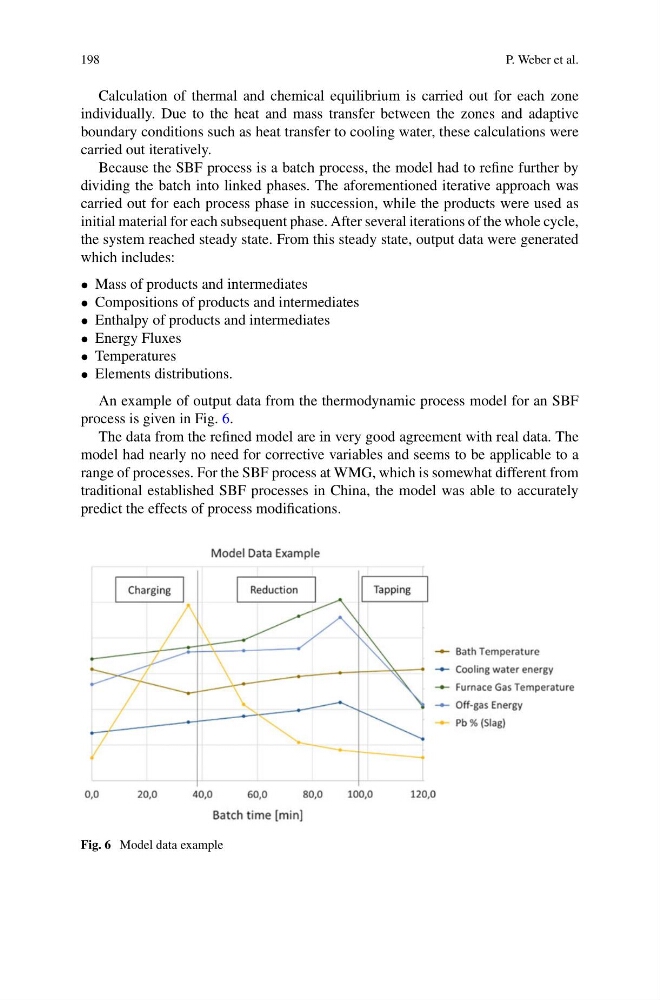
An example of output data from the thermodynamic process model for an SBF
process is given in Fig. 6.
The data from the refined model are in very good agreement with real data. The
model had nearly no need for corrective variables and seems to be applicable to a
range of processes. For the SBF process at WMG, which is somewhat different from
traditional established SBF processes in China, the model was able to accurately
predict the effects of process modifications.
Fig. 6 Model data example
P. Weber et al.
Calculation of thermal and chemical equilibrium is carried out for each zone
individually. Due to the heat and mass transfer between the zones and adaptive
boundary conditions such as heat transfer to cooling water, these calculations were
carried out iteratively.
Because the SBF process is a batch process, the model had to refine further by
dividing the batch into linked phases. The aforementioned iterative approach was
carried out for each process phase in succession, while the products were used as
initial material for each subsequent phase. After several iterations of the whole cycle,
the system reached steady state. From this steady state, output data were generated
which includes:
• Mass of products and intermediates
• Compositions of products and intermediates
• Enthalpy of products and intermediates
• Energy Fluxes
• Temperatures
• Elements distributions.
An example of output data from the thermodynamic process model for an SBF
process is given in Fig. 6.
The data from the refined model are in very good agreement with real data. The
model had nearly no need for corrective variables and seems to be applicable to a
range of processes. For the SBF process at WMG, which is somewhat different from
traditional established SBF processes in China, the model was able to accurately
predict the effects of process modifications.
Fig. 6 Model data example