

114
M. Moats and T. Hymer
Resistance
The resistance overpotential is created on a macroscale by electrode misalign and on
the microscale by a rough surface, porous surface, or a surface film. This can cause a
re-direction of current flow to paths of less resistance or an increase in overpotential.
Hence, resistance overpotential may be related to the adsorption of gelatin molecules
on zinc surfaces, or misalignment of electrode leading to preferred plating at edges.
Zinc Electrodeposition Versus Hydrogen Evolution
Since polarization is at least a five component value, deciding which components
are involved in a single measured overpotential value is where difficulties arise.
Polarization is further complicated in zinc electrowinning because there are two
competing reduction reactions— zinc electrodeposition and hydrogen reduction. The
hydrogen reduction reaction has its own set of polarization values.
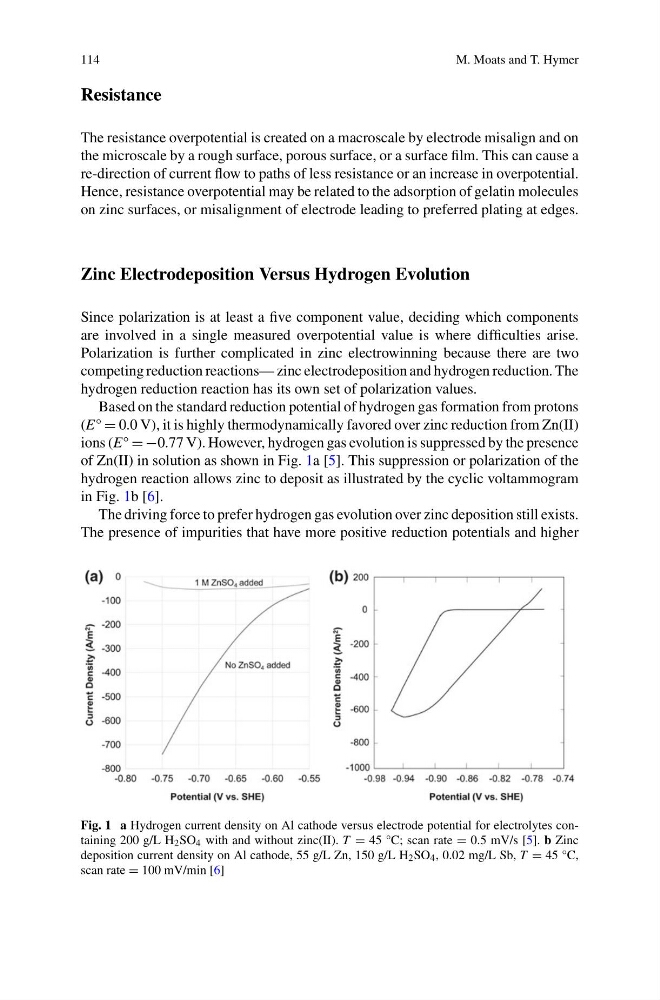
Based on the standard reduction potential of hydrogen gas formation from protons
(E° = 0.0 V), it is highly thermodynamically favored over zinc reduction from Zn(II)
ions (E° = −0.77 V). However, hydrogen gas evolution is suppressed by the presence
of Zn(II) in solution as shown in Fig. 1a [5]. This suppression or polarization of the
hydrogen reaction allows zinc to deposit as illustrated by the cyclic voltammogram
in Fig. 1b [6].
The driving force to prefer hydrogen gas evolution over zinc deposition still exists.
The presence of impurities that have more positive reduction potentials and higher
Fig. 1 a Hydrogen current density on Al cathode versus electrode potential for electrolytes containing 200 g/L H 2 SO 4 with and without zinc(II). T = 45 °C; scan rate = 0.5 mV/s [5]. b Zinc
deposition current density on Al cathode, 55 g/L Zn, 150 g/L H 2 SO 4 , 0.02 mg/L Sb, T = 45 °C,
scan rate = 100 mV/min [6]
M. Moats and T. Hymer
Resistance
The resistance overpotential is created on a macroscale by electrode misalign and on
the microscale by a rough surface, porous surface, or a surface film. This can cause a
re-direction of current flow to paths of less resistance or an increase in overpotential.
Hence, resistance overpotential may be related to the adsorption of gelatin molecules
on zinc surfaces, or misalignment of electrode leading to preferred plating at edges.
Zinc Electrodeposition Versus Hydrogen Evolution
Since polarization is at least a five component value, deciding which components
are involved in a single measured overpotential value is where difficulties arise.
Polarization is further complicated in zinc electrowinning because there are two
competing reduction reactions— zinc electrodeposition and hydrogen reduction. The
hydrogen reduction reaction has its own set of polarization values.
Based on the standard reduction potential of hydrogen gas formation from protons
(E° = 0.0 V), it is highly thermodynamically favored over zinc reduction from Zn(II)
ions (E° = −0.77 V). However, hydrogen gas evolution is suppressed by the presence
of Zn(II) in solution as shown in Fig. 1a [5]. This suppression or polarization of the
hydrogen reaction allows zinc to deposit as illustrated by the cyclic voltammogram
in Fig. 1b [6].
The driving force to prefer hydrogen gas evolution over zinc deposition still exists.
The presence of impurities that have more positive reduction potentials and higher
Fig. 1 a Hydrogen current density on Al cathode versus electrode potential for electrolytes containing 200 g/L H 2 SO 4 with and without zinc(II). T = 45 °C; scan rate = 0.5 mV/s [5]. b Zinc
deposition current density on Al cathode, 55 g/L Zn, 150 g/L H 2 SO 4 , 0.02 mg/L Sb, T = 45 °C,
scan rate = 100 mV/min [6]