

94
S. Takaya et al.
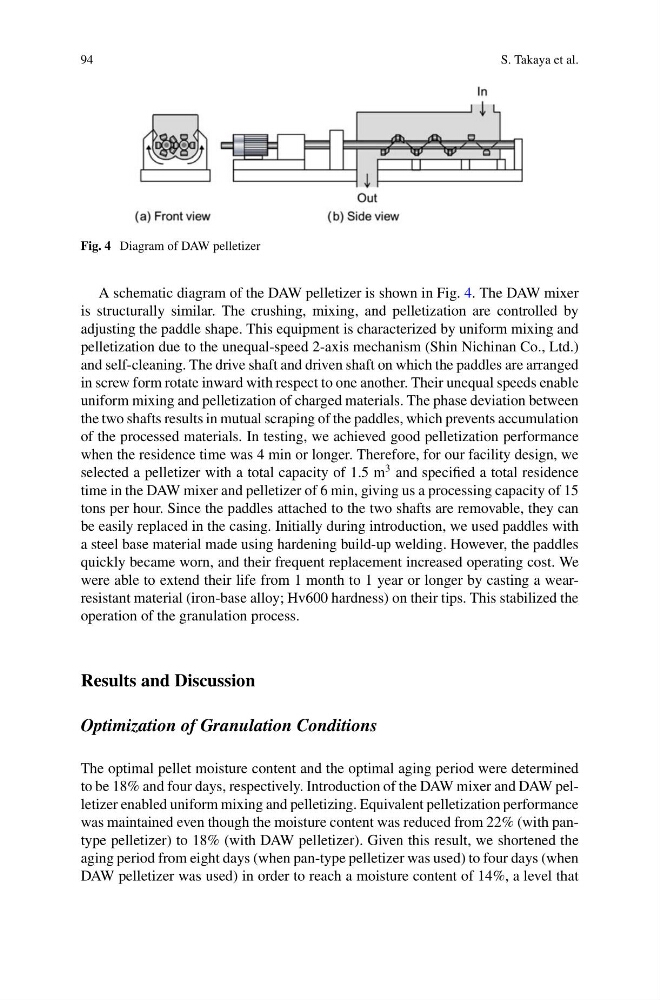
Fig. 4 Diagram of DAW pelletizer
A schematic diagram of the DAW pelletizer is shown in Fig. 4. The DAW mixer
is structurally similar. The crushing, mixing, and pelletization are controlled by
adjusting the paddle shape. This equipment is characterized by uniform mixing and
pelletization due to the unequal-speed 2-axis mechanism (Shin Nichinan Co., Ltd.)
and self-cleaning. The drive shaft and driven shaft on which the paddles are arranged
in screw form rotate inward with respect to one another. Their unequal speeds enable
uniform mixing and pelletization of charged materials. The phase deviation between
the two shafts results in mutual scraping of the paddles, which prevents accumulation
of the processed materials. In testing, we achieved good pelletization performance
when the residence time was 4 min or longer. Therefore, for our facility design, we
selected a pelletizer with a total capacity of 1.5 m
3 and specified a total residence
time in the DAW mixer and pelletizer of 6 min, giving us a processing capacity of 15
tons per hour. Since the paddles attached to the two shafts are removable, they can
be easily replaced in the casing. Initially during introduction, we used paddles with
a steel base material made using hardening build-up welding. However, the paddles
quickly became worn, and their frequent replacement increased operating cost. We
were able to extend their life from 1 month to 1 year or longer by casting a wearresistant material (iron-base alloy; Hv600 hardness) on their tips. This stabilized the
operation of the granulation process.
Results and Discussion
Optimization of Granulation Conditions
The optimal pellet moisture content and the optimal aging period were determined
to be 18% and four days, respectively. Introduction of the DAW mixer and DAW pelletizer enabled uniform mixing and pelletizing. Equivalent pelletization performance
was maintained even though the moisture content was reduced from 22% (with pantype pelletizer) to 18% (with DAW pelletizer). Given this result, we shortened the
aging period from eight days (when pan-type pelletizer was used) to four days (when
DAW pelletizer was used) in order to reach a moisture content of 14%, a level that
S. Takaya et al.
Fig. 4 Diagram of DAW pelletizer
A schematic diagram of the DAW pelletizer is shown in Fig. 4. The DAW mixer
is structurally similar. The crushing, mixing, and pelletization are controlled by
adjusting the paddle shape. This equipment is characterized by uniform mixing and
pelletization due to the unequal-speed 2-axis mechanism (Shin Nichinan Co., Ltd.)
and self-cleaning. The drive shaft and driven shaft on which the paddles are arranged
in screw form rotate inward with respect to one another. Their unequal speeds enable
uniform mixing and pelletization of charged materials. The phase deviation between
the two shafts results in mutual scraping of the paddles, which prevents accumulation
of the processed materials. In testing, we achieved good pelletization performance
when the residence time was 4 min or longer. Therefore, for our facility design, we
selected a pelletizer with a total capacity of 1.5 m
3 and specified a total residence
time in the DAW mixer and pelletizer of 6 min, giving us a processing capacity of 15
tons per hour. Since the paddles attached to the two shafts are removable, they can
be easily replaced in the casing. Initially during introduction, we used paddles with
a steel base material made using hardening build-up welding. However, the paddles
quickly became worn, and their frequent replacement increased operating cost. We
were able to extend their life from 1 month to 1 year or longer by casting a wearresistant material (iron-base alloy; Hv600 hardness) on their tips. This stabilized the
operation of the granulation process.
Results and Discussion
Optimization of Granulation Conditions
The optimal pellet moisture content and the optimal aging period were determined
to be 18% and four days, respectively. Introduction of the DAW mixer and DAW pelletizer enabled uniform mixing and pelletizing. Equivalent pelletization performance
was maintained even though the moisture content was reduced from 22% (with pantype pelletizer) to 18% (with DAW pelletizer). Given this result, we shortened the
aging period from eight days (when pan-type pelletizer was used) to four days (when
DAW pelletizer was used) in order to reach a moisture content of 14%, a level that