

Recent Development of EAF Dust Treating at Shisaka Smelting …
93
in the reduction roasting process. As a result, the zinc loss in the clinker increased
when EAF dust with a high concentration of zinc was treated, so the treatment of
high-zinc EAF dust was inefficient for a long time.
To increase the zinc recovery rate, we introduced a commonly used pan-type
pelletizer off-line in 2008. However, the moisture content of pellets is high with this
type of pelletizer, so the pellets had to be aged for a long time in the storage yard.
The amount of granulation was thus limited to about 2000 tons per month due to the
limited capacity of the storage yard. In addition, it was difficult to crush the EAF
dust particles and uniformly mix them with a reducing agent, so we were unable to
improve the zinc recovery rate. We thus considered introduction of a new granulation
process [1–3].
Methods
Introduction of New Granulation Process
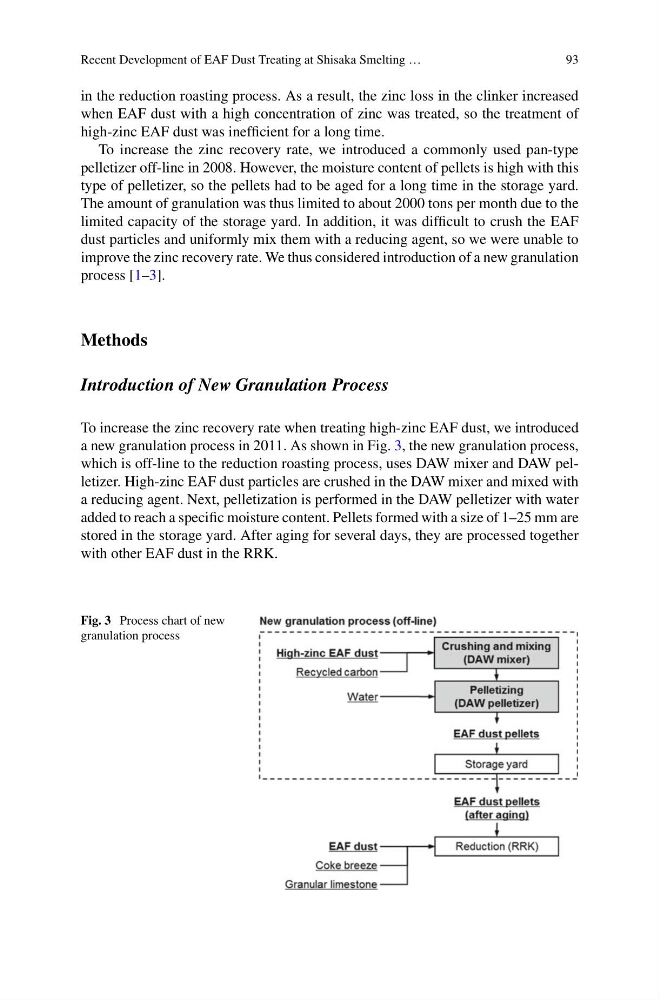
To increase the zinc recovery rate when treating high-zinc EAF dust, we introduced
a new granulation process in 2011. As shown in Fig. 3, the new granulation process,
which is off-line to the reduction roasting process, uses DAW mixer and DAW pelletizer. High-zinc EAF dust particles are crushed in the DAW mixer and mixed with
a reducing agent. Next, pelletization is performed in the DAW pelletizer with water
added to reach a specific moisture content. Pellets formed with a size of 1–25 mm are
stored in the storage yard. After aging for several days, they are processed together
with other EAF dust in the RRK.
Fig. 3 Process chart of new
granulation process
93
in the reduction roasting process. As a result, the zinc loss in the clinker increased
when EAF dust with a high concentration of zinc was treated, so the treatment of
high-zinc EAF dust was inefficient for a long time.
To increase the zinc recovery rate, we introduced a commonly used pan-type
pelletizer off-line in 2008. However, the moisture content of pellets is high with this
type of pelletizer, so the pellets had to be aged for a long time in the storage yard.
The amount of granulation was thus limited to about 2000 tons per month due to the
limited capacity of the storage yard. In addition, it was difficult to crush the EAF
dust particles and uniformly mix them with a reducing agent, so we were unable to
improve the zinc recovery rate. We thus considered introduction of a new granulation
process [1–3].
Methods
Introduction of New Granulation Process
To increase the zinc recovery rate when treating high-zinc EAF dust, we introduced
a new granulation process in 2011. As shown in Fig. 3, the new granulation process,
which is off-line to the reduction roasting process, uses DAW mixer and DAW pelletizer. High-zinc EAF dust particles are crushed in the DAW mixer and mixed with
a reducing agent. Next, pelletization is performed in the DAW pelletizer with water
added to reach a specific moisture content. Pellets formed with a size of 1–25 mm are
stored in the storage yard. After aging for several days, they are processed together
with other EAF dust in the RRK.
Fig. 3 Process chart of new
granulation process