

72
5 Mechanisms Involved in the Electrolytic Fabrication …
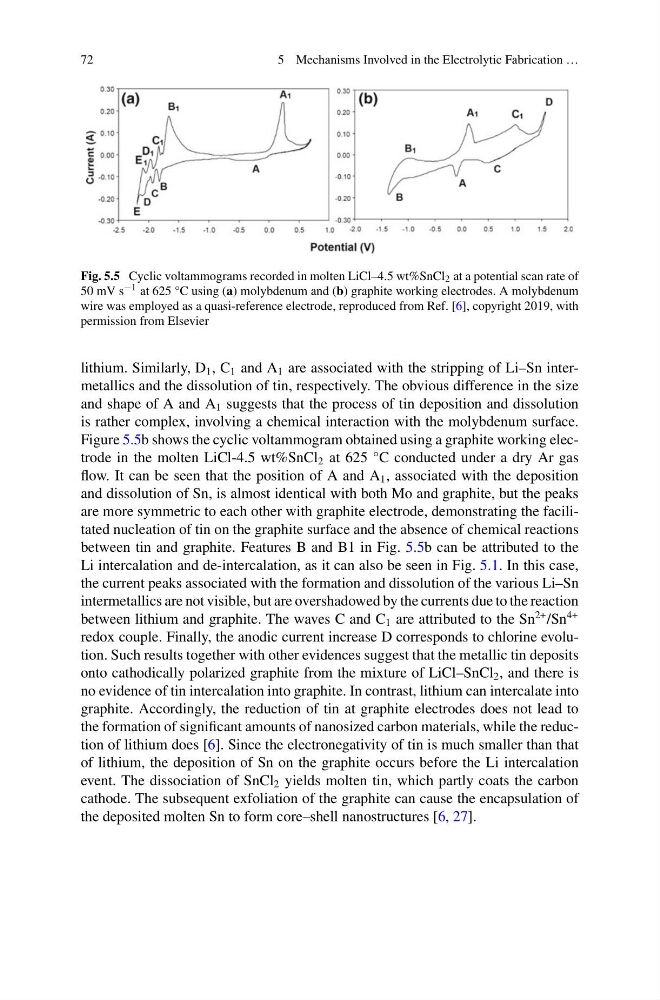
Fig. 5.5 Cyclic voltammograms recorded in molten LiCl–4.5 wt%SnCl 2 at a potential scan rate of
50 mV s −1 at 625 °C using (a) molybdenum and (b) graphite working electrodes. A molybdenum
wire was employed as a quasi-reference electrode, reproduced from Ref. [6], copyright 2019, with
permission from Elsevier
lithium. Similarly, D 1 , C 1 and A 1 are associated with the stripping of Li–Sn intermetallics and the dissolution of tin, respectively. The obvious difference in the size
and shape of A and A 1 suggests that the process of tin deposition and dissolution
is rather complex, involving a chemical interaction with the molybdenum surface.
Figure 5.5b shows the cyclic voltammogram obtained using a graphite working electrode in the molten LiCl-4.5 wt%SnCl 2 at 625 °C conducted under a dry Ar gas
flow. It can be seen that the position of A and A 1 , associated with the deposition
and dissolution of Sn, is almost identical with both Mo and graphite, but the peaks
are more symmetric to each other with graphite electrode, demonstrating the facilitated nucleation of tin on the graphite surface and the absence of chemical reactions
between tin and graphite. Features B and B1 in Fig. 5.5b can be attributed to the
Li intercalation and de-intercalation, as it can also be seen in Fig. 5.1. In this case,
the current peaks associated with the formation and dissolution of the various Li–Sn
intermetallics are not visible, but are overshadowed by the currents due to the reaction
between lithium and graphite. The waves C and C 1 are attributed to the Sn
2+ /Sn
4+
redox couple. Finally, the anodic current increase D corresponds to chlorine evolution. Such results together with other evidences suggest that the metallic tin deposits
onto cathodically polarized graphite from the mixture of LiCl–SnCl 2 , and there is
no evidence of tin intercalation into graphite. In contrast, lithium can intercalate into
graphite. Accordingly, the reduction of tin at graphite electrodes does not lead to
the formation of significant amounts of nanosized carbon materials, while the reduction of lithium does [6]. Since the electronegativity of tin is much smaller than that
of lithium, the deposition of Sn on the graphite occurs before the Li intercalation
event. The dissociation of SnCl 2 yields molten tin, which partly coats the carbon
cathode. The subsequent exfoliation of the graphite can cause the encapsulation of
the deposited molten Sn to form core–shell nanostructures [6, 27].
5 Mechanisms Involved in the Electrolytic Fabrication …
Fig. 5.5 Cyclic voltammograms recorded in molten LiCl–4.5 wt%SnCl 2 at a potential scan rate of
50 mV s −1 at 625 °C using (a) molybdenum and (b) graphite working electrodes. A molybdenum
wire was employed as a quasi-reference electrode, reproduced from Ref. [6], copyright 2019, with
permission from Elsevier
lithium. Similarly, D 1 , C 1 and A 1 are associated with the stripping of Li–Sn intermetallics and the dissolution of tin, respectively. The obvious difference in the size
and shape of A and A 1 suggests that the process of tin deposition and dissolution
is rather complex, involving a chemical interaction with the molybdenum surface.
Figure 5.5b shows the cyclic voltammogram obtained using a graphite working electrode in the molten LiCl-4.5 wt%SnCl 2 at 625 °C conducted under a dry Ar gas
flow. It can be seen that the position of A and A 1 , associated with the deposition
and dissolution of Sn, is almost identical with both Mo and graphite, but the peaks
are more symmetric to each other with graphite electrode, demonstrating the facilitated nucleation of tin on the graphite surface and the absence of chemical reactions
between tin and graphite. Features B and B1 in Fig. 5.5b can be attributed to the
Li intercalation and de-intercalation, as it can also be seen in Fig. 5.1. In this case,
the current peaks associated with the formation and dissolution of the various Li–Sn
intermetallics are not visible, but are overshadowed by the currents due to the reaction
between lithium and graphite. The waves C and C 1 are attributed to the Sn
2+ /Sn
4+
redox couple. Finally, the anodic current increase D corresponds to chlorine evolution. Such results together with other evidences suggest that the metallic tin deposits
onto cathodically polarized graphite from the mixture of LiCl–SnCl 2 , and there is
no evidence of tin intercalation into graphite. In contrast, lithium can intercalate into
graphite. Accordingly, the reduction of tin at graphite electrodes does not lead to
the formation of significant amounts of nanosized carbon materials, while the reduction of lithium does [6]. Since the electronegativity of tin is much smaller than that
of lithium, the deposition of Sn on the graphite occurs before the Li intercalation
event. The dissociation of SnCl 2 yields molten tin, which partly coats the carbon
cathode. The subsequent exfoliation of the graphite can cause the encapsulation of
the deposited molten Sn to form core–shell nanostructures [6, 27].