

68
5 Mechanisms Involved in the Electrolytic Fabrication …
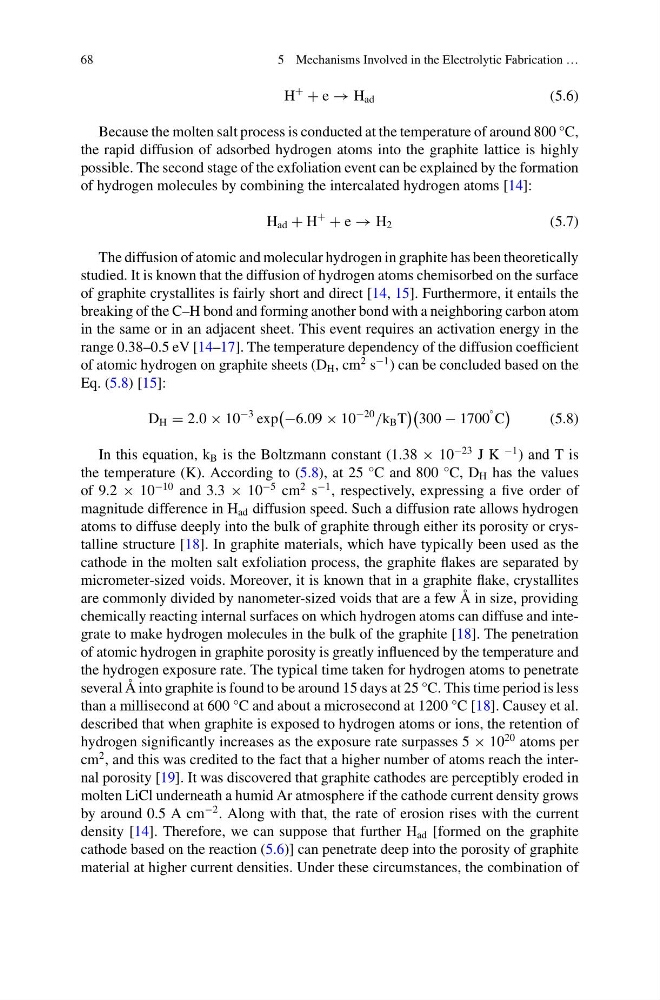
H
+
+ e → H ad
(5.6)
Because the molten salt process is conducted at the temperature of around 800 °C,
the rapid diffusion of adsorbed hydrogen atoms into the graphite lattice is highly
possible. The second stage of the exfoliation event can be explained by the formation
of hydrogen molecules by combining the intercalated hydrogen atoms [14]:
H ad + H
+
+ e → H 2
(5.7)
The diffusion of atomic and molecular hydrogen in graphite has been theoretically
studied. It is known that the diffusion of hydrogen atoms chemisorbed on the surface
of graphite crystallites is fairly short and direct [14, 15]. Furthermore, it entails the
breaking of the C–H bond and forming another bond with a neighboring carbon atom
in the same or in an adjacent sheet. This event requires an activation energy in the
range 0.38–0.5 eV [14–17]. The temperature dependency of the diffusion coefficient
of atomic hydrogen on graphite sheets (D H , cm
2 s
−1 ) can be concluded based on the
Eq. (5.8) [15]:
D H = 2.0 × 10
−3 exp
−6.09 × 10
−20
/k B T
300 − 1700
◦ C
(5.8)
In this equation, k B is the Boltzmann constant (1.38 × 10
−23 J K
−1 ) and T is
the temperature (K). According to (5.8), at 25 °C and 800 °C, D H has the values
of 9.2 × 10
−10 and 3.3 × 10
−5 cm
2 s
−1 , respectively, expressing a five order of
magnitude difference in H ad diffusion speed. Such a diffusion rate allows hydrogen
atoms to diffuse deeply into the bulk of graphite through either its porosity or crystalline structure [18]. In graphite materials, which have typically been used as the
cathode in the molten salt exfoliation process, the graphite flakes are separated by
micrometer-sized voids. Moreover, it is known that in a graphite flake, crystallites
are commonly divided by nanometer-sized voids that are a few Å in size, providing
chemically reacting internal surfaces on which hydrogen atoms can diffuse and integrate to make hydrogen molecules in the bulk of the graphite [18]. The penetration
of atomic hydrogen in graphite porosity is greatly influenced by the temperature and
the hydrogen exposure rate. The typical time taken for hydrogen atoms to penetrate
several Å into graphite is found to be around 15 days at 25 °C. This time period is less
than a millisecond at 600 °C and about a microsecond at 1200 °C [18]. Causey et al.
described that when graphite is exposed to hydrogen atoms or ions, the retention of
hydrogen significantly increases as the exposure rate surpasses 5 × 10
20 atoms per
cm
2 , and this was credited to the fact that a higher number of atoms reach the internal porosity [19]. It was discovered that graphite cathodes are perceptibly eroded in
molten LiCl underneath a humid Ar atmosphere if the cathode current density grows
by around 0.5 A cm
−2 . Along with that, the rate of erosion rises with the current
density [14]. Therefore, we can suppose that further H ad [formed on the graphite
cathode based on the reaction (5.6)] can penetrate deep into the porosity of graphite
material at higher current densities. Under these circumstances, the combination of
5 Mechanisms Involved in the Electrolytic Fabrication …
H
+
+ e → H ad
(5.6)
Because the molten salt process is conducted at the temperature of around 800 °C,
the rapid diffusion of adsorbed hydrogen atoms into the graphite lattice is highly
possible. The second stage of the exfoliation event can be explained by the formation
of hydrogen molecules by combining the intercalated hydrogen atoms [14]:
H ad + H
+
+ e → H 2
(5.7)
The diffusion of atomic and molecular hydrogen in graphite has been theoretically
studied. It is known that the diffusion of hydrogen atoms chemisorbed on the surface
of graphite crystallites is fairly short and direct [14, 15]. Furthermore, it entails the
breaking of the C–H bond and forming another bond with a neighboring carbon atom
in the same or in an adjacent sheet. This event requires an activation energy in the
range 0.38–0.5 eV [14–17]. The temperature dependency of the diffusion coefficient
of atomic hydrogen on graphite sheets (D H , cm
2 s
−1 ) can be concluded based on the
Eq. (5.8) [15]:
D H = 2.0 × 10
−3 exp
−6.09 × 10
−20
/k B T
300 − 1700
◦ C
(5.8)
In this equation, k B is the Boltzmann constant (1.38 × 10
−23 J K
−1 ) and T is
the temperature (K). According to (5.8), at 25 °C and 800 °C, D H has the values
of 9.2 × 10
−10 and 3.3 × 10
−5 cm
2 s
−1 , respectively, expressing a five order of
magnitude difference in H ad diffusion speed. Such a diffusion rate allows hydrogen
atoms to diffuse deeply into the bulk of graphite through either its porosity or crystalline structure [18]. In graphite materials, which have typically been used as the
cathode in the molten salt exfoliation process, the graphite flakes are separated by
micrometer-sized voids. Moreover, it is known that in a graphite flake, crystallites
are commonly divided by nanometer-sized voids that are a few Å in size, providing
chemically reacting internal surfaces on which hydrogen atoms can diffuse and integrate to make hydrogen molecules in the bulk of the graphite [18]. The penetration
of atomic hydrogen in graphite porosity is greatly influenced by the temperature and
the hydrogen exposure rate. The typical time taken for hydrogen atoms to penetrate
several Å into graphite is found to be around 15 days at 25 °C. This time period is less
than a millisecond at 600 °C and about a microsecond at 1200 °C [18]. Causey et al.
described that when graphite is exposed to hydrogen atoms or ions, the retention of
hydrogen significantly increases as the exposure rate surpasses 5 × 10
20 atoms per
cm
2 , and this was credited to the fact that a higher number of atoms reach the internal porosity [19]. It was discovered that graphite cathodes are perceptibly eroded in
molten LiCl underneath a humid Ar atmosphere if the cathode current density grows
by around 0.5 A cm
−2 . Along with that, the rate of erosion rises with the current
density [14]. Therefore, we can suppose that further H ad [formed on the graphite
cathode based on the reaction (5.6)] can penetrate deep into the porosity of graphite
material at higher current densities. Under these circumstances, the combination of