

5.2 Thermokinetic Characteristics of LiCl
67
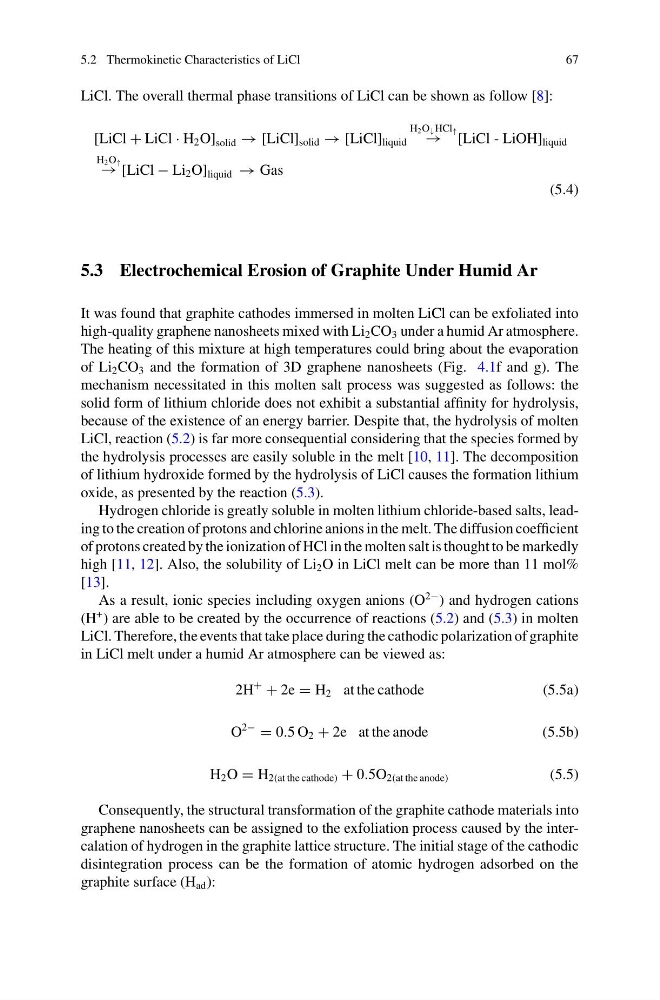
LiCl. The overall thermal phase transitions of LiCl can be shown as follow [8]:
[LiCl + LiCl · H 2 O] solid → [LiCl] solid → [LiCl] liquid
H 2 O ↓ HCl ↑
→ [LiCl - LiOH] liquid
H 2 O ↑
→ [LiCl − Li 2 O] liquid → Gas
(5.4)
5.3 Electrochemical Erosion of Graphite Under Humid Ar
It was found that graphite cathodes immersed in molten LiCl can be exfoliated into
high-quality graphene nanosheets mixed with Li 2 CO 3 under a humid Ar atmosphere.
The heating of this mixture at high temperatures could bring about the evaporation
of Li 2 CO 3 and the formation of 3D graphene nanosheets (Fig. 4.1f and g). The
mechanism necessitated in this molten salt process was suggested as follows: the
solid form of lithium chloride does not exhibit a substantial affinity for hydrolysis,
because of the existence of an energy barrier. Despite that, the hydrolysis of molten
LiCl, reaction (5.2) is far more consequential considering that the species formed by
the hydrolysis processes are easily soluble in the melt [10, 11]. The decomposition
of lithium hydroxide formed by the hydrolysis of LiCl causes the formation lithium
oxide, as presented by the reaction (5.3).
Hydrogen chloride is greatly soluble in molten lithium chloride-based salts, leading to the creation of protons and chlorine anions in the melt. The diffusion coefficient
of protons created by the ionization of HCl in the molten salt is thought to be markedly
high [11, 12]. Also, the solubility of Li 2 O in LiCl melt can be more than 11 mol%
[13].
As a result, ionic species including oxygen anions (O
2− ) and hydrogen cations
(H
+ ) are able to be created by the occurrence of reactions (5.2) and (5.3) in molten
LiCl. Therefore, the events that take place during the cathodic polarization of graphite
in LiCl melt under a humid Ar atmosphere can be viewed as:
2H
+
+ 2e = H 2 at the cathode
(5.5a)
O
2−
= 0.5 O 2 + 2e at the anode
(5.5b)
H 2 O = H 2(at the cathode) + 0.5O 2(at the anode)
(5.5)
Consequently, the structural transformation of the graphite cathode materials into
graphene nanosheets can be assigned to the exfoliation process caused by the intercalation of hydrogen in the graphite lattice structure. The initial stage of the cathodic
disintegration process can be the formation of atomic hydrogen adsorbed on the
graphite surface (H ad ):
67
LiCl. The overall thermal phase transitions of LiCl can be shown as follow [8]:
[LiCl + LiCl · H 2 O] solid → [LiCl] solid → [LiCl] liquid
H 2 O ↓ HCl ↑
→ [LiCl - LiOH] liquid
H 2 O ↑
→ [LiCl − Li 2 O] liquid → Gas
(5.4)
5.3 Electrochemical Erosion of Graphite Under Humid Ar
It was found that graphite cathodes immersed in molten LiCl can be exfoliated into
high-quality graphene nanosheets mixed with Li 2 CO 3 under a humid Ar atmosphere.
The heating of this mixture at high temperatures could bring about the evaporation
of Li 2 CO 3 and the formation of 3D graphene nanosheets (Fig. 4.1f and g). The
mechanism necessitated in this molten salt process was suggested as follows: the
solid form of lithium chloride does not exhibit a substantial affinity for hydrolysis,
because of the existence of an energy barrier. Despite that, the hydrolysis of molten
LiCl, reaction (5.2) is far more consequential considering that the species formed by
the hydrolysis processes are easily soluble in the melt [10, 11]. The decomposition
of lithium hydroxide formed by the hydrolysis of LiCl causes the formation lithium
oxide, as presented by the reaction (5.3).
Hydrogen chloride is greatly soluble in molten lithium chloride-based salts, leading to the creation of protons and chlorine anions in the melt. The diffusion coefficient
of protons created by the ionization of HCl in the molten salt is thought to be markedly
high [11, 12]. Also, the solubility of Li 2 O in LiCl melt can be more than 11 mol%
[13].
As a result, ionic species including oxygen anions (O
2− ) and hydrogen cations
(H
+ ) are able to be created by the occurrence of reactions (5.2) and (5.3) in molten
LiCl. Therefore, the events that take place during the cathodic polarization of graphite
in LiCl melt under a humid Ar atmosphere can be viewed as:
2H
+
+ 2e = H 2 at the cathode
(5.5a)
O
2−
= 0.5 O 2 + 2e at the anode
(5.5b)
H 2 O = H 2(at the cathode) + 0.5O 2(at the anode)
(5.5)
Consequently, the structural transformation of the graphite cathode materials into
graphene nanosheets can be assigned to the exfoliation process caused by the intercalation of hydrogen in the graphite lattice structure. The initial stage of the cathodic
disintegration process can be the formation of atomic hydrogen adsorbed on the
graphite surface (H ad ):