

44
4 Cathodic Exfoliation of Graphite in Molten Salt Electrolytes
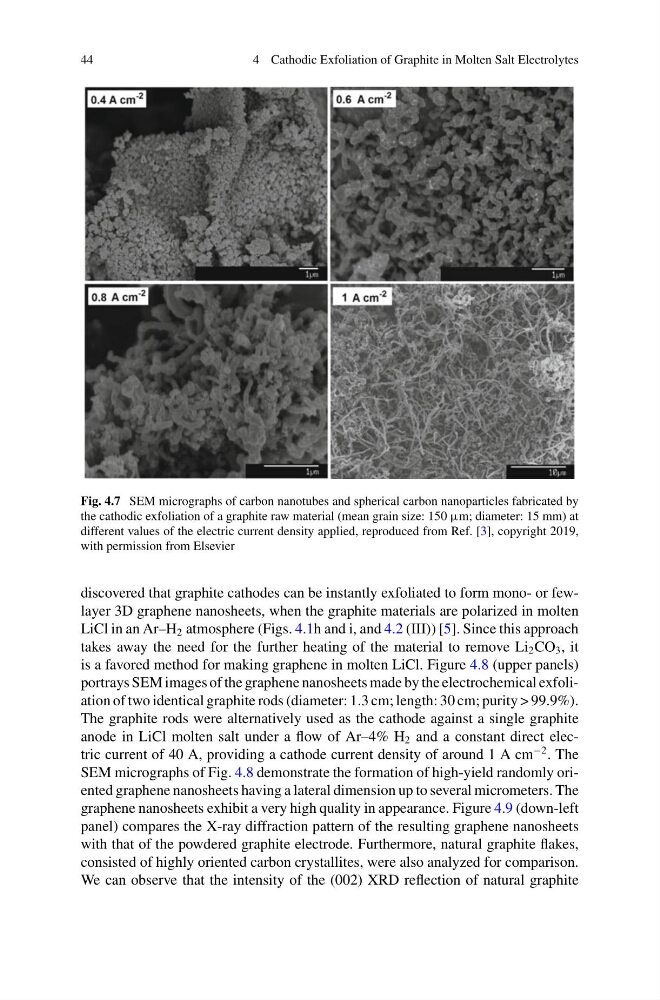
Fig. 4.7 SEM micrographs of carbon nanotubes and spherical carbon nanoparticles fabricated by
the cathodic exfoliation of a graphite raw material (mean grain size: 150 μm; diameter: 15 mm) at
different values of the electric current density applied, reproduced from Ref. [3], copyright 2019,
with permission from Elsevier
discovered that graphite cathodes can be instantly exfoliated to form mono- or fewlayer 3D graphene nanosheets, when the graphite materials are polarized in molten
LiCl in an Ar–H 2 atmosphere (Figs. 4.1h and i, and 4.2 (III)) [5]. Since this approach
takes away the need for the further heating of the material to remove Li 2 CO 3 , it
is a favored method for making graphene in molten LiCl. Figure 4.8 (upper panels)
portrays SEM images of the graphene nanosheets made by the electrochemical exfoliation of two identical graphite rods (diameter: 1.3 cm; length: 30 cm; purity > 99.9%).
The graphite rods were alternatively used as the cathode against a single graphite
anode in LiCl molten salt under a flow of Ar–4% H 2 and a constant direct electric current of 40 A, providing a cathode current density of around 1 A cm
−2 . The
SEM micrographs of Fig. 4.8 demonstrate the formation of high-yield randomly oriented graphene nanosheets having a lateral dimension up to several micrometers. The
graphene nanosheets exhibit a very high quality in appearance. Figure 4.9 (down-left
panel) compares the X-ray diffraction pattern of the resulting graphene nanosheets
with that of the powdered graphite electrode. Furthermore, natural graphite flakes,
consisted of highly oriented carbon crystallites, were also analyzed for comparison.
We can observe that the intensity of the (002) XRD reflection of natural graphite
4 Cathodic Exfoliation of Graphite in Molten Salt Electrolytes
Fig. 4.7 SEM micrographs of carbon nanotubes and spherical carbon nanoparticles fabricated by
the cathodic exfoliation of a graphite raw material (mean grain size: 150 μm; diameter: 15 mm) at
different values of the electric current density applied, reproduced from Ref. [3], copyright 2019,
with permission from Elsevier
discovered that graphite cathodes can be instantly exfoliated to form mono- or fewlayer 3D graphene nanosheets, when the graphite materials are polarized in molten
LiCl in an Ar–H 2 atmosphere (Figs. 4.1h and i, and 4.2 (III)) [5]. Since this approach
takes away the need for the further heating of the material to remove Li 2 CO 3 , it
is a favored method for making graphene in molten LiCl. Figure 4.8 (upper panels)
portrays SEM images of the graphene nanosheets made by the electrochemical exfoliation of two identical graphite rods (diameter: 1.3 cm; length: 30 cm; purity > 99.9%).
The graphite rods were alternatively used as the cathode against a single graphite
anode in LiCl molten salt under a flow of Ar–4% H 2 and a constant direct electric current of 40 A, providing a cathode current density of around 1 A cm
−2 . The
SEM micrographs of Fig. 4.8 demonstrate the formation of high-yield randomly oriented graphene nanosheets having a lateral dimension up to several micrometers. The
graphene nanosheets exhibit a very high quality in appearance. Figure 4.9 (down-left
panel) compares the X-ray diffraction pattern of the resulting graphene nanosheets
with that of the powdered graphite electrode. Furthermore, natural graphite flakes,
consisted of highly oriented carbon crystallites, were also analyzed for comparison.
We can observe that the intensity of the (002) XRD reflection of natural graphite