

4.1 Molten Salt Production of Carbon Nanotubes
43
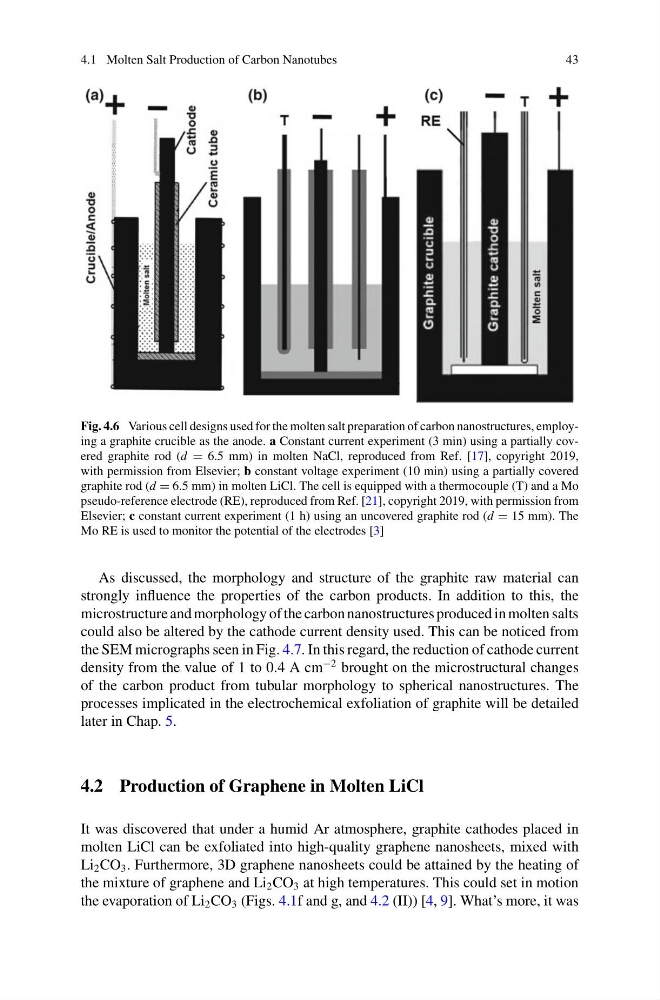
Fig. 4.6 Various cell designs used for the molten salt preparation of carbon nanostructures, employing a graphite crucible as the anode. a Constant current experiment (3 min) using a partially covered graphite rod (d = 6.5 mm) in molten NaCl, reproduced from Ref. [17], copyright 2019,
with permission from Elsevier; b constant voltage experiment (10 min) using a partially covered
graphite rod (d = 6.5 mm) in molten LiCl. The cell is equipped with a thermocouple (T) and a Mo
pseudo-reference electrode (RE), reproduced from Ref. [21], copyright 2019, with permission from
Elsevier; c constant current experiment (1 h) using an uncovered graphite rod (d = 15 mm). The
Mo RE is used to monitor the potential of the electrodes [3]
As discussed, the morphology and structure of the graphite raw material can
strongly influence the properties of the carbon products. In addition to this, the
microstructure and morphology of the carbon nanostructures produced in molten salts
could also be altered by the cathode current density used. This can be noticed from
the SEM micrographs seen in Fig. 4.7. In this regard, the reduction of cathode current
density from the value of 1 to 0.4 A cm
−2 brought on the microstructural changes
of the carbon product from tubular morphology to spherical nanostructures. The
processes implicated in the electrochemical exfoliation of graphite will be detailed
later in Chap. 5.
4.2 Production of Graphene in Molten LiCl
It was discovered that under a humid Ar atmosphere, graphite cathodes placed in
molten LiCl can be exfoliated into high-quality graphene nanosheets, mixed with
Li 2 CO 3 . Furthermore, 3D graphene nanosheets could be attained by the heating of
the mixture of graphene and Li 2 CO 3 at high temperatures. This could set in motion
the evaporation of Li 2 CO 3 (Figs. 4.1f and g, and 4.2 (II)) [4, 9]. What’s more, it was
43
Fig. 4.6 Various cell designs used for the molten salt preparation of carbon nanostructures, employing a graphite crucible as the anode. a Constant current experiment (3 min) using a partially covered graphite rod (d = 6.5 mm) in molten NaCl, reproduced from Ref. [17], copyright 2019,
with permission from Elsevier; b constant voltage experiment (10 min) using a partially covered
graphite rod (d = 6.5 mm) in molten LiCl. The cell is equipped with a thermocouple (T) and a Mo
pseudo-reference electrode (RE), reproduced from Ref. [21], copyright 2019, with permission from
Elsevier; c constant current experiment (1 h) using an uncovered graphite rod (d = 15 mm). The
Mo RE is used to monitor the potential of the electrodes [3]
As discussed, the morphology and structure of the graphite raw material can
strongly influence the properties of the carbon products. In addition to this, the
microstructure and morphology of the carbon nanostructures produced in molten salts
could also be altered by the cathode current density used. This can be noticed from
the SEM micrographs seen in Fig. 4.7. In this regard, the reduction of cathode current
density from the value of 1 to 0.4 A cm
−2 brought on the microstructural changes
of the carbon product from tubular morphology to spherical nanostructures. The
processes implicated in the electrochemical exfoliation of graphite will be detailed
later in Chap. 5.
4.2 Production of Graphene in Molten LiCl
It was discovered that under a humid Ar atmosphere, graphite cathodes placed in
molten LiCl can be exfoliated into high-quality graphene nanosheets, mixed with
Li 2 CO 3 . Furthermore, 3D graphene nanosheets could be attained by the heating of
the mixture of graphene and Li 2 CO 3 at high temperatures. This could set in motion
the evaporation of Li 2 CO 3 (Figs. 4.1f and g, and 4.2 (II)) [4, 9]. What’s more, it was