

4.1 Molten Salt Production of Carbon Nanotubes
41
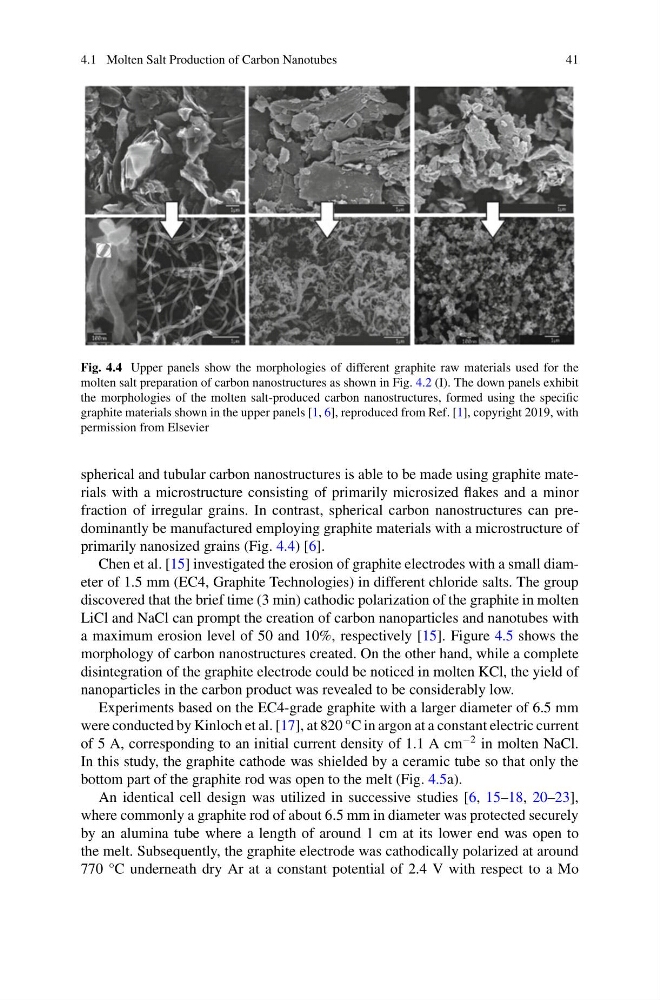
Fig. 4.4 Upper panels show the morphologies of different graphite raw materials used for the
molten salt preparation of carbon nanostructures as shown in Fig. 4.2 (I). The down panels exhibit
the morphologies of the molten salt-produced carbon nanostructures, formed using the specific
graphite materials shown in the upper panels [1, 6], reproduced from Ref. [1], copyright 2019, with
permission from Elsevier
spherical and tubular carbon nanostructures is able to be made using graphite materials with a microstructure consisting of primarily microsized flakes and a minor
fraction of irregular grains. In contrast, spherical carbon nanostructures can predominantly be manufactured employing graphite materials with a microstructure of
primarily nanosized grains (Fig. 4.4) [6].
Chen et al. [15] investigated the erosion of graphite electrodes with a small diameter of 1.5 mm (EC4, Graphite Technologies) in different chloride salts. The group
discovered that the brief time (3 min) cathodic polarization of the graphite in molten
LiCl and NaCl can prompt the creation of carbon nanoparticles and nanotubes with
a maximum erosion level of 50 and 10%, respectively [15]. Figure 4.5 shows the
morphology of carbon nanostructures created. On the other hand, while a complete
disintegration of the graphite electrode could be noticed in molten KCl, the yield of
nanoparticles in the carbon product was revealed to be considerably low.
Experiments based on the EC4-grade graphite with a larger diameter of 6.5 mm
were conducted by Kinloch et al. [17], at 820 °C in argon at a constant electric current
of 5 A, corresponding to an initial current density of 1.1 A cm
−2 in molten NaCl.
In this study, the graphite cathode was shielded by a ceramic tube so that only the
bottom part of the graphite rod was open to the melt (Fig. 4.5a).
An identical cell design was utilized in successive studies [6, 15–18, 20–23],
where commonly a graphite rod of about 6.5 mm in diameter was protected securely
by an alumina tube where a length of around 1 cm at its lower end was open to
the melt. Subsequently, the graphite electrode was cathodically polarized at around
770 °C underneath dry Ar at a constant potential of 2.4 V with respect to a Mo
41
Fig. 4.4 Upper panels show the morphologies of different graphite raw materials used for the
molten salt preparation of carbon nanostructures as shown in Fig. 4.2 (I). The down panels exhibit
the morphologies of the molten salt-produced carbon nanostructures, formed using the specific
graphite materials shown in the upper panels [1, 6], reproduced from Ref. [1], copyright 2019, with
permission from Elsevier
spherical and tubular carbon nanostructures is able to be made using graphite materials with a microstructure consisting of primarily microsized flakes and a minor
fraction of irregular grains. In contrast, spherical carbon nanostructures can predominantly be manufactured employing graphite materials with a microstructure of
primarily nanosized grains (Fig. 4.4) [6].
Chen et al. [15] investigated the erosion of graphite electrodes with a small diameter of 1.5 mm (EC4, Graphite Technologies) in different chloride salts. The group
discovered that the brief time (3 min) cathodic polarization of the graphite in molten
LiCl and NaCl can prompt the creation of carbon nanoparticles and nanotubes with
a maximum erosion level of 50 and 10%, respectively [15]. Figure 4.5 shows the
morphology of carbon nanostructures created. On the other hand, while a complete
disintegration of the graphite electrode could be noticed in molten KCl, the yield of
nanoparticles in the carbon product was revealed to be considerably low.
Experiments based on the EC4-grade graphite with a larger diameter of 6.5 mm
were conducted by Kinloch et al. [17], at 820 °C in argon at a constant electric current
of 5 A, corresponding to an initial current density of 1.1 A cm
−2 in molten NaCl.
In this study, the graphite cathode was shielded by a ceramic tube so that only the
bottom part of the graphite rod was open to the melt (Fig. 4.5a).
An identical cell design was utilized in successive studies [6, 15–18, 20–23],
where commonly a graphite rod of about 6.5 mm in diameter was protected securely
by an alumina tube where a length of around 1 cm at its lower end was open to
the melt. Subsequently, the graphite electrode was cathodically polarized at around
770 °C underneath dry Ar at a constant potential of 2.4 V with respect to a Mo