

40
4 Cathodic Exfoliation of Graphite in Molten Salt Electrolytes
from the solidified salt (Figs. 4.1d and e, and 4.2 (I)). One appealing attribute of
this technology is that CNTs and the spherical nanoparticles are able to be produced
by adequately controlling the processing parameters. These parameters include the
morphology of the graphite raw materials and the electrochemical processing parameters which are used throughout the molten salt process. The technical details of these
technologies are discussed in [6–23].
The commercial graphite electrodes, which are used in the molten salt exfoliation
process, are commonly manufactured by the carbonization of blended carbonaceous
materials in an oxygen-free furnace at 1000–1300 °C. These mixtures may contain
petroleum coke, pitch coke, carbon black, coal tar and petroleum pitch. The carbonization process is followed by the graphitization step which is usually carried out
at temperatures greater than 2500 °C. This ends in the vaporization of binder residues
and the crystallization of amorphous carbonaceous precursors. Depending on the processing conditions, the resulting graphite material manufactured can include graphite
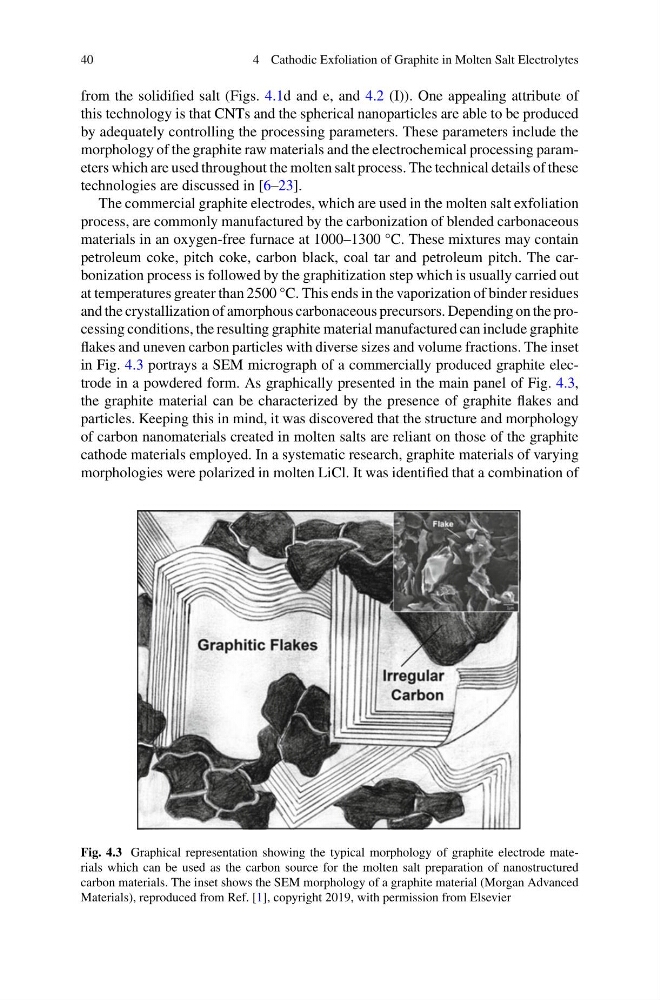
flakes and uneven carbon particles with diverse sizes and volume fractions. The inset
in Fig. 4.3 portrays a SEM micrograph of a commercially produced graphite electrode in a powdered form. As graphically presented in the main panel of Fig. 4.3,
the graphite material can be characterized by the presence of graphite flakes and
particles. Keeping this in mind, it was discovered that the structure and morphology
of carbon nanomaterials created in molten salts are reliant on those of the graphite
cathode materials employed. In a systematic research, graphite materials of varying
morphologies were polarized in molten LiCl. It was identified that a combination of
Fig. 4.3 Graphical representation showing the typical morphology of graphite electrode materials which can be used as the carbon source for the molten salt preparation of nanostructured
carbon materials. The inset shows the SEM morphology of a graphite material (Morgan Advanced
Materials), reproduced from Ref. [1], copyright 2019, with permission from Elsevier
4 Cathodic Exfoliation of Graphite in Molten Salt Electrolytes
from the solidified salt (Figs. 4.1d and e, and 4.2 (I)). One appealing attribute of
this technology is that CNTs and the spherical nanoparticles are able to be produced
by adequately controlling the processing parameters. These parameters include the
morphology of the graphite raw materials and the electrochemical processing parameters which are used throughout the molten salt process. The technical details of these
technologies are discussed in [6–23].
The commercial graphite electrodes, which are used in the molten salt exfoliation
process, are commonly manufactured by the carbonization of blended carbonaceous
materials in an oxygen-free furnace at 1000–1300 °C. These mixtures may contain
petroleum coke, pitch coke, carbon black, coal tar and petroleum pitch. The carbonization process is followed by the graphitization step which is usually carried out
at temperatures greater than 2500 °C. This ends in the vaporization of binder residues
and the crystallization of amorphous carbonaceous precursors. Depending on the processing conditions, the resulting graphite material manufactured can include graphite
flakes and uneven carbon particles with diverse sizes and volume fractions. The inset
in Fig. 4.3 portrays a SEM micrograph of a commercially produced graphite electrode in a powdered form. As graphically presented in the main panel of Fig. 4.3,
the graphite material can be characterized by the presence of graphite flakes and
particles. Keeping this in mind, it was discovered that the structure and morphology
of carbon nanomaterials created in molten salts are reliant on those of the graphite
cathode materials employed. In a systematic research, graphite materials of varying
morphologies were polarized in molten LiCl. It was identified that a combination of
Fig. 4.3 Graphical representation showing the typical morphology of graphite electrode materials which can be used as the carbon source for the molten salt preparation of nanostructured
carbon materials. The inset shows the SEM morphology of a graphite material (Morgan Advanced
Materials), reproduced from Ref. [1], copyright 2019, with permission from Elsevier