

24
3 Interaction of Molten Salts with Graphite
For more comprehensive investigations of the phenomena taking place during
the heating of the graphite–LiCl mixture, the activation energy of the respective
transitions was identified based on Eq. (3.2).
In
B
T
2
P
= −
E C
RT P
+ constant
(3.2)
where B is the heating rate, T p is the temperature at the specific peak, E c is the
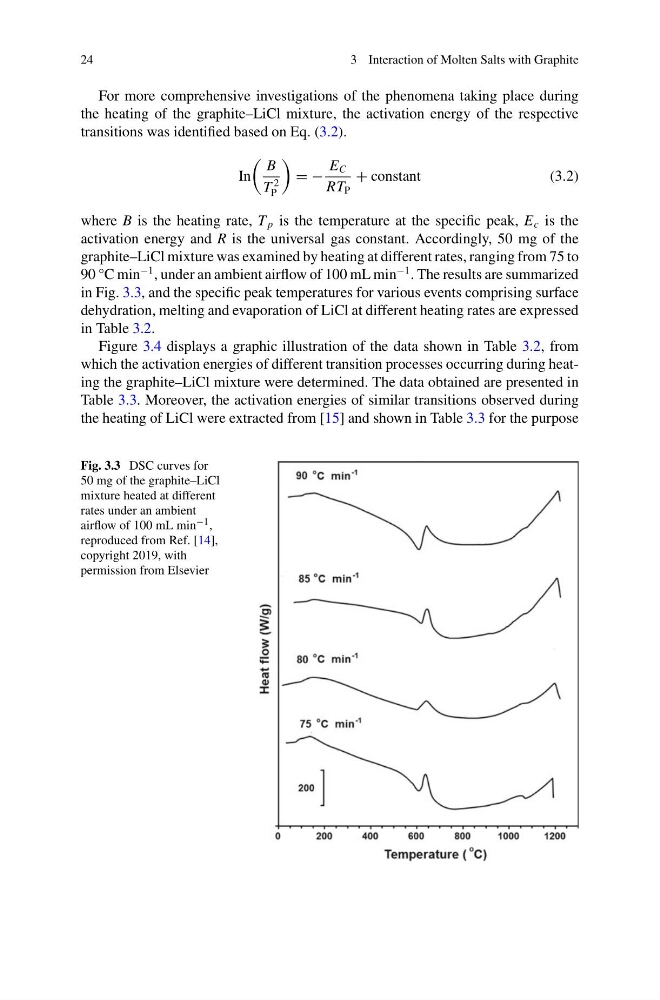
activation energy and R is the universal gas constant. Accordingly, 50 mg of the
graphite–LiCl mixture was examined by heating at different rates, ranging from 75 to
90 °C min
−1 , under an ambient airflow of 100 mL min
−1 . The results are summarized
in Fig. 3.3, and the specific peak temperatures for various events comprising surface
dehydration, melting and evaporation of LiCl at different heating rates are expressed
in Table 3.2.
Figure 3.4 displays a graphic illustration of the data shown in Table 3.2, from
which the activation energies of different transition processes occurring during heating the graphite–LiCl mixture were determined. The data obtained are presented in
Table 3.3. Moreover, the activation energies of similar transitions observed during
the heating of LiCl were extracted from [15] and shown in Table 3.3 for the purpose
Fig. 3.3 DSC curves for
50 mg of the graphite–LiCl
mixture heated at different
rates under an ambient
airflow of 100 mL min −1 ,
reproduced from Ref. [14],
copyright 2019, with
permission from Elsevier
3 Interaction of Molten Salts with Graphite
For more comprehensive investigations of the phenomena taking place during
the heating of the graphite–LiCl mixture, the activation energy of the respective
transitions was identified based on Eq. (3.2).
In
B
T
2
P
= −
E C
RT P
+ constant
(3.2)
where B is the heating rate, T p is the temperature at the specific peak, E c is the
activation energy and R is the universal gas constant. Accordingly, 50 mg of the
graphite–LiCl mixture was examined by heating at different rates, ranging from 75 to
90 °C min
−1 , under an ambient airflow of 100 mL min
−1 . The results are summarized
in Fig. 3.3, and the specific peak temperatures for various events comprising surface
dehydration, melting and evaporation of LiCl at different heating rates are expressed
in Table 3.2.
Figure 3.4 displays a graphic illustration of the data shown in Table 3.2, from
which the activation energies of different transition processes occurring during heating the graphite–LiCl mixture were determined. The data obtained are presented in
Table 3.3. Moreover, the activation energies of similar transitions observed during
the heating of LiCl were extracted from [15] and shown in Table 3.3 for the purpose
Fig. 3.3 DSC curves for
50 mg of the graphite–LiCl
mixture heated at different
rates under an ambient
airflow of 100 mL min −1 ,
reproduced from Ref. [14],
copyright 2019, with
permission from Elsevier