

22
3 Interaction of Molten Salts with Graphite
3.2 Thermal Analysis of Lithium Chloride
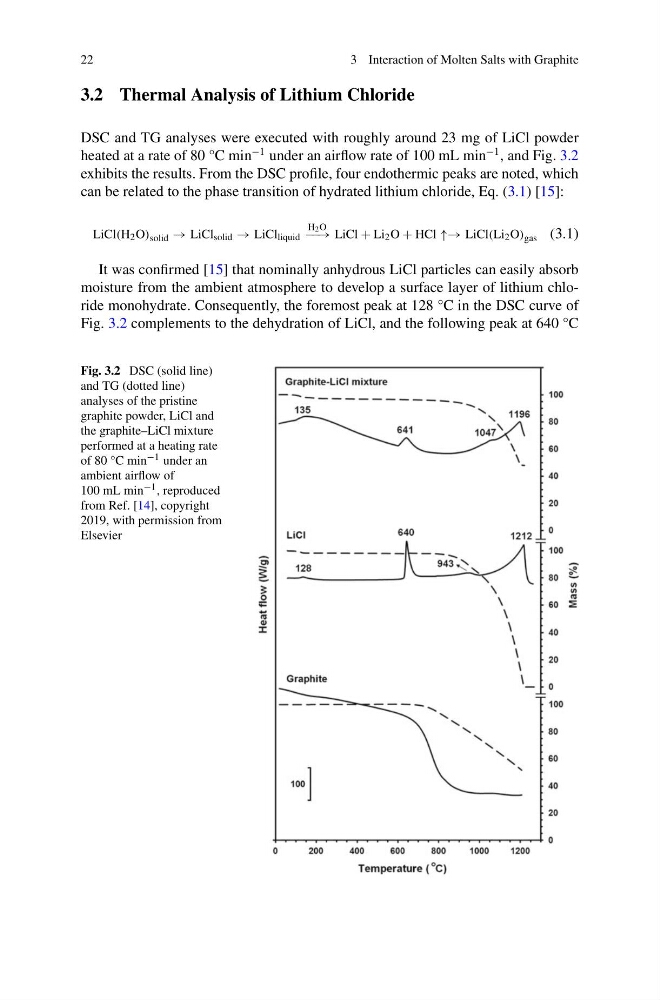
DSC and TG analyses were executed with roughly around 23 mg of LiCl powder
heated at a rate of 80 °C min
−1 under an airflow rate of 100 mL min
−1 , and Fig. 3.2
exhibits the results. From the DSC profile, four endothermic peaks are noted, which
can be related to the phase transition of hydrated lithium chloride, Eq. (3.1) [15]:
LiCl(H 2 O) solid → LiCl solid → LiCl liquid
H2O
− − → LiCl + Li 2 O + HCl ↑→ LiCl(Li 2 O) gas (3.1)
It was confirmed [15] that nominally anhydrous LiCl particles can easily absorb
moisture from the ambient atmosphere to develop a surface layer of lithium chloride monohydrate. Consequently, the foremost peak at 128 °C in the DSC curve of
Fig. 3.2 complements to the dehydration of LiCl, and the following peak at 640 °C
Fig. 3.2 DSC (solid line)
and TG (dotted line)
analyses of the pristine
graphite powder, LiCl and
the graphite–LiCl mixture
performed at a heating rate
of 80 °C min −1 under an
ambient airflow of
100 mL min −1 , reproduced
from Ref. [14], copyright
2019, with permission from
Elsevier
3 Interaction of Molten Salts with Graphite
3.2 Thermal Analysis of Lithium Chloride
DSC and TG analyses were executed with roughly around 23 mg of LiCl powder
heated at a rate of 80 °C min
−1 under an airflow rate of 100 mL min
−1 , and Fig. 3.2
exhibits the results. From the DSC profile, four endothermic peaks are noted, which
can be related to the phase transition of hydrated lithium chloride, Eq. (3.1) [15]:
LiCl(H 2 O) solid → LiCl solid → LiCl liquid
H2O
− − → LiCl + Li 2 O + HCl ↑→ LiCl(Li 2 O) gas (3.1)
It was confirmed [15] that nominally anhydrous LiCl particles can easily absorb
moisture from the ambient atmosphere to develop a surface layer of lithium chloride monohydrate. Consequently, the foremost peak at 128 °C in the DSC curve of
Fig. 3.2 complements to the dehydration of LiCl, and the following peak at 640 °C
Fig. 3.2 DSC (solid line)
and TG (dotted line)
analyses of the pristine
graphite powder, LiCl and
the graphite–LiCl mixture
performed at a heating rate
of 80 °C min −1 under an
ambient airflow of
100 mL min −1 , reproduced
from Ref. [14], copyright
2019, with permission from
Elsevier