

3.1 Thermal Analysis of Pristine Graphite Powder
21
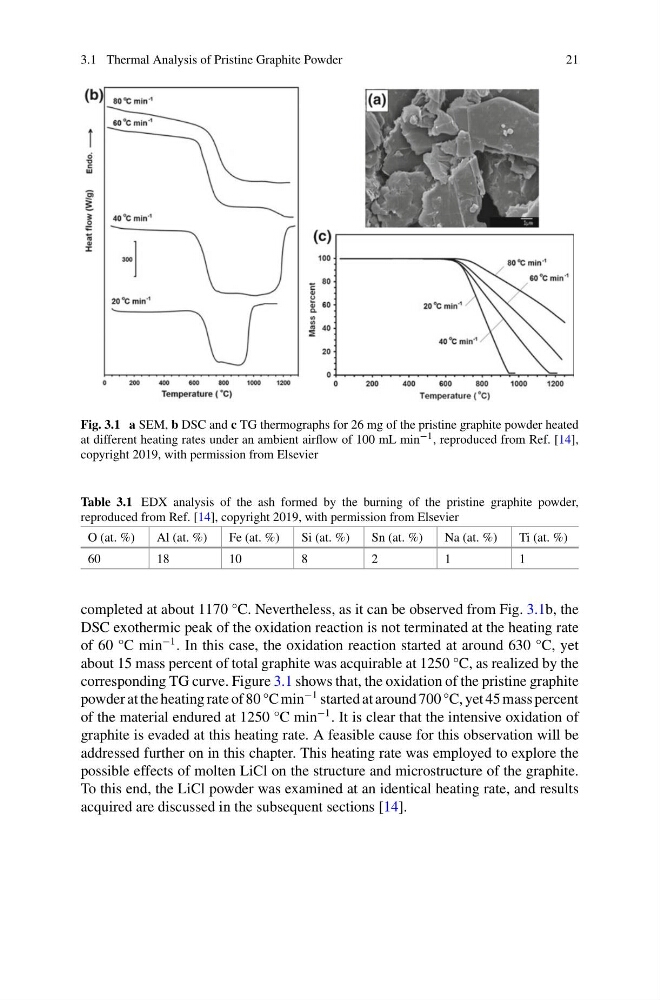
Fig. 3.1 a SEM, b DSC and c TG thermographs for 26 mg of the pristine graphite powder heated
at different heating rates under an ambient airflow of 100 mL min −1 , reproduced from Ref. [14],
copyright 2019, with permission from Elsevier
Table 3.1 EDX analysis of the ash formed by the burning of the pristine graphite powder,
reproduced from Ref. [14], copyright 2019, with permission from Elsevier
O (at. %)
Al (at. %)
Fe (at. %)
Si (at. %)
Sn (at. %)
Na (at. %)
Ti (at. %)
60
18
10
8
2
1
1
completed at about 1170 °C. Nevertheless, as it can be observed from Fig. 3.1b, the
DSC exothermic peak of the oxidation reaction is not terminated at the heating rate
of 60 °C min
−1 . In this case, the oxidation reaction started at around 630 °C, yet
about 15 mass percent of total graphite was acquirable at 1250 °C, as realized by the
corresponding TG curve. Figure 3.1 shows that, the oxidation of the pristine graphite
powder at the heating rate of 80 °C min
−1 started at around 700 °C, yet 45 mass percent
of the material endured at 1250 °C min
−1 . It is clear that the intensive oxidation of
graphite is evaded at this heating rate. A feasible cause for this observation will be
addressed further on in this chapter. This heating rate was employed to explore the
possible effects of molten LiCl on the structure and microstructure of the graphite.
To this end, the LiCl powder was examined at an identical heating rate, and results
acquired are discussed in the subsequent sections [14].
21
Fig. 3.1 a SEM, b DSC and c TG thermographs for 26 mg of the pristine graphite powder heated
at different heating rates under an ambient airflow of 100 mL min −1 , reproduced from Ref. [14],
copyright 2019, with permission from Elsevier
Table 3.1 EDX analysis of the ash formed by the burning of the pristine graphite powder,
reproduced from Ref. [14], copyright 2019, with permission from Elsevier
O (at. %)
Al (at. %)
Fe (at. %)
Si (at. %)
Sn (at. %)
Na (at. %)
Ti (at. %)
60
18
10
8
2
1
1
completed at about 1170 °C. Nevertheless, as it can be observed from Fig. 3.1b, the
DSC exothermic peak of the oxidation reaction is not terminated at the heating rate
of 60 °C min
−1 . In this case, the oxidation reaction started at around 630 °C, yet
about 15 mass percent of total graphite was acquirable at 1250 °C, as realized by the
corresponding TG curve. Figure 3.1 shows that, the oxidation of the pristine graphite
powder at the heating rate of 80 °C min
−1 started at around 700 °C, yet 45 mass percent
of the material endured at 1250 °C min
−1 . It is clear that the intensive oxidation of
graphite is evaded at this heating rate. A feasible cause for this observation will be
addressed further on in this chapter. This heating rate was employed to explore the
possible effects of molten LiCl on the structure and microstructure of the graphite.
To this end, the LiCl powder was examined at an identical heating rate, and results
acquired are discussed in the subsequent sections [14].