

10
2 Production of Advanced Materials in Molten Salts
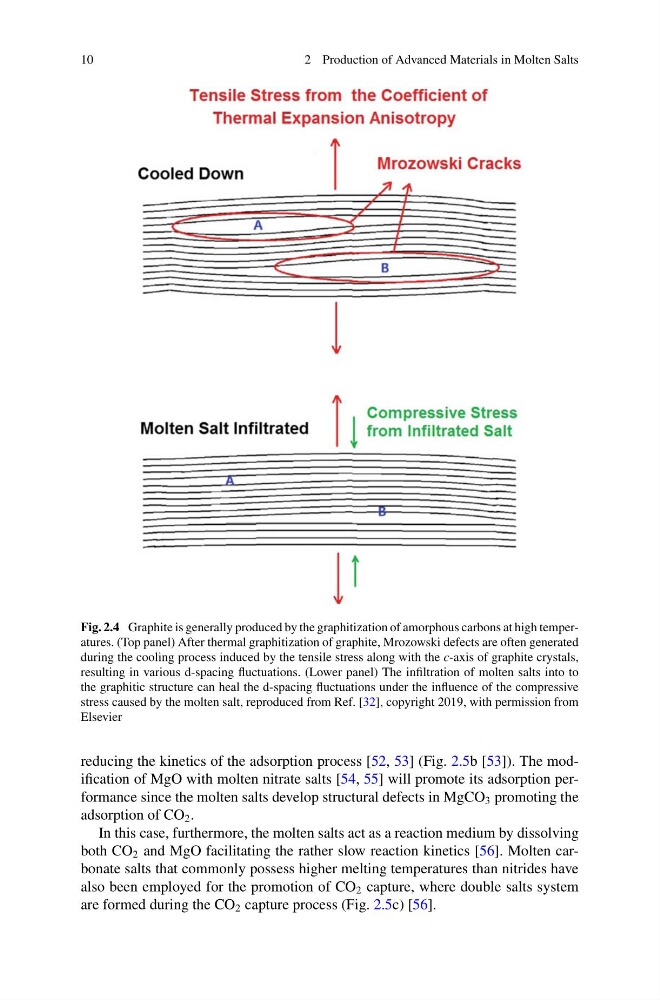
Fig. 2.4 Graphite is generally produced by the graphitization of amorphous carbons at high temperatures. (Top panel) After thermal graphitization of graphite, Mrozowski defects are often generated
during the cooling process induced by the tensile stress along with the c-axis of graphite crystals,
resulting in various d-spacing fluctuations. (Lower panel) The infiltration of molten salts into to
the graphitic structure can heal the d-spacing fluctuations under the influence of the compressive
stress caused by the molten salt, reproduced from Ref. [32], copyright 2019, with permission from
Elsevier
reducing the kinetics of the adsorption process [52, 53] (Fig. 2.5b [53]). The modification of MgO with molten nitrate salts [54, 55] will promote its adsorption performance since the molten salts develop structural defects in MgCO 3 promoting the
adsorption of CO 2 .
In this case, furthermore, the molten salts act as a reaction medium by dissolving
both CO 2 and MgO facilitating the rather slow reaction kinetics [56]. Molten carbonate salts that commonly possess higher melting temperatures than nitrides have
also been employed for the promotion of CO 2 capture, where double salts system
are formed during the CO 2 capture process (Fig. 2.5c) [56].
2 Production of Advanced Materials in Molten Salts
Fig. 2.4 Graphite is generally produced by the graphitization of amorphous carbons at high temperatures. (Top panel) After thermal graphitization of graphite, Mrozowski defects are often generated
during the cooling process induced by the tensile stress along with the c-axis of graphite crystals,
resulting in various d-spacing fluctuations. (Lower panel) The infiltration of molten salts into to
the graphitic structure can heal the d-spacing fluctuations under the influence of the compressive
stress caused by the molten salt, reproduced from Ref. [32], copyright 2019, with permission from
Elsevier
reducing the kinetics of the adsorption process [52, 53] (Fig. 2.5b [53]). The modification of MgO with molten nitrate salts [54, 55] will promote its adsorption performance since the molten salts develop structural defects in MgCO 3 promoting the
adsorption of CO 2 .
In this case, furthermore, the molten salts act as a reaction medium by dissolving
both CO 2 and MgO facilitating the rather slow reaction kinetics [56]. Molten carbonate salts that commonly possess higher melting temperatures than nitrides have
also been employed for the promotion of CO 2 capture, where double salts system
are formed during the CO 2 capture process (Fig. 2.5c) [56].