

8.2 Conversion of Carbon Nanostructures into Nanodiamonds
145
surface tension brought about by the nanometer-sized curvature of carbon nanomaterials [11]. Furthermore, sp
3 bonds have been observed in used graphitic anodes
retrieved from lithium batteries in which lithium has been inserted into and extracted
from the graphite over many cycles [26]. There have, therefore, been many attempts
to convert CNTs into diamond using laser irradiation, shock waves, spark plasma sintering and radio frequency hydrogen plasma techniques [27–35]. Some success was
achieved at 4.5 GPa and 1300 °C with a Ni–Mn–Co catalyst where it was observed
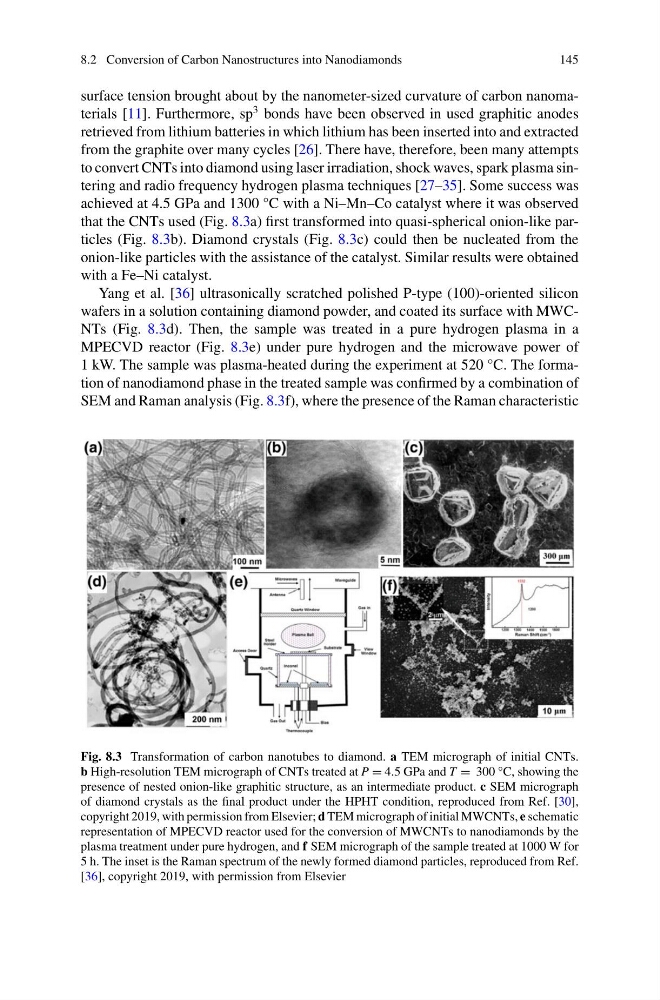
that the CNTs used (Fig. 8.3a) first transformed into quasi-spherical onion-like particles (Fig. 8.3b). Diamond crystals (Fig. 8.3c) could then be nucleated from the
onion-like particles with the assistance of the catalyst. Similar results were obtained
with a Fe–Ni catalyst.
Yang et al. [36] ultrasonically scratched polished P-type (100)-oriented silicon
wafers in a solution containing diamond powder, and coated its surface with MWCNTs (Fig. 8.3d). Then, the sample was treated in a pure hydrogen plasma in a
MPECVD reactor (Fig. 8.3e) under pure hydrogen and the microwave power of
1 kW. The sample was plasma-heated during the experiment at 520 °C. The formation of nanodiamond phase in the treated sample was confirmed by a combination of
SEM and Raman analysis (Fig. 8.3f), where the presence of the Raman characteristic
Fig. 8.3 Transformation of carbon nanotubes to diamond. a TEM micrograph of initial CNTs.
b High-resolution TEM micrograph of CNTs treated at P = 4.5 GPa and T = 300 °C, showing the
presence of nested onion-like graphitic structure, as an intermediate product. c SEM micrograph
of diamond crystals as the final product under the HPHT condition, reproduced from Ref. [30],
copyright 2019, with permission from Elsevier; d TEM micrograph of initial MWCNTs, e schematic
representation of MPECVD reactor used for the conversion of MWCNTs to nanodiamonds by the
plasma treatment under pure hydrogen, and f SEM micrograph of the sample treated at 1000 W for
5 h. The inset is the Raman spectrum of the newly formed diamond particles, reproduced from Ref.
[36], copyright 2019, with permission from Elsevier
145
surface tension brought about by the nanometer-sized curvature of carbon nanomaterials [11]. Furthermore, sp
3 bonds have been observed in used graphitic anodes
retrieved from lithium batteries in which lithium has been inserted into and extracted
from the graphite over many cycles [26]. There have, therefore, been many attempts
to convert CNTs into diamond using laser irradiation, shock waves, spark plasma sintering and radio frequency hydrogen plasma techniques [27–35]. Some success was
achieved at 4.5 GPa and 1300 °C with a Ni–Mn–Co catalyst where it was observed
that the CNTs used (Fig. 8.3a) first transformed into quasi-spherical onion-like particles (Fig. 8.3b). Diamond crystals (Fig. 8.3c) could then be nucleated from the
onion-like particles with the assistance of the catalyst. Similar results were obtained
with a Fe–Ni catalyst.
Yang et al. [36] ultrasonically scratched polished P-type (100)-oriented silicon
wafers in a solution containing diamond powder, and coated its surface with MWCNTs (Fig. 8.3d). Then, the sample was treated in a pure hydrogen plasma in a
MPECVD reactor (Fig. 8.3e) under pure hydrogen and the microwave power of
1 kW. The sample was plasma-heated during the experiment at 520 °C. The formation of nanodiamond phase in the treated sample was confirmed by a combination of
SEM and Raman analysis (Fig. 8.3f), where the presence of the Raman characteristic
Fig. 8.3 Transformation of carbon nanotubes to diamond. a TEM micrograph of initial CNTs.
b High-resolution TEM micrograph of CNTs treated at P = 4.5 GPa and T = 300 °C, showing the
presence of nested onion-like graphitic structure, as an intermediate product. c SEM micrograph
of diamond crystals as the final product under the HPHT condition, reproduced from Ref. [30],
copyright 2019, with permission from Elsevier; d TEM micrograph of initial MWCNTs, e schematic
representation of MPECVD reactor used for the conversion of MWCNTs to nanodiamonds by the
plasma treatment under pure hydrogen, and f SEM micrograph of the sample treated at 1000 W for
5 h. The inset is the Raman spectrum of the newly formed diamond particles, reproduced from Ref.
[36], copyright 2019, with permission from Elsevier