

144
8 Molten Salt-Assisted Preparation of Nanodiamonds at Atmospheric …
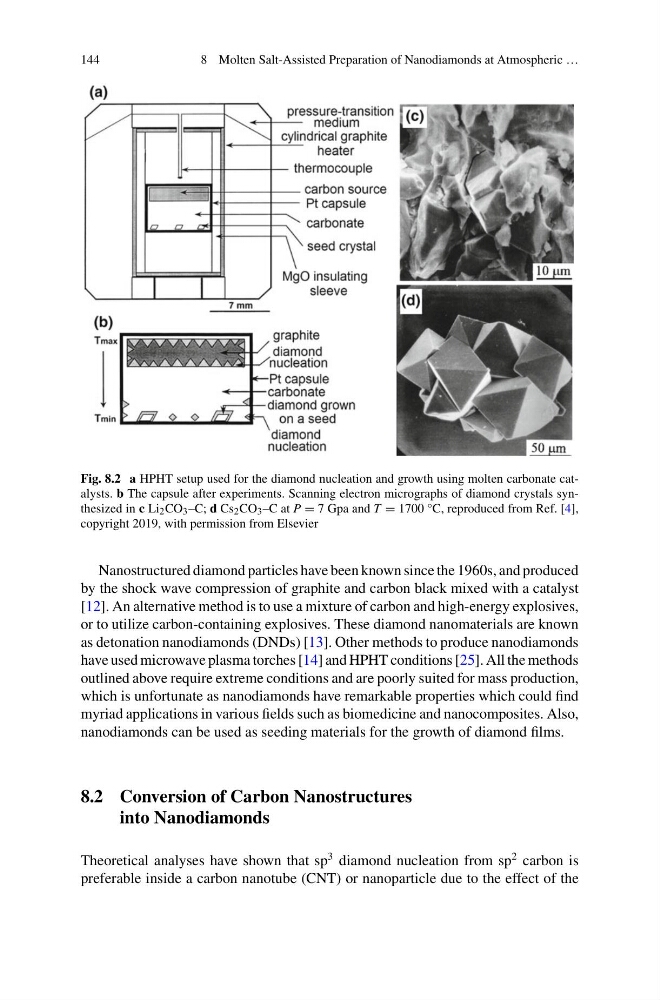
Fig. 8.2 a HPHT setup used for the diamond nucleation and growth using molten carbonate catalysts. b The capsule after experiments. Scanning electron micrographs of diamond crystals synthesized in c Li 2 CO 3 –C; d Cs 2 CO 3 –C at P = 7 Gpa and T = 1700 °C, reproduced from Ref. [4],
copyright 2019, with permission from Elsevier
Nanostructured diamond particles have been known since the 1960s, and produced
by the shock wave compression of graphite and carbon black mixed with a catalyst
[12]. An alternative method is to use a mixture of carbon and high-energy explosives,
or to utilize carbon-containing explosives. These diamond nanomaterials are known
as detonation nanodiamonds (DNDs) [13]. Other methods to produce nanodiamonds
have used microwave plasma torches [14] and HPHT conditions [25]. All the methods
outlined above require extreme conditions and are poorly suited for mass production,
which is unfortunate as nanodiamonds have remarkable properties which could find
myriad applications in various fields such as biomedicine and nanocomposites. Also,
nanodiamonds can be used as seeding materials for the growth of diamond films.
8.2 Conversion of Carbon Nanostructures
into Nanodiamonds
Theoretical analyses have shown that sp
3 diamond nucleation from sp
2 carbon is
preferable inside a carbon nanotube (CNT) or nanoparticle due to the effect of the
8 Molten Salt-Assisted Preparation of Nanodiamonds at Atmospheric …
Fig. 8.2 a HPHT setup used for the diamond nucleation and growth using molten carbonate catalysts. b The capsule after experiments. Scanning electron micrographs of diamond crystals synthesized in c Li 2 CO 3 –C; d Cs 2 CO 3 –C at P = 7 Gpa and T = 1700 °C, reproduced from Ref. [4],
copyright 2019, with permission from Elsevier
Nanostructured diamond particles have been known since the 1960s, and produced
by the shock wave compression of graphite and carbon black mixed with a catalyst
[12]. An alternative method is to use a mixture of carbon and high-energy explosives,
or to utilize carbon-containing explosives. These diamond nanomaterials are known
as detonation nanodiamonds (DNDs) [13]. Other methods to produce nanodiamonds
have used microwave plasma torches [14] and HPHT conditions [25]. All the methods
outlined above require extreme conditions and are poorly suited for mass production,
which is unfortunate as nanodiamonds have remarkable properties which could find
myriad applications in various fields such as biomedicine and nanocomposites. Also,
nanodiamonds can be used as seeding materials for the growth of diamond films.
8.2 Conversion of Carbon Nanostructures
into Nanodiamonds
Theoretical analyses have shown that sp
3 diamond nucleation from sp
2 carbon is
preferable inside a carbon nanotube (CNT) or nanoparticle due to the effect of the