

118
7 Molten Salt Conversion of Plastics into Highly Conductive …
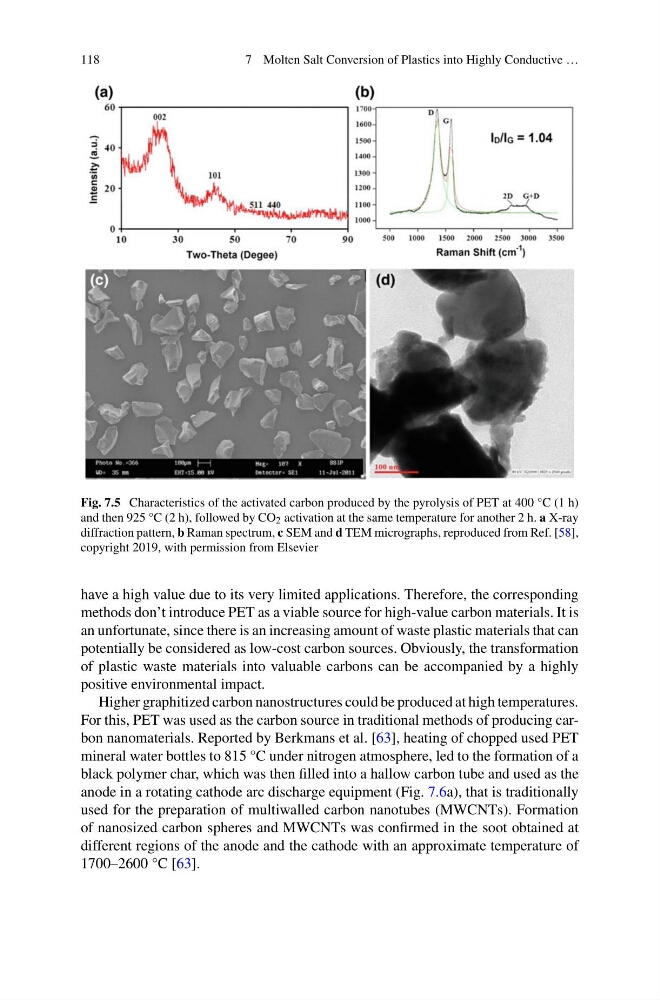
Fig. 7.5 Characteristics of the activated carbon produced by the pyrolysis of PET at 400 °C (1 h)
and then 925 °C (2 h), followed by CO 2 activation at the same temperature for another 2 h. a X-ray
diffraction pattern, b Raman spectrum, c SEM and d TEM micrographs, reproduced from Ref. [58],
copyright 2019, with permission from Elsevier
have a high value due to its very limited applications. Therefore, the corresponding
methods don’t introduce PET as a viable source for high-value carbon materials. It is
an unfortunate, since there is an increasing amount of waste plastic materials that can
potentially be considered as low-cost carbon sources. Obviously, the transformation
of plastic waste materials into valuable carbons can be accompanied by a highly
positive environmental impact.
Higher graphitized carbon nanostructures could be produced at high temperatures.
For this, PET was used as the carbon source in traditional methods of producing carbon nanomaterials. Reported by Berkmans et al. [63], heating of chopped used PET
mineral water bottles to 815 °C under nitrogen atmosphere, led to the formation of a
black polymer char, which was then filled into a hallow carbon tube and used as the
anode in a rotating cathode arc discharge equipment (Fig. 7.6a), that is traditionally
used for the preparation of multiwalled carbon nanotubes (MWCNTs). Formation
of nanosized carbon spheres and MWCNTs was confirmed in the soot obtained at
different regions of the anode and the cathode with an approximate temperature of
1700–2600 °C [63].
7 Molten Salt Conversion of Plastics into Highly Conductive …
Fig. 7.5 Characteristics of the activated carbon produced by the pyrolysis of PET at 400 °C (1 h)
and then 925 °C (2 h), followed by CO 2 activation at the same temperature for another 2 h. a X-ray
diffraction pattern, b Raman spectrum, c SEM and d TEM micrographs, reproduced from Ref. [58],
copyright 2019, with permission from Elsevier
have a high value due to its very limited applications. Therefore, the corresponding
methods don’t introduce PET as a viable source for high-value carbon materials. It is
an unfortunate, since there is an increasing amount of waste plastic materials that can
potentially be considered as low-cost carbon sources. Obviously, the transformation
of plastic waste materials into valuable carbons can be accompanied by a highly
positive environmental impact.
Higher graphitized carbon nanostructures could be produced at high temperatures.
For this, PET was used as the carbon source in traditional methods of producing carbon nanomaterials. Reported by Berkmans et al. [63], heating of chopped used PET
mineral water bottles to 815 °C under nitrogen atmosphere, led to the formation of a
black polymer char, which was then filled into a hallow carbon tube and used as the
anode in a rotating cathode arc discharge equipment (Fig. 7.6a), that is traditionally
used for the preparation of multiwalled carbon nanotubes (MWCNTs). Formation
of nanosized carbon spheres and MWCNTs was confirmed in the soot obtained at
different regions of the anode and the cathode with an approximate temperature of
1700–2600 °C [63].