

112
7 Molten Salt Conversion of Plastics into Highly Conductive …
can also be concluded that the plastic bottle was made of pure PET. The high carbon
content of waste PET objects as well as the lack of inorganic impurities makes such
waste materials very attractive sources for the preparation of solid carbon materials.
7.2 Carbonization of PET
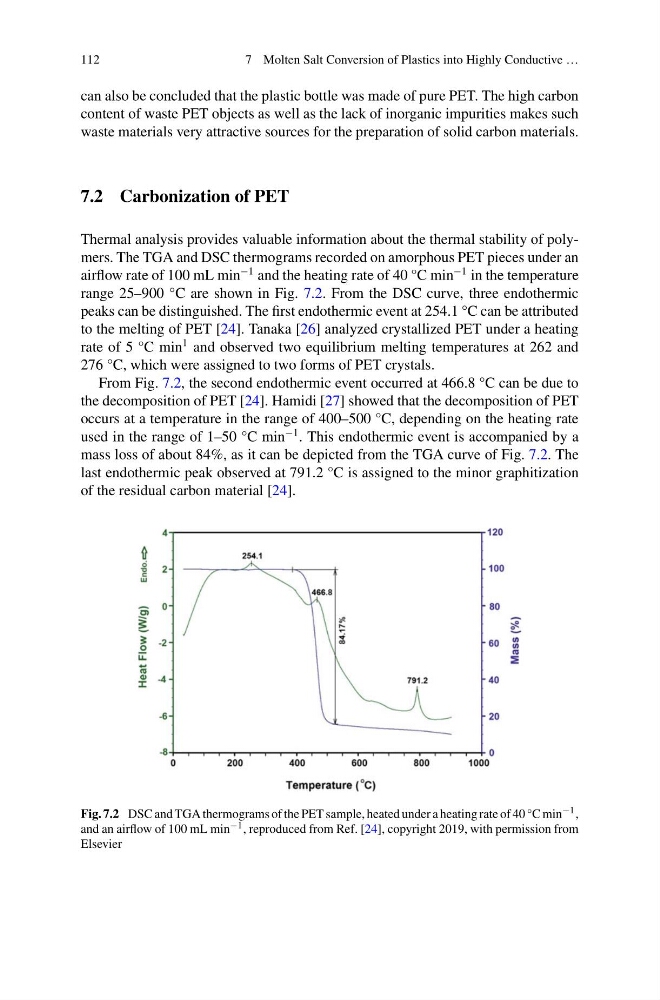
Thermal analysis provides valuable information about the thermal stability of polymers. The TGA and DSC thermograms recorded on amorphous PET pieces under an
airflow rate of 100 mL min
−1 and the heating rate of 40 °C min
−1 in the temperature
range 25–900 °C are shown in Fig. 7.2. From the DSC curve, three endothermic
peaks can be distinguished. The first endothermic event at 254.1 °C can be attributed
to the melting of PET [24]. Tanaka [26] analyzed crystallized PET under a heating
rate of 5 °C min
1 and observed two equilibrium melting temperatures at 262 and
276 °C, which were assigned to two forms of PET crystals.
From Fig. 7.2, the second endothermic event occurred at 466.8 °C can be due to
the decomposition of PET [24]. Hamidi [27] showed that the decomposition of PET
occurs at a temperature in the range of 400–500 °C, depending on the heating rate
used in the range of 1–50 °C min
−1 . This endothermic event is accompanied by a
mass loss of about 84%, as it can be depicted from the TGA curve of Fig. 7.2. The
last endothermic peak observed at 791.2 °C is assigned to the minor graphitization
of the residual carbon material [24].
Fig. 7.2 DSC and TGA thermograms of the PET sample, heated under a heating rate of 40 °C min −1 ,
and an airflow of 100 mL min −1 , reproduced from Ref. [24], copyright 2019, with permission from
Elsevier
7 Molten Salt Conversion of Plastics into Highly Conductive …
can also be concluded that the plastic bottle was made of pure PET. The high carbon
content of waste PET objects as well as the lack of inorganic impurities makes such
waste materials very attractive sources for the preparation of solid carbon materials.
7.2 Carbonization of PET
Thermal analysis provides valuable information about the thermal stability of polymers. The TGA and DSC thermograms recorded on amorphous PET pieces under an
airflow rate of 100 mL min
−1 and the heating rate of 40 °C min
−1 in the temperature
range 25–900 °C are shown in Fig. 7.2. From the DSC curve, three endothermic
peaks can be distinguished. The first endothermic event at 254.1 °C can be attributed
to the melting of PET [24]. Tanaka [26] analyzed crystallized PET under a heating
rate of 5 °C min
1 and observed two equilibrium melting temperatures at 262 and
276 °C, which were assigned to two forms of PET crystals.
From Fig. 7.2, the second endothermic event occurred at 466.8 °C can be due to
the decomposition of PET [24]. Hamidi [27] showed that the decomposition of PET
occurs at a temperature in the range of 400–500 °C, depending on the heating rate
used in the range of 1–50 °C min
−1 . This endothermic event is accompanied by a
mass loss of about 84%, as it can be depicted from the TGA curve of Fig. 7.2. The
last endothermic peak observed at 791.2 °C is assigned to the minor graphitization
of the residual carbon material [24].
Fig. 7.2 DSC and TGA thermograms of the PET sample, heated under a heating rate of 40 °C min −1 ,
and an airflow of 100 mL min −1 , reproduced from Ref. [24], copyright 2019, with permission from
Elsevier